



Why anticipatory bail rejection spells bigger trouble for Senthil Balaji in TASMAC case
Justice GK Ilanthiraiyan of the Madras High Court observed that materials on record show clear evidence of malpractices and loss to the government

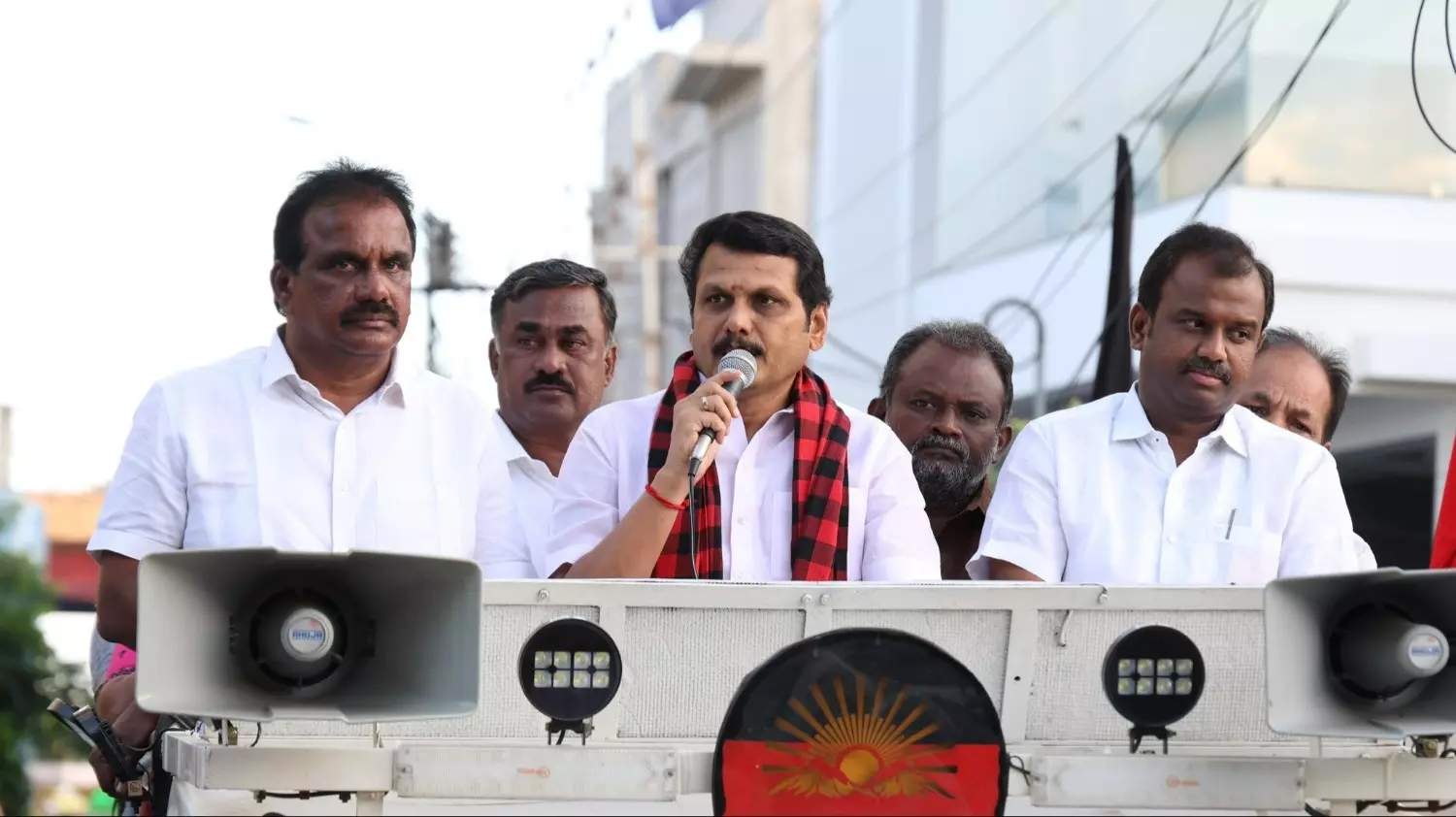
The Madras High Court on Thursday (July 30) rejected former Tamil Nadu minister V Senthil Balaji’s anticipatory bail plea in the fresh TASMAC corruption case.
The dismissal by Justice GK Ilanthiraiyan not only exposes the DMK leader to the immediate risk of arrest but also opens the door for custodial interrogation, a critical setback that significantly strengthens the hand of investigators at a time when the probe is still in its early stages.
SC to hear appeal
Balaji has appealed the Madras High Court’s dismissal of his anticipatory bail plea in the Supreme Court and the appeal petition is scheduled for hearing on Friday (July 31).
Also read: Anbumani takes full control of PMK as Ramadoss retires, ending bitter family feud
Balaji, named the prime accused in Directorate of Vigilance and Anti-Corruption (DVAC) Headquarters Crime No. 05/2026 registered on July 28, had rushed to the High Court seeking pre-arrest protection. His lawyers argued that the FIR levelled only general allegations against him with no specific complaint and claimed he had no link to any offences committed by Tamil Nadu State Marketing Corporation (TASMAC) officials.
The prosecution countered that the case involves possible irregularities running up to Rs 100 crore and that a thorough investigation is essential. Granting anticipatory bail now, they said, would cripple the probe.
The court agreed. Justice Ilanthiraiyan observed that materials on record show clear evidence of malpractices and loss to the government. There is a prima facie case that the accused abused their official positions. Custodial interrogation, the judge ruled, is necessary. The anticipatory bail petition was dismissed.
More trouble for Balaji?
The denial of pre-arrest bail is particularly damaging for several reasons. First, it removes the protective shield that would have prevented Balaji’s arrest. DVAC can now take him into custody for questioning, a step courts usually reserve for cases where investigators need to confront an accused with documents, recover evidence, or prevent influence over witnesses.
Also read: Karnataka must release 3,500 cusecs of Cauvery water to Tamil Nadu, orders CWMA
Second, the court’s explicit finding of prima facie evidence of abuse of power and financial loss legitimises the FIR at the highest judicial level so early in the investigation. This observation will make it harder for Balaji to secure regular bail later if arrested.
Third, the timing is crucial. Just a day before the High Court hearing, DVAC teams had already conducted searches at 45 locations across Tamil Nadu, houses of the accused, distilleries, transport firms, bottling units and district TASMAC offices seizing documents and digital evidence. One premises was sealed. With material already in hand and the court now endorsing the need for custody, investigators are in a strong position to press ahead aggressively.
Meanwhile, the DVAC police plan to issue summons to the accused, including Senthil Balaji and others named in the FIR.
What FIR says
The FIR highlights a sharp contrast in TASMAC’s finances: revenue from retail liquor shops rose steadily, while income from the roughly 3,240 TASMAC bars declined. In 2021, tenders were invited for 857 bars in Coimbatore, Nilgiris, Tirupur, Erode, Namakkal and Karur districts. District managers allegedly breached tender norms by restricting witnesses at the bid opening, favouring specific participants, and allowing cartelisation. This was evidenced by earnest money deposit demand drafts drawn from the same bank with sequential serial numbers.
Of the 857 bars, 284 were shown as closed on paper yet continued operating without licence renewal, resulting in estimated revenue losses of over Rs 17 crore in Coimbatore North, Rs 13.5 crore in Coimbatore South, and nearly Rs 2 crore in the Nilgiris during 2022-23. Further irregularities are alleged in transport tenders for 45 TASMAC depots.
Demand drafts submitted by one transporter were allegedly misused to favour other firms. Bars were often run by third parties rather than the licence holders. An organised syndicate, referred to in the FIR as the “Karur gang” linked to Mulanoor Karthik, is said to have controlled multiple bars and influenced allotments across the state. Political intermediaries allegedly collected “party funds” from bar owners.
The FIR also details cash generation through inflated or bogus invoices by old-bottle suppliers to distilleries, with the proceeds allegedly used for kickbacks to TASMAC officials. Specific transactions involving firms such as GLR Holdings, Crystal Bottles and SNJ Group entities are cited, running into tens and hundreds of crores. Higher officials, including the then MD, are accused of favouring selected distilleries and of systematic overcharging of customers beyond MRP.
Rathesh Raj Shanmugavel is portrayed as an unauthorised power broker who allegedly directed the MD on brand approvals, bar tenders and transfers on instructions from the then minister. Transfers and postings of TASMAC officials are said to have been influenced for undue advantage.
Political debate over case
The fresh FIR marks the first time Tamil Nadu Police have booked a case primarily on the basis of Enforcement Directorate’s (ED) documents and evidence. It comes against the backdrop of prolonged scrutiny of TASMAC operations. The ED had earlier registered an ECIR (CEZO-II/23/2023) in October 2023, drawing on multiple earlier DVAC FIRs and surprise raids linked to the same alleged irregularities.
A Supreme Court stay on aspects of the ED’s investigation in the related SLP continues to remain in force. By relying in part on the ED’s own counter-affidavit, the new state-level FIR provides a stronger predicate offence document. This document had previously posed judicial hurdles during the earlier DMK administration and is viewed in some quarters as potentially easing the path for central agencies.
The case has been registered under the present TVK government. While the move has been welcomed by those tracking the ED’s long-pending probes into the liquor trade, questions persist about the precise administrative or political gains for the state government, the degree to which the new investigation will complement rather than merely parallel ongoing central proceedings, and whether this explicit use of central agency documents signals a deeper shift in Centre-State anti-corruption coordination.
Notably, certain names featured in related ED filings do not appear among the accused listed in the latest DVAC FIR. The fresh FIR comes against the backdrop of earlier ED proceedings that began in 2023 based on previous DVAC complaints.
