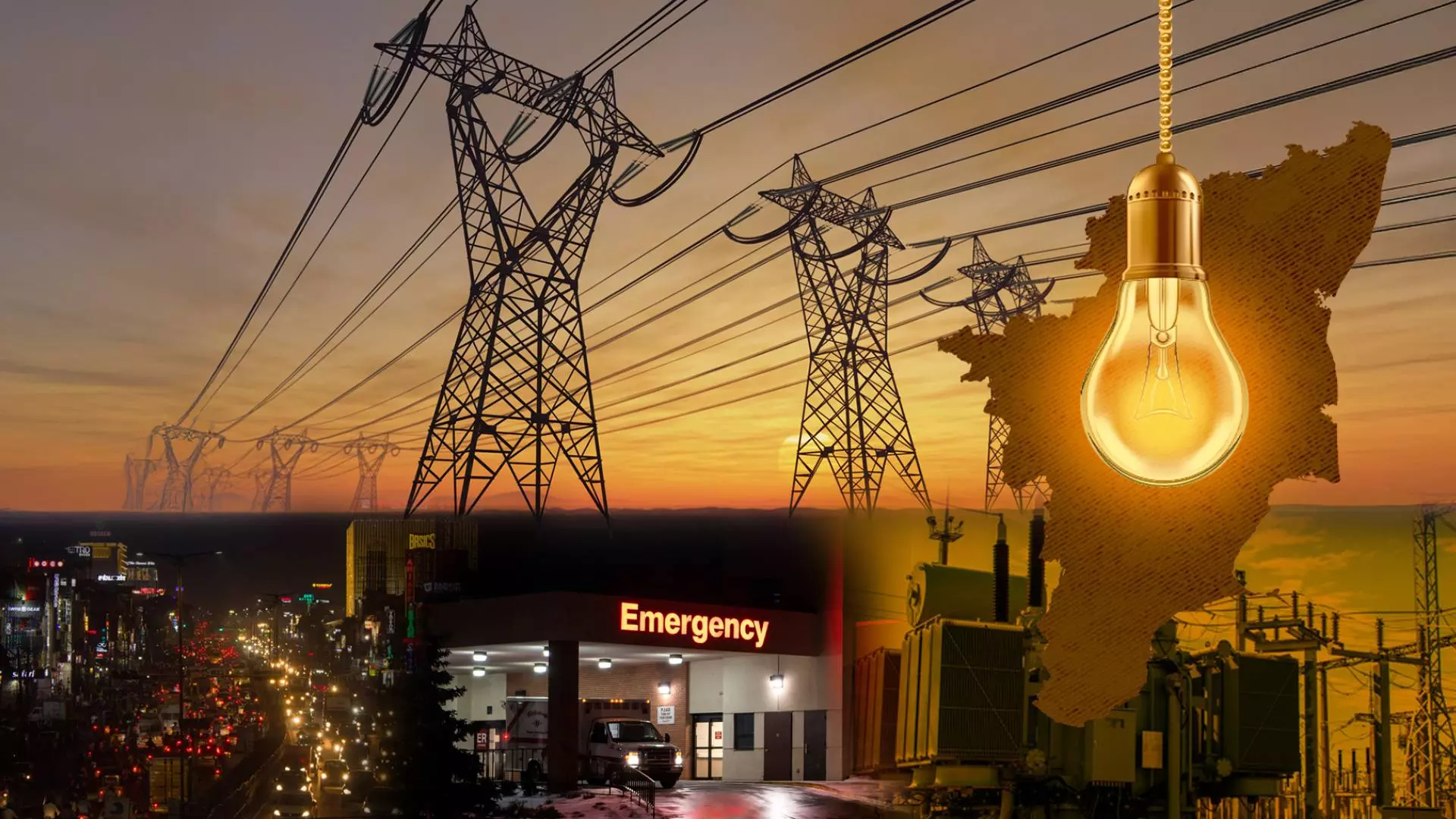
Tamil Nadu's summer blackouts expose a deepening power crisis
As Tamil Nadu battles heatwaves and repeated outages, rising electricity demand and mounting power costs expose deeper structural problems in its power sector

For the past few weeks, residents across Tamil Nadu have been battling sweaty nights, scorching afternoons and repeated power cuts. From crowded cities to remote villages, people say outages have been occurring without warning, leaving homes, streets and businesses in darkness during peak summer heat.
In several places, fans stopped working, water pumps failed, and households were left struggling through hours-long outages. In some alarming instances, hospitals were also affected, with critically ill patients reportedly shifted from ICUs to nearby facilities after power failures disrupted operations.
Also Read: Fourth AIADMK rebel MLA resigns as EPS faction battles TVK defections
As temperatures across Tamil Nadu hover between 36 degree Celsius and 41 degree Celsius, the power disruptions have now become a major political issue. Opposition parties have accused the TVK government led by Chief Minister C. Joseph Vijay of failing to prevent unannounced power cuts and demanded immediate corrective measures.
Government response
When The Federal contacted Energy Minister CTR Nirmal Kumar, he said the outages were largely caused by legacy transformers and ageing infrastructure. The minister also claimed that certain individuals were “sabotaging” the power supply.
He further stated that some “black sheep” within the department were contributing to the disruptions, a remark that reportedly angered several electricity department employees.
However, energy experts say the minister may have overlooked a larger structural issue.
According to the latest National Generation Adequacy Plan released by the Central Electricity Authority, Tamil Nadu’s electricity demand is projected to rise sharply over the next decade.
Also Read: Coimbatore girl’s sexual assault and murder spark outrage in TN; two arrested
The report estimates that the state’s energy requirement could increase by nearly 89 per cent between 2026-27 and 2035-36.
Tamil Nadu’s projected demand stands at 1,48,219 million units in 2026-27. By 2035-36, that figure is expected to rise to 2,80,398 million units.
Among southern states, Tamil Nadu is projected to rank second in electricity demand, behind Andhra Pradesh, which is expected to touch 2,93,798 million units by 2035-36. At the national level, Gujarat is expected to record one of the highest energy requirements at 3,65,811 million units.
Financial burden
Tamil Nadu Power Distribution Corporation Limited (TNPDCL) is already spending nearly 75 per cent of its income on purchasing electricity.
According to the utility’s 16th annual report for 2024-25, the corporation spent Rs 75,960.32 crore on power purchases against a total income of Rs 1,00,417.13 crore.
Experts warn that this level of expenditure is unsustainable in the long run.
Tamil Nadu’s own electricity generation from more than 40 power plants is currently insufficient to meet peak-hour demand. As consumption rises every year, the state continues to rely heavily on expensive external power procurement.
Experts say Tamil Nadu may eventually need to reduce its dependence on costly private power purchases and invest more aggressively in expanding state-owned generation capacity.
Ground realities
Employees in the electricity department pointed to multiple operational issues behind the recent disruptions.
They cited supply interruptions due to overload, major vacancies among field-level workers and delays in commissioning state-owned power plants.
According to employees, substations and transformers are functioning under severe stress, especially during peak night-time demand when air conditioners, coolers and household appliances operate continuously.
Also Read: Can Vijay’s TVK repeat the TN miracle in Kerala? 'Here, we watch actors only in films'
Jayasankar, General Secretary of COTEE, said: “Every year we need 1500 megawatts additional surplus. But in the past five years, there has been no new power generation. Udankudi, Uppur, Ennore heat expansion plans have also not been completed so far.”
He added: “Earlier, we expected maximum peak demand between 6.30 pm and 11.30 pm. But this time it extended till 3.30 in the morning. That is why we are facing shortages and consumer problems. Field staff are very limited. More than 80 per cent of field staff positions are vacant and there has been no recruitment in the past five years.”
Official explanation
Meanwhile, Tamil Nadu Electricity Board Chairperson and Managing Director J. Radhakrishnan said the state currently has adequate power availability and has been comfortably meeting daily peak demand, which has remained below 20,000 MW in recent days.
According to him, most of the recent disruptions were localised and linked to distribution-level faults and equipment failures.
He listed several reasons for the outages, including fuse-off calls due to overload during peak night hours, underground cable faults, jumper cuts, snapping of conductors and substation-related interruptions and tripping.
He also said planned maintenance shutdowns carried out to strengthen infrastructure had contributed to temporary disruptions in some areas.
(The content above has been transcribed from video using a fine-tuned AI model. To ensure accuracy, quality, and editorial integrity, we employ a Human-In-The-Loop (HITL) process. While AI assists in creating the initial draft, our experienced editorial team carefully reviews, edits, and refines the content before publication. At The Federal, we combine the efficiency of AI with the expertise of human editors to deliver reliable and insightful journalism.)