Maran's 'divisive' comment: Why North-bashing may not work electorally
Tamil Nadu’s people are proud of their language and culture, but that does not mean they hate Hindi or people from the North, says S Srinivasan in AI with Sanket episode

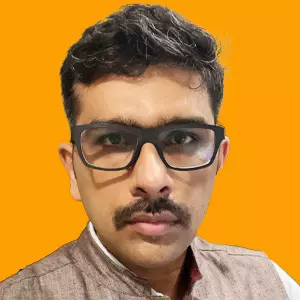
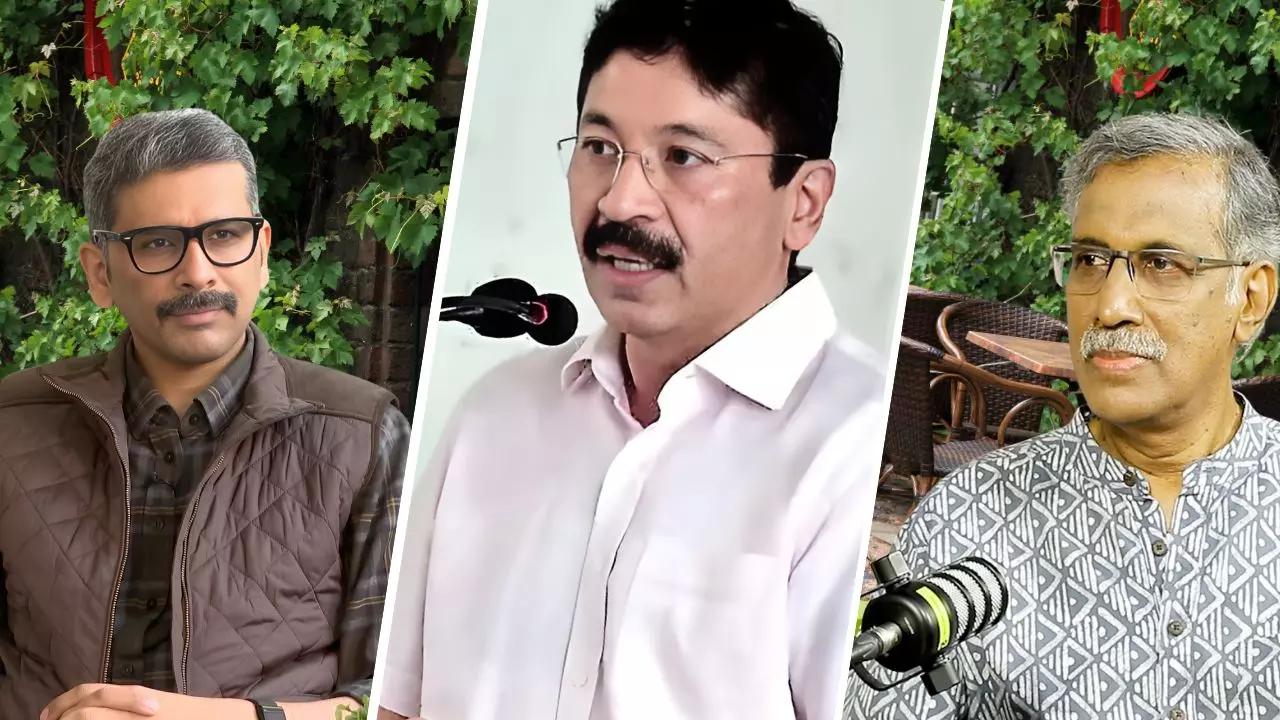
What is the political fallout of controversial remarks by DMK MP Dayanidhi Maran comparing women in North and South India? On AI with Sanket, Sanket speaks to S Srinivasan, Editor-in-Chief of The Federal, to unpack the impactof his controversial statement. The conversation examines the persistence of North–South rhetoric ahead of the Tamil Nadu elections, underlying anxieties around migration, population trends, and delimitation, and why such statements may create noise without significantly altering electoral outcomes, even as they reflect deeper federal concerns.
How do you assess Dayanidhi Maran’s remarks comparing women in North and South India? Do such comments have any political traction on the ground?
As for the 2026 Tamil Nadu elections, they are around the corner, but I don’t think such comments will have much impact. Comparing the South with the North in this manner is not going to help electorally. Tamil Nadu has a large migrant population, and targeting people from the North is unlikely to benefit the DMK.
What the party seems to be doing is speaking to its core voter base. The message is essentially that, as a Dravidian party, it has done a good job—especially in social sectors like education, population control, and women’s empowerment. But the comparison itself is very coarse. For a former Union minister to make such a statement is divisive and clearly polarising.
Also Read: Shift toward TVK could turn into costly gamble for Tamil Nadu Congress
This also connects to broader federal issues, including the evaluation of states and the report of the 16th Finance Commission. All these matters are interlinked. As elections approach, such statements are surfacing more frequently, but I don’t see them delivering political dividends.
You’ve described these remarks as divisive. We’ve seen similar statements earlier, including references to North Indians in places like Coimbatore. As someone who has worked across India, do you think this reflects a deeper mindset among sections of Tamil society?
I don’t think there is a “god complex” among the educated elite in Tamil Nadu. This issue has very little attraction among educated people, who understand that this is not how politics should be conducted.
This rhetoric is more about sending a message to a basic political cadre. Even people with high literacy understand the realities. In fact, such comments often end up damaging alliance partners in the North rather than helping locally.
We saw this earlier when Udayanidhi Stalin’s comments on Sanatan Dharma created difficulties for the Congress during elections in Madhya Pradesh. The Congress had to repeatedly distance itself from those remarks.
Tamil Nadu’s people are proud of their language and culture, but that does not mean they hate Hindi or people from the North. There is a clear understanding that demographic shifts are happening and that migrant labour is essential to the state’s economy. Chennai, Coimbatore, Tiruppur — you will find workers from Bihar, Uttar Pradesh, Uttarakhand, West Bengal, Nepal, and elsewhere across hotels, construction, and services. There is no widespread hostility.
If migrants are so integral to the economy, why do politicians still use this language?
Industries in Tamil Nadu actually prefer migrant workers in many cases. They are seen as more manageable, willing to work longer hours, and often accept lower wages than local workers. Industrialists understand this reality, and so does the educated public.
It is largely politicians who continue to use this language. This rhetoric is not very different from statements made by leaders elsewhere in the country—whether it is Sakshi Maharaj or others talking about having more children. These are polarising tactics, but I am quite sure they will not influence election outcomes in Tamil Nadu.
Some argue that these remarks are linked to concerns over population decline and delimitation. Is that the real issue beneath the rhetoric?
Yes, that is where the anxiety really lies. Leaders like Chandrababu Naidu and even Chief Minister M.K. Stalin have spoken about demographic shifts and fertility rates in the context of delimitation.
There is a contradiction here. On one hand, there is praise for educating women and reducing fertility rates. On the other, there are calls—sometimes symbolic, sometimes literal—for having more children. This contradiction is embarrassing and reveals confusion in political messaging.
The North Indian comparison is repeatedly used because the BJP is perceived as a North Indian party trying to make inroads into Tamil Nadu. By emphasising this, Dravidian parties attempt to portray the BJP as alien and highlight their own social sector achievements.
Is this kind of identity politics new to Tamil Nadu?
No, identity politics has long been part of Tamil Nadu’s political playbook. It operates at multiple levels—Dravidian identity, Tamil identity, and linguistic pride.
When religious identity becomes dominant elsewhere, caste identity or language identity often emerges as a counter here. Pongal, for example, is a community festival celebrating harvest and gratitude to nature. It is not inherently political, yet it often gets pulled into identity debates.
People largely take such rhetoric with a pinch of salt. They recognise it as part of a polarising playbook rather than something rooted in everyday reality.
Let’s come to delimitation. Is the fear that southern states may lose political representation a genuine concern?
Yes, this is a real federal issue. Delimitation is closely tied to population and also affects financial allocations through mechanisms like the Finance Commission.
States in the South feel they contribute significantly to India’s GDP—about 33 percent collectively—but receive less in return because population carries heavy weightage in fund allocation. The 16th Finance Commission has submitted its report, but until it is tabled in Parliament, we don’t know its recommendations.
The concern is that states which successfully controlled population growth may be politically “punished” through reduced representation. That fear resonates because it connects population, political power, and fiscal justice.
But isn’t the southern economy itself dependent on migrant labour from the North? Doesn’t that make the rhetoric contradictory?
That is absolutely true. Tamil Nadu is highly industrialised and depends heavily on migrant labour, especially in services and manufacturing. These workers are essential to keeping the economy running.
This contradiction is precisely why othering makes little sense. Migration eventually reshapes politics too, as seen in Delhi, where migrants from Uttar Pradesh and Bihar have become a significant political force.
Tamil Nadu has not reached that stage yet, largely because its culture is more accommodating and there is no hyper-nationalist regional party with mass appeal. Identity-based parties exist, but their vote share remains limited.
Beyond delimitation, what are the broader federal grievances that fuel this sentiment?
There is a persistent feeling of state versus Centre. This includes concerns over delayed or inadequate central assistance during floods and cyclones, interference in state subjects like education and health, and friction involving the role of governors.
When these issues combine with delimitation fears, the anxiety deepens. Any delimitation exercise must be handled carefully, because mishandling it could trigger unrest and deepen regional grievances.
As someone who has lived extensively in North India, did you personally experience the kind of “othering” often spoken about in the South?
In urban India, I did not experience any serious othering. I lived in Delhi and Madhya Pradesh, and while there is ignorance—people using terms like “Madrasi” or lumping the entire South together—it is not organised hostility.
There are occasional remarks about language or skin colour, but nothing systematic. Similar ignorance exists everywhere. Beyond a point, many people see everything south of Delhi as just “South India.”
In Tamil Nadu too, there is no widespread hate. In fact, many migrants learn Tamil, speak it with pride, and are warmly accepted. The environment is largely peaceful and welcoming.
So, would it be fair to say these controversies are exaggerated compared to realities on the ground?
Yes, more is often made of these stray comments than what actually exists on the ground. They generate headlines and debate, but everyday social relations in Tamil Nadu are far more harmonious than political rhetoric suggests.
The content above has been transcribed using a fine-tuned AI model. To ensure accuracy, quality, and editorial integrity, we employ a Human-In-The-Loop (HITL) process. While AI assists in creating the initial draft, our experienced editorial team carefully reviews, edits, and refines the content before publication. At The Federal, we combine the efficiency of AI with the expertise of human editors to deliver reliable and insightful journalism.