Why CM Vijay is clinging to TN's ultimate political tradition, holding home portfolio
From Annadurai to Stalin and now Vijay, Tamil Nadu chief ministers have rarely surrendered the key portfolio. Why is policing central to political power?

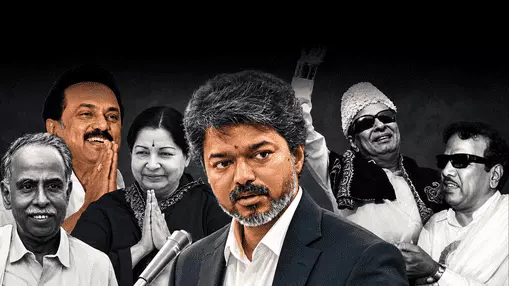
In Tamil Nadu, chief ministers holding the home portfolio is not a new political development. From C N Annadurai, M Karunanidhi, J Jayalalithaa to M K Stalin to the incumbent Joseph Vijay, almost every major leader from the state has retained direct control over the law-and-order machinery.
Also read: Vijay's next frontier: TVK quietly begins Kerala expansion
After taking oath as the CM on May 10, Vijay retained key portfolios including home and special programme implementation. He also took women and child welfare under his control, signalling that governance and welfare delivery will remain central to his administration.
But why is it that Tamil Nadu's chief ministers almost never give the crucial home portfolio to another minister?
The Congress era
Before 1967, the year the Congress's rule in the province ended, the political structure in the then Madras Presidency (and later State) was very different. Several Congress governments functioned with separate home ministers.
Between 1946 and 1967, leaders including C Rajagopalachari, K Kamaraj and M Bhakthavatsalam governed the State. Some leaders, including Rajaji and Tanguturi Prakasam, retained the home portfolio themselves, while others appointed separate ministers.
Also read: Congress to join Tamil Nadu cabinet after 59 years with two ministers
One of the most dramatic episodes unfolded in 1947 under then chief minister (then called premier) O P Ramaswamy Reddiyar.
He appointed P Subbarayan as Home Minister. But the relationship soon deteriorated amid disagreements over authority and administration. The Home portfolio was briefly taken away from Subbarayan before being restored following intervention from national leaders, including Sardar Vallabhbhai Patel.
Power struggle
The conflict did not end there.
In 1948, Subbarayan resigned, accusing the premier of interference in his department. Ramaswamy Reddiyar defended his actions in the name of “good government”.
The episode revealed a political lesson that would later define Tamil Nadu politics — control over policing and law and order was too politically sensitive for chief ministers to remain distant from it.
The turning point came in 1967 when the Dravida Munnetra Kazhagam, led by Annadurai, defeated the Congress and formed the government for the first time.
From that moment, chief ministers directly controlling Home Affairs became the political norm in Tamil Nadu.
Dravidian model
Even during periods of political instability, leaders refused to part with the portfolio.
After the death of former chief minister M G Ramachandran in 1987, interim CM V R Nedunchezhiyan retained home affairs. Even V N Janaki Ramachandran, who became the chief minister for just 23 days in early 1988, kept the department under her control.
Successive Dravidian leaders continued the same approach. Karunanidhi, Jayalalithaa and Stalin kept home. Now, Vijay has joined that long-standing political tradition.
Agitation politics
Tamil Nadu’s political history also explains why the home portfolio became so crucial.
The state has witnessed several major social and political agitations in the past — from anti-Hindi protests and caste tensions to communal flare-ups and large-scale demonstrations over education, language and identity politics.
Also read: Vijay’s suit sparks debate on politics, identity and symbolism
In such moments, direct control over police and intelligence machinery becomes politically vital for any chief minister.
The anti-Hindi agitation period of the 1960s remains one of the clearest examples. Even though P Kakkan served as home minister under Bhakthavatsalam, the Madras State chief minister’s influence over law-and-order decisions remained decisive.
The message became firmly embedded in Tamil Nadu politics: the CM could never remain detached from internal security and policing.
Kamaraj exception
There was, however, one important exception.
In 1957, Kamaraj voluntarily handed over the home portfolio to Bhakthavatsalam during his term as the chief minister of Madras State.
“Kamaraj: I consider this the most important task ahead, and so, I want to devote myself to this work.”
Kamaraj chose to focus directly on rural development, community welfare and improving living conditions during the Second Five-Year Plan period (1956-61).
But even Kamaraj returned to holding the home department later.
Interestingly, in the last six decades, the portfolio was only temporarily transferred when chief ministers travelled abroad.
Remote control
When Annadurai visited the United States in 1968, Nedunchezhiyan briefly handled home.
Similarly, during Karunanidhi’s Europe tour in 1971 and MGR’s foreign visits in 1978 and 1985, senior ministers temporarily took charge of the department.
Also read: CM Vijay keeps home, welfare portfolios as TN's TVK-led cabinet takes shape
But even that practice largely disappeared in recent decades because modern communication technology allowed chief ministers to govern remotely.
Vijay too has sent a signal
By retaining home, Vijay signals that he wants direct control over policing, administration and crisis management.
At the same time, by combining women and child welfare under his office, the current chief minister also appears to be projecting governance through welfare delivery and social protection.
Whether this strengthens his leadership or centralises excessive authority in one office will remain a closely watched political question in Tamil Nadu.
But one reality remains unchanged across generations of Dravidian politics — in Tamil Nadu, the home department has never been just another ministry. It has long been viewed as the real seat of political power.
The content above has been transcribed from video using a fine-tuned AI model. To ensure accuracy, quality, and editorial integrity, we employ a Human-In-The-Loop (HITL) process. While AI assists in creating the initial draft, our experienced editorial team carefully reviews, edits, and refines the content before publication. At The Federal, we combine the efficiency of AI with the expertise of human editors to deliver reliable and insightful journalism.