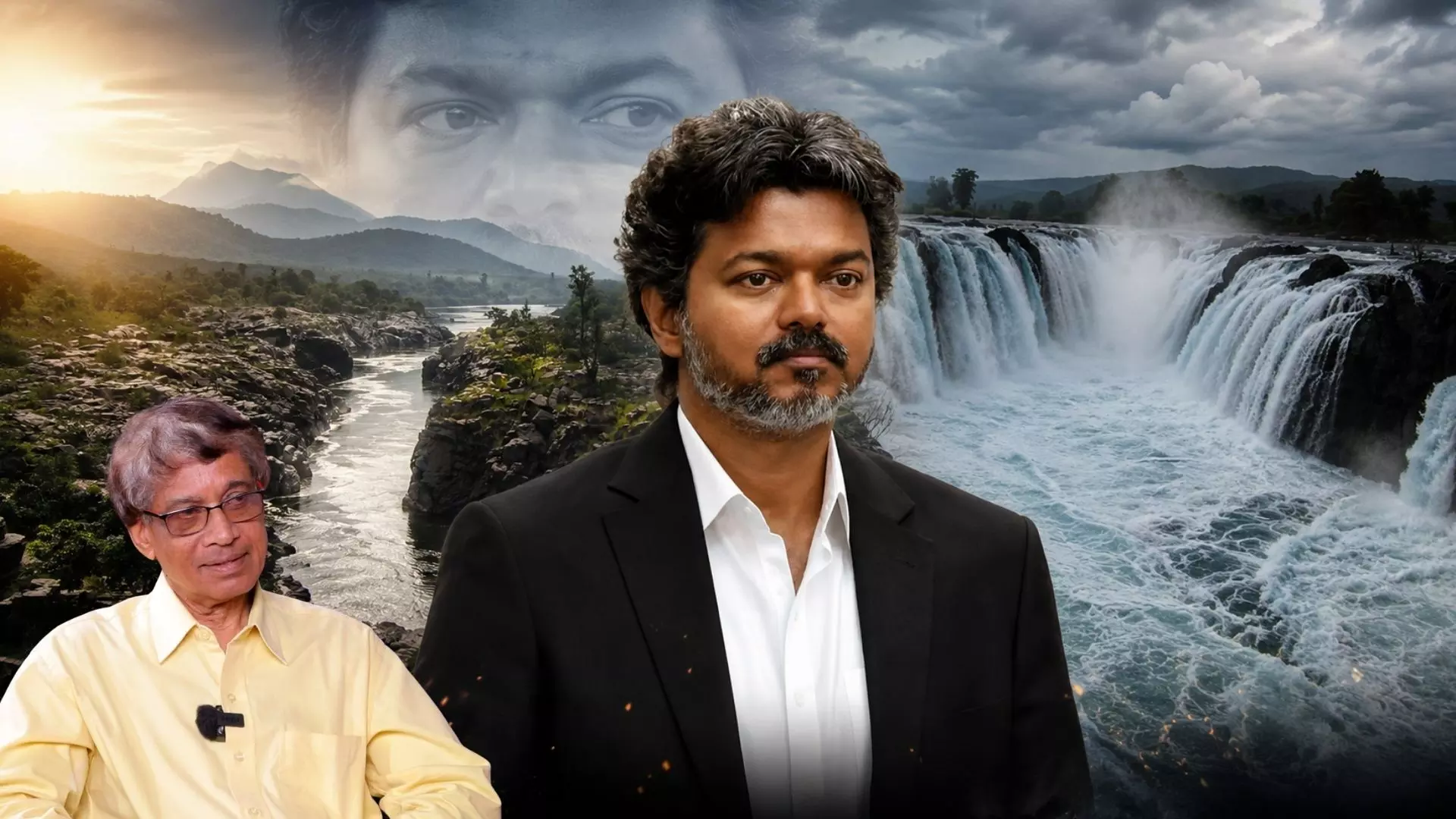
‘Godavari-Cauvery link is no alternative to TN’s Cauvery water rights’ | Interview
Prof S Janakarajan flags climate risks, interstate disputes, ecological damage and high costs, and urges Tamil Nadu to conserve its own water resources

Tamil Nadu should not view the proposed Godavari-Cauvery river link as an alternative to securing its rightful share of Cauvery water from Karnataka, says water resources expert Prof S Janakarajan. He argues that the proposal to transfer so-called surplus water from one river basin to another overlooks the uncertainties posed by climate change, competing claims from several states, ecological costs and the enormous expense of maintaining such infrastructure.
The debate over river interlinking has gained renewed attention, with the government pushing the idea of linking the Godavari and Kaveri rivers. But Prof Janakarajan says Tamil Nadu should first focus on securing its existing water rights and conserving the rainfall it already receives. The Federal spoke to Prof Janakarajan about the feasibility and consequences of river interlinking.
How do you view the government's renewed push for interlinking rivers, particularly the Godavari-Cauvery link?
In a few words, asking for the Godavari-Cauvery link is actually a way of avoiding the problem. You are not trying to look at the possibility of securing the Cauvery water that Tamil Nadu is entitled to as the answer to its ongoing dispute with Karnataka.
Also read | Cauvery row: SC asks Karnataka to comply with CWMA's directions on water release to TN
The Tamil Nadu government should insist on implementing its rights over Cauvery water as per the tribunal's final award and the Supreme Court's final judgment. The Cauvery Water Management Authority is also very clear about what Karnataka should do. With all that in place, why avoid the issue?
Let's talk about the Godavari-Cauvery link separately. It should not be looked at as a solution to the Cauvery issue. These are different issues.
Why is securing Cauvery water so important for Tamil Nadu's farmers?
Over the last 15 years, the Cauvery Delta has been facing either floods or drought. There is no steady flow of water and agriculture is not sustainable. Farmers lose crops because of either floods or drought. This is mainly because Karnataka releases water when its reservoirs are full or there is heavy rainfall. Otherwise, there is no water.
We should be very careful about establishing our right to Cauvery water. It is completely different from the Godavari-Kaveri link.
Can the Godavari-Cauvery link at least help augment Tamil Nadu’s water supply?
If Tamil Nadu is facing a deficit, you are going to augment the water supply by linking the Godavari to the Cauvery. It is only to augment. It is only to supplement the existing water supply, not an alternative.
These two are different. Please don't mistake it. The Godavari-Cauvery link is not an alternative to your water problem. It is only to augment the water supply or ease the situation.
But isn't the idea attractive because the Godavari is seen as having surplus water?
Who says there is a surplus? What constitutes surplus water? There may be surplus water today, but it could disappear tomorrow. The Cauvery is now water-deficit.
Surplus is a subjective concept. What you see as surplus today may simply be water flowing into the sea during a particular period. You may find hundreds of TMC of water as surplus today, but who are the contending states for the Godavari?
Maharashtra, Telangana, Andhra Pradesh and Odisha have interests in the basin. They need water and want to use the so-called surplus. If you pursue the Godavari link, you may have to deal with everybody. It will multiply water interests and become a hurdle.
How much water could Tamil Nadu actually receive through the proposed link?
They are saying they cannot ultimately give 200 TMC to Tamil Nadu. At best, it could be 80 to 90 TMC.
That 80 to 90 TMC is at the supply point. By the time it reaches the Pennar region and Tamil Nadu border, there will be transmission losses, evaporation and recharge.
And how much money are you going to spend? Today it has exceeded Rs 1 lakh crore. If you spend Rs 1 lakh crore, you may need at least Rs 10,000 crore every year for operation and maintenance. Who is going to spend that money?
Could the project become even more complicated because of the larger peninsular river-linking plan?
This is part of a peninsular river link. The contending states — Maharashtra, Karnataka, Telangana, Andhra Pradesh and others — say that Godavari and Cauvery cannot be linked just like that. They say it is part of the peninsular river link and therefore has to be linked to the Mahanadi, which is in Odisha.
Now you are going to link the Mahanadi with the Godavari and then the Godavari with the Cauvery. Look at how the scope expands.
Tamil Nadu is only going to be a receiver. You just have to wait and see how much water you are going to get. It is going to escalate interstate water disputes. I don't think it will become a reality in the near future. It is a mirage.
How does climate change affect the feasibility of interlinking rivers?
Climate change is really going to aggravate the problem of floods and droughts.
Once every four or five years, we may have a very serious flood. There is going to be a huge flow of water. Then, in the subsequent years, we may not get that much water.
Therefore, you may not be in a position to divert that much water. Climate change is going to become a deciding factor in determining whether interlinking is going to have a positive impact or not.
In the future, climate is going to decide the nature of water availability, how much water is available and how much can be diverted.
What are the ecological risks of transferring water between rivers?
First of all, river linking should not be treated as plumbing work. A river is a living system, not a pipe that can simply be cut and diverted. When a river flows across a 1 to 1.5-km-wide region, its floodplains support billions of life forms and enormous biodiversity. Diverting water and reducing the flow can cause immeasurable and irreparable damage to that ecosystem.
Also read | Cauvery row: TN farmers hopeful as SC directs Karnataka to heed CWMA order
Secondly, river linking will displace people and take over land, including agricultural land. You may benefit some communities downstream, but thousands could lose their homes and livelihoods elsewhere. How is that fair or justifiable?
Thirdly, the canals will carry water only when there is surplus. There is no guarantee of surplus water every year or throughout the year. During dry periods, the canals could remain unused, raising a crucial question: who will maintain them? Without regular maintenance, they will fill with weeds, stones and garbage and become unusable.
If the canals cannot be kept functional, the huge investment in them will simply go to waste.
Does the Telugu Ganga project offer an example of the problems involved in transferring water across basins?
Take the Telugu Ganga canal, through which you get Krishna water for drinking water supply to Chennai. As per the agreement, you are supposed to get 15 TMC of water.
When N Chandrababu Naidu was the chief minister of undivided Andhra Pradesh, he was very keen to divert water because he wanted to supply water to the Rayalaseema region, which is a dry tract.
Water from Krishna has to pass through Rayalaseema before reaching Tamil Nadu. Out of the 15 TMC, at least 12 TMC goes towards Rayalaseema. You get only around 3 TMC.
You have spent around Rs 5,000 crore on it. And who is maintaining it now?
That is a short link, a mini-link. Krishna is already considered a deficit basin. When water is diverted from Godavari to Krishna, Krishna has to be filled first. There are already five or six states fighting for this water, and new demands will join them.
Should Tamil Nadu focus more strongly on its Cauvery rights instead of looking at the Godavari-Cauvery link?
People in the Government of India and the Central Water Commission have raised the Godavari-Cauvery link whenever there is a problem of this kind. It is only to evade the real issue.
I think we have to insist on distress sharing. The tribunal has already developed a distress-sharing formula, and the Supreme Court has endorsed it.
How does the distress-sharing formula work?
It is a proportionate system. If Karnataka has only 40 per cent of the water available, Tamil Nadu should get 40 per cent of its prescribed share. If only 10 per cent is available, it should get 10 per cent. We have to insist on this formula.
What is your concern over the proposed Mekedatu reservoir?
If they construct the proposed Mekedatu reservoir, that is going to be a disaster for Tamil Nadu. They say it will have a capacity of around 67 TMC, with 400 MW of power generation. If you develop that reservoir just upstream of Biligundlu, what will you get?
Karnataka Chief Minister DK Shivakumar says it is for the benefit of Tamil Nadu and to protect it from floods. This is nonsense. Water should, as a matter of fact, go to the Bay of Bengal. You cannot arrest all the water from reaching the sea.
Why is it important for freshwater to reach the sea?
You have to protect the coastal ecosystem. Freshwater should flow into the sea.
Nobody can say that water joining the sea is waste. Whenever water reaches the sea, you call it surplus. That is absolute nonsense. That is nature's course. Even in the tribunal, they allow 10 per cent of water to reach the sea as environmental flow. At least 10 per cent of the total available water should flow to the sea.
Should the focus therefore shift from river interlinking to conserving local water bodies?
Yes. We have thousands of water bodies. When you get heavy downpours in a short duration, you should be in a position to conserve the water.
My key concept is always water conservation. If you conserve water where you receive it, don't allow it to flow away. Through water bodies or groundwater recharge, you can augment the water supply.
Also read | Cauvery protests intensify in Mandya over water release to Tamil Nadu
Tamil Nadu is not water-starved. We get nearly 970 mm of rainfall annually, and now it is probably more than 1,000 mm. Chennai gets around 1,300 mm. We suffer for want of water because we don't conserve it.
When you have plenty of water, conserve it in water bodies, check dams and dams. During a drought year, you can use that water. Make sure the water bodies are desilted and properly maintained.
Don't look for water coming from another state, 1,000 km away. This kind of water-supply augmentation is not sustainable. So make sure you get the water available to you and conserve it. Unfortunately, we are not doing that.