



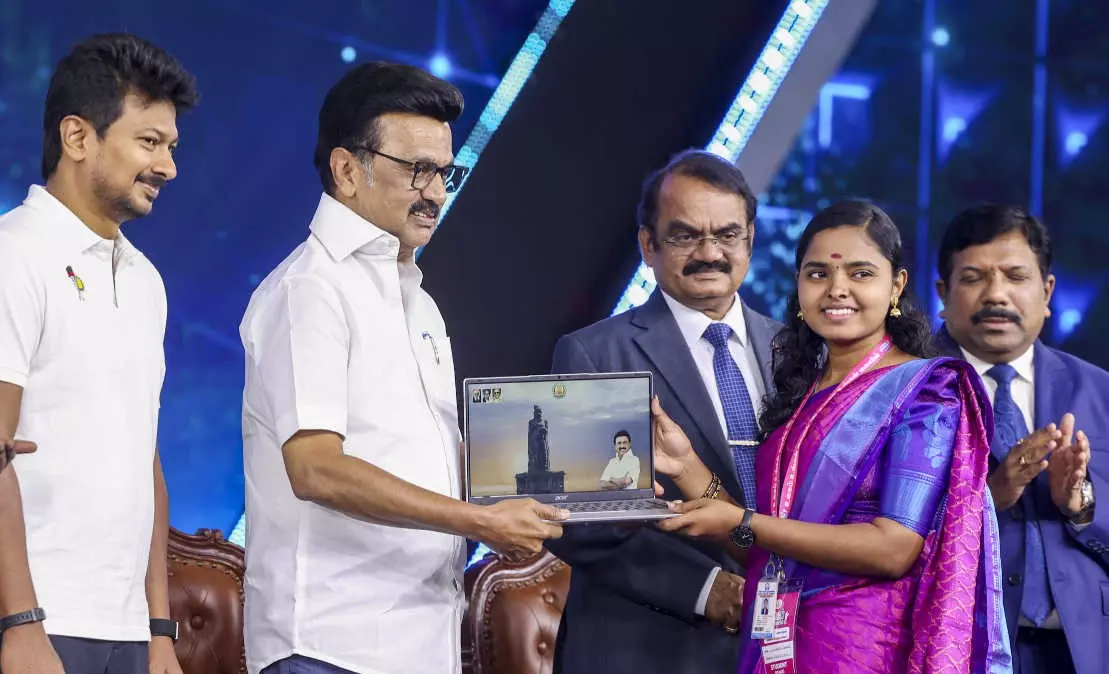
TN Chief Minister MK Stalin (second from left) and Deputy CM Udhayanidhi Stalin (left) during the launch of distribution of free laptops to college students in Chennai on Monday (Jan 5). Photo: PTI
DMK revives free laptop scheme amid slew of welfare measures ahead of 2026 polls
The 'Ulagam Ungal Kaiyil' (the world in your hands) initiative, halted for four years, aims to cover 10 lakh students in the first phase, amid criticism from the AIADMK

In a high-profile event on Monday (January 5), Tamil Nadu Chief Minister MK Stalin relaunched the long-paused free laptop distribution scheme for college students, marking the resumption of a programme halted for nearly four years due to financial constraints.
The initiative, dubbed “Ulagam Ungal Kaiyil” (The World in Your Hands), kicked off with the distribution of laptops to students at the Chennai Trade Centre.
This move comes alongside recent announcements of enhanced Pongal gifts, expanded women's entitlement programmes, and a new assured pension scheme for government employees, fuelling speculation that the ruling Dravida Munnetra Kazhagam (DMK) is bolstering its voter base ahead of the upcoming Assembly elections expected in April-May.
‘Investment in future generation’s education’: Stalin
During the launch, Stalin emphasised the scheme's role in empowering the youth.
"This laptop is not a mere gift; it's an opportunity to conquer the world. It's not an expense but an investment in the future generation's education," he said, urging students to use the devices as a "launchpad for their careers" rather than for entertainment.
He highlighted the government's broader welfare efforts, including monthly financial aid for mothers and students, Pongal bonuses, school breakfast programmes, and job creation initiatives to attract global industries.
Also Read: CM Stalin launches Tamil Nadu Assured Pension Scheme for govt staff
The free laptop scheme was originally introduced by the All India Anna Dravida Munnetra Kazhagam (AIADMK) government in 2011, benefitting over 52 lakh students at a cost of Rs 7,350 crore until 2021. However, the DMK government, which came to power in 2021, paused it citing severe financial strain exacerbated by the COVID-19 pandemic and the implementation of the Goods and Services Tax (GST) regime, which centralised tax revenues and reduced states' fiscal autonomy.
‘Scheme targets Gen Z voters’
Senior journalist T Ramakrishnan noted in a recent analysis that the scheme's revival targets "Gen Z voters" and aims to address long-pending demands, especially with elections looming.
The state announced in its 2025-26 budget the procurement of 20 lakh laptops over two phases, with the first phase covering 10 lakh students across engineering, arts, science, medical, agriculture, law, and polytechnic streams.
Laptops from brands like Dell, HP, Acer, and others are being distributed, with the rollout expected to complete by February 2026.
Also Read: Dravida Aatchi: Why it’s not easy to erase 50 years of Dravidian rule
The total cost for this phase is estimated at around Rs 2,000 crore, part of a broader push to bridge the digital divide in education. This resumption aligns with the DMK's post-2021 strategy of rolling out flagship welfare programmes.
Key initiatives include the Kalaignar Magalir Urimai Thogai (women's entitlement scheme), Pudhumai Penn (for girl students), Tamil Pudhalvan (for boy students), Chief Minister's Breakfast Scheme, and enhanced Pongal gifts.
Critics, including AIADMK leader Edappadi K Palaniswami, allege these are "electoral gimmicks”, pointing out that the laptop programme was discontinued under DMK rule and is now being revived for votes.
Beneficiary Reach: Empowering millions through targeted aid
The DMK government's welfare net has expanded significantly since 2021, reaching an estimated 25 per cent of Tamil Nadu's 7.7 crore population.
Here's a breakdown of key schemes and their beneficiaries as of late 2025:
Free Laptop Scheme: Targets 20 lakh college students over two years, starting with 10 lakh in the first phase (2025-26). Beneficiaries include students from government and aided colleges, with priority for those in technical and professional courses.
Kalaignar Magalir Urimai Thogai: Provides Rs 1,000 monthly to eligible women heads of households. As of May 2025, it benefits 1.15 crore women from economically-weaker sections, though opposition parties criticise it for not being universal as promised in the DMK's 2021 manifesto.
Pudhumai Penn Scheme: Offers Rs 1,000 monthly to girl students pursuing higher education after completing Classes 6-12 in government schools. It has aided 4.9 lakh girls as of mid-2025, with an extension to government-aided Tamil-medium schools benefitting an additional 75,000.
Tamil Pudhalvan Scheme: A counterpart for boys, launched in 2024, providing Rs 1,000 monthly for higher education materials. It covers 4.25 lakh beneficiaries as of 2025.
Also Read: Slew of welfare measures in PTR's maiden full budget for TN
Chief Minister's Breakfast Scheme: Ensures nutritious morning meals for primary school children to combat hunger and improve attendance. It reaches 17.53 lakh students across government schools.
Pongal Gift Package: Announced just days ago, this includes Rs 3,000 cash per rice ration-card holder, plus 1 kg raw rice, 1 kg sugar, and one sugarcane. Over 2 crore families are expected to benefit, including those in Sri Lankan Tamil rehabilitation camps. This is an increase from the Rs 1,000 cash given in 2023-24, discontinued in 2025 due to financial constraints but now revived with a higher amount.
Tamil Nadu Assured Pension Scheme (TAPS): Launched on January 3, 2026, it guarantees 50 per cent of the last-drawn basic pay as pension for state government employees and teachers, with dearness allowance hikes twice yearly. The state will bear the full additional cost beyond employees' 10 per cent contribution, involving a one-time Rs 13,000 crore infusion into the pension fund and annual contributions of Rs 11,000 crore. It applies to those joining after April 1, 2004, under the contributory system, and is set to take effect from January 2027. This addresses a 20-year demand for restoring the Old Pension Scheme, benefitting lakhs of employees.
Other programmes like Makkalai Thedi Maruthuvam (doorstep healthcare) have covered 2.2 crore people, earning international praise.
Balancing welfare with fiscal discipline
Tamil Nadu's economy, the second-largest in India, is projected at Rs 35.67 lakh cr GSDP for 2025-26, with a per capita income significantly higher than the national average. However, the state faces fiscal challenges. Revenue receipts for 2025-26 are estimated at Rs 3,31,569 crore, with own tax revenue at Rs 2,20,895 cr (up 15 per cent from prior estimates), including Rs 58,022 cr from GST.
Non-tax revenue stands at Rs 28,819 cr, while central transfers and grants total Rs 81,855 cr. The GST regime has strained state finances, with Ramakrishnan highlighting that it led to "severe fiscal pressure" post-implementation, reducing Tamil Nadu's share in tax revenues. The state's outstanding debt is projected to reach Rs 9.29 lakh crore by March 2026, or 26.07 per cent of GSDP down from 26.43 per cent in 2024-25 but above pre-COVID levels.
Also Read: Will Pinarayi Vijayan's 'welfare gamble' pay off in 2026 Assembly elections?
Fiscal deficit is capped at 3 per cent of GSDP (Rs 1,07,070 cr), and revenue deficit at Rs 41,635 cr (1.17 per cent of GSDP). Interest payments consume 21 per cent of revenue receipts, higher than many states. Despite these pressures, the government has allocated Rs 13,720 cr for Magalir Urimai Thogai, Rs 3,851 cr for social security pensions, and Rs 420 cr for Pudhumai Penn in the 2025-26 budget.
‘Responsible moves’
Ramakrishnan argues that while these schemes may strain finances for the next 6-7 years, they are "responsible" moves, and there's "no fault" in pre-election implementations as long as they comply with laws (no schemes within 60 days of polls). He dismisses opposition criticism, noting similar actions in other states like Bihar.
With elections just months away, the DMK's flurry of announcements of laptops, Pongal cash, and pensions appears timed to consolidate support among youth, women, families, and employees. Political analysts see it as a bid for a second consecutive term, rare for the party. While beneficiaries welcome the aid, critics question sustainability amid debt burdens.
‘Fear of defeat’: EPS
AIADMK general secretary and Leader of the Opposition Edappadi K Palaniswami (EPS) has sharply criticised the DMK government's decision to restart the free laptop distribution scheme, alleging it stems from "fear of defeat" in the upcoming 2026 Assembly elections.
Palaniswami reminded the public that the free laptop scheme was originally a flagship programme of the AIADMK, launched in 2011 by late Chief Minister J Jayalalithaa as an election promise to bridge the digital divide and empower students.
Under AIADMK rule from 2011 to 2021, over 52 lakh laptops were distributed to school and college students at a cost of Rs 7,350 crore. The opposition leader accused the DMK of halting the scheme immediately after coming to power in 2021, depriving poor and rural students of educational tools for nearly four years.
Also Read: Modi asks BJP MPs to highlight welfare measures in social justice fortnight
"Now, with elections just months away, they are hastily reviving our scheme and claiming credit," Palaniswami charged.
He promised that if the AIADMK returned to power in 2026, the party would fully restore and expand the original laptop distribution for the genuine welfare of students, without electoral motives.
The government maintains these are investments in human capital, not mere populism. As Tamil Nadu navigates economic headwinds, the true impact will unfold in the ballot box.
