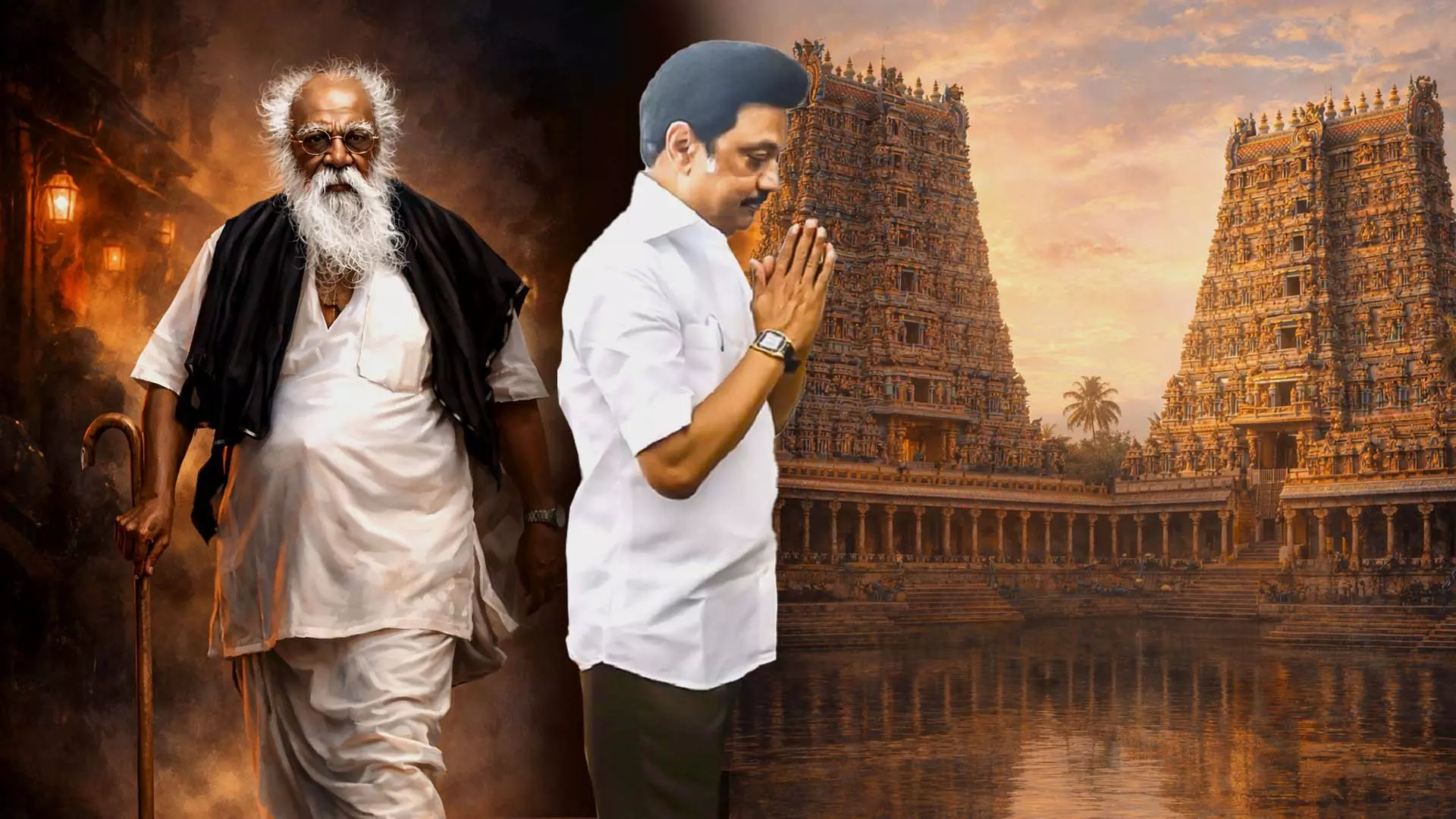
Is DMK rewriting its Periyarist playbook to counter Hindutva in Tamil Nadu?
Party argues shift is just a strategic response to changing political landscape, where religion acts as a central axis of mobilisation: Part 1 of a 3-part series

The DMK, long identified with rationalism and social justice, is navigating a complex political moment in Tamil Nadu. With the BJP's Hindutva narrative gaining traction, the DMK is recalibrating its public posture, asserting that it opposes Hindutva politics but not Hindu faith.
This repositioning is visible in both symbolism and governance. From temple administration to the language used by party leaders, the DMK is signalling a broader cultural engagement while insisting that its core Periyarist principles remain intact.
The party argues that this shift is not an ideological retreat but a strategic response to a changing political landscape, where religion has become a central axis of mobilisation.
A visible shift
Under the current DMK government led by Chief Minister MK Stalin, the Hindu Religious and Charitable Endowments (HR&CE) Department presents a markedly different image from the past. Temple renovations, religious processions and public participation by ministers in spiritual events have become more frequent.
Unlike earlier DMK regimes under M Karunanidhi, several party leaders are now seen wearing sacred ash or vermilion at official and political events. Temple visits, once politically sensitive for a rationalist party, are no longer unusual.
Party leaders maintain that this is political realism rather than ideological compromise, aimed at countering the BJP’s attempt to brand the DMK as anti-Hindu.
Analysts’ view
Political analysts describe the change as a deliberate balancing act between faith and ideology. According to them, the DMK has widened its cultural messaging without conceding ideological ground to Hindutva.
R Kannan, political analyst, points to a significant acknowledgement by the party leadership. “MK Stalin was compelled to acknowledge that 90 per cent of the DMK’s members are Hindus. This was a party built on a rationalist ideology, but it’s now openly admitting its Hindu base.”
Kannan adds that the party continues to use its rationalist legacy as a political shield. “There is an ideological bent in the DMK’s approach. They see the Periyarist, rationalist veneer as a shield against the Hindutva-wielding BJP.”
Constitution first
The DMK leadership draws a clear distinction between party ideology and government responsibility. Leaders stress that while the party may speak the language of rationalism, the government must function within constitutional limits.
TKS Elangovan, DMK spokesperson, explains this separation. “Government is different from party. The party can talk about atheism, but the government has to go by the Constitution; every citizen has the right to follow any religion.”
For Elangovan, rationalism has never meant hostility towards faith. “Our main aim was never atheism. It was social equality — that is, all men are born equal. We have not compromised on that.”
Social reform legacy
The DMK links its engagement with temples to its long history of social reform. Leaders argue that the party’s movement dismantled caste barriers within religious spaces, enabling communities once excluded to participate fully.
Highlighting this legacy, Elangovan says, “Those who were once not allowed into temples are now ministers wearing sacred ash. That itself is the success of the DMK movement; every section has been uplifted.”
The party contends that its interventions in temple administration are about ensuring equality and representation, not promoting religious orthodoxy.
Rejecting the charge
The DMK firmly rejects the BJP’s allegation that it is anti-Hindu. Leaders describe this narrative as a distortion of the party’s pro-backward-class mission.
Elangovan responds bluntly to the charge. “Who is against Hindus? The DMK was started to empower the backward and scheduled caste people — who comprise 90 per cent of Hindus. The party was started for their welfare.”
By framing social justice as inseparable from the welfare of Hindu communities, the DMK seeks to counter the BJP’s polarising pitch.
A new grammar
Between religious symbolism and constitutional secularism, the DMK is attempting to craft a new political grammar. The party hopes this calibrated approach will blunt the BJP’s Hindutva appeal while preserving its Periyarist identity.
From rationalist rhetoric to hands-on temple administration, the DMK’s evolution reflects the shifting contours of Tamil Nadu politics. Whether this balancing act strengthens its electoral base or risks diluting its ideological core remains an open question, one that will be tested in the years ahead.
The content above has been transcribed from video using a fine-tuned AI model. To ensure accuracy, quality, and editorial integrity, we employ a Human-In-The-Loop (HITL) process. While AI assists in creating the initial draft, our experienced editorial team carefully reviews, edits, and refines the content before publication. At The Federal, we combine the efficiency of AI with the expertise of human editors to deliver reliable and insightful journalism.