







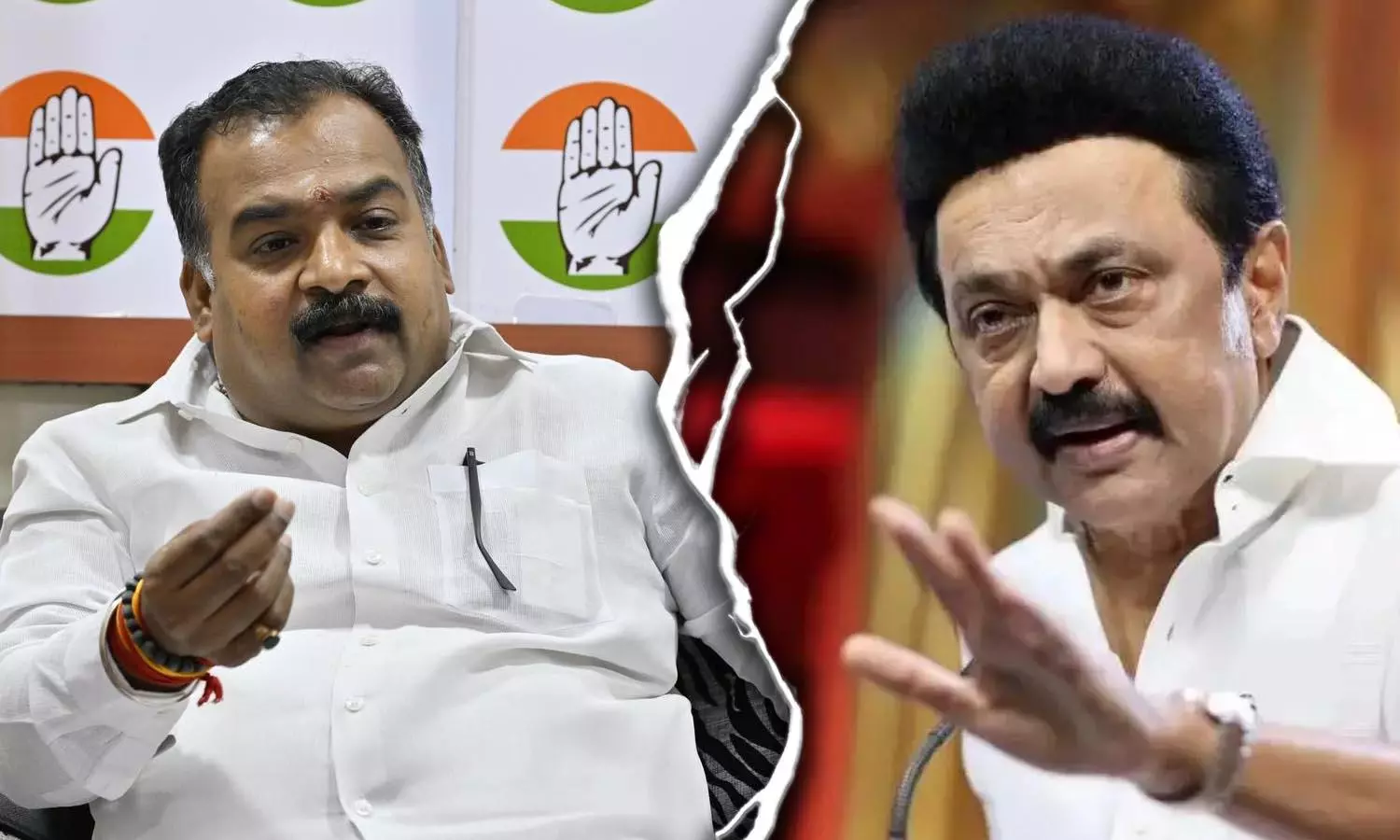
Tamil Nadu Congress Committee chief Manickam Tagore (left) and the DMK trade accusations over electoral defeat and protest politics. (Right: DMK chief M K Stalin).
DMK-Congress feud: SIR becomes flashpoint in Tamil Nadu’s new political equation
War of words over SIR and DMK's absence from Delhi protest highlight how electoral defeat and scramble for power can turn old friends into bitter rivals

In the corridors of Tamil Nadu politics, where alliances have long been forged and frayed over seats and ideology, the DMK and the Congress are trading bitter accusations that sound less like former partners and more like open rivals. The flashpoint is the Special Intensive Revision (SIR) of electoral rolls.
The Opposition at the national level alleges this process has deleted millions of genuine names nationwide under the leadership of Chief Election Commissioner (CEC) Gyanesh Kumar. While the INDIA Bloc staged a high-profile “March for Democracy” in Delhi this week, marching to the Supreme Court and filing a petition, the DMK stayed away. What followed was a sharp, personal war of words that laid bare how electoral defeat and the scramble for power can turn old friends into enemies.
Tagore’s criticism
The latest clash was ignited by Tamil Nadu Congress Committee president Manickam Tagore. He rejected the DMK’s claim that voter deletions under the SIR process were a major reason for its electoral setback. Citing a pre-poll speech by then chief minister MK Stalin in Madurai, Tagore noted that the DMK had boasted of a vast booth-level network that had ensured no eligible voter was removed in Tamil Nadu and that the exercise had gone smoothly.
Also read: SIR cannot explain DMK’s defeat, says TNCC chief Manickam Tagore
He argued that the real causes of defeat were unprecedented corruption, deteriorating law and order, objectionable remarks against women, and the DMK’s treatment of its own alliance partners. He further criticised the DMK’s absence from the Delhi protest, where Left parties, the VCK and MDMK leaders participated, suggesting the Dravidian party was reluctant to antagonise the BJP.
DMK’s retort
Responding to this, in a statement, the DMK accused Tagore, along with leaders such as Girish Chodankar and Praveen Chakravarthy, of acting as "sleeper cells" who undermined the anti-BJP alliance with daily criticism even before the polls. It labelled them "parasites" and "rotten bodies" whose presence had burdened the coalition and contributed to vote losses. Calling Tagore a "TVK slave" who "kneels at Vijay’s feet," the DMK questioned why he was attacking the DMK while remaining silent on the silence of Chief Minister C Joseph Vijay and his TVK (now an ally of the Congress) government on the issue of SIR.
DMK highlighted its own record: Stalin was among the first Tamil Nadu leaders to demand Gyanesh Kumar’s removal after an Indian Express report on alleged irregularities; DMK MPs signed a notice seeking the CEC’s ouster; and the party protested the detention of young activists opposing SIR in Chennai under the TVK government.
Also read: ‘Afraid of Vijay?’: DMK questions Rahul Gandhi’s ‘silence’ on TN SIR
Having exited the INDIA Bloc after the Congress severed ties with it to ally with the TVK, something which the DMK calls "betrayal," the party declared it has no obligation to join Congress-led agitations. “Our path is an independent one,” it asserted, warning Tagore that continued slander would carry consequences and that he should "shut his mouth."
Congress pushback
Congress leaders pushed back against the personal tone. They condemned what they called obscene and low-level language, including threats of the sort “shut your mouth or it will be shut,” arguing that such rhetoric harms Tamil Nadu’s political culture and cannot substitute for answering questions with facts.
Party spokespersons insisted they are “not slaves,” that Manickam Tagore is unafraid, and that they will hit back. They demanded the DMK clarify its dual stance on the SIR process and face the truth rather than resort to abuse.
Power realignment
This is not merely a local quarrel. It illustrates a familiar pattern in Indian politics: alliances of convenience fracture when the arithmetic of power changes. The Congress, seeking relevance and ministerial space after decades as a junior partner, calculated that supporting the TVK offered a better immediate path.
Also read: Act of betrayal, says DMK after Congress opts to back TVK in TN govt formation
The DMK, nursing the wounds of defeat and the loss of its long-time ally, has chosen to weaponise the language of betrayal while positioning itself as the uncompromising defender of secular and anti-BJP credentials. On the SIR issue itself, both parties have publicly opposed large-scale deletions and called for accountability from the Election Commission, yet their mutual recriminations now overshadow any shared ground.
Shifting positions
Political observer Dayalan Shanmugam pointed to a striking inconsistency in the current arrangement. While a major protest against the Election Commission was underway in Delhi, he noted that in Chennai the prime minister was seen holding the hand of the chief minister and ascending the stage with him. Yet the TVK remains part of the INDIA Bloc. Shanmugam said this political posture of the TVK is difficult to understand and argued that the party is unlikely to replicate the strong anti-BJP role the DMK once played. At the same time, he observed that the DMK itself has also moved away from the intensity of its earlier anti-BJP politics, a shift that is notable in the present context.
He suggested that the DMK may be calculating its own course in light of Vijay’s partnership with the Congress. With the chief minister, who is aligned with the Congress, not pursuing aggressive anti-BJP politics, the DMK could reasonably ask why it should take the lead in opposition actions. This observation highlights how the post-election realignment has left both the DMK and its former ally in ambiguous positions: one outside the INDIA Bloc and the other inside a government whose national posture remains unclear. This further complicates any prospect of reviving the old partnership.