



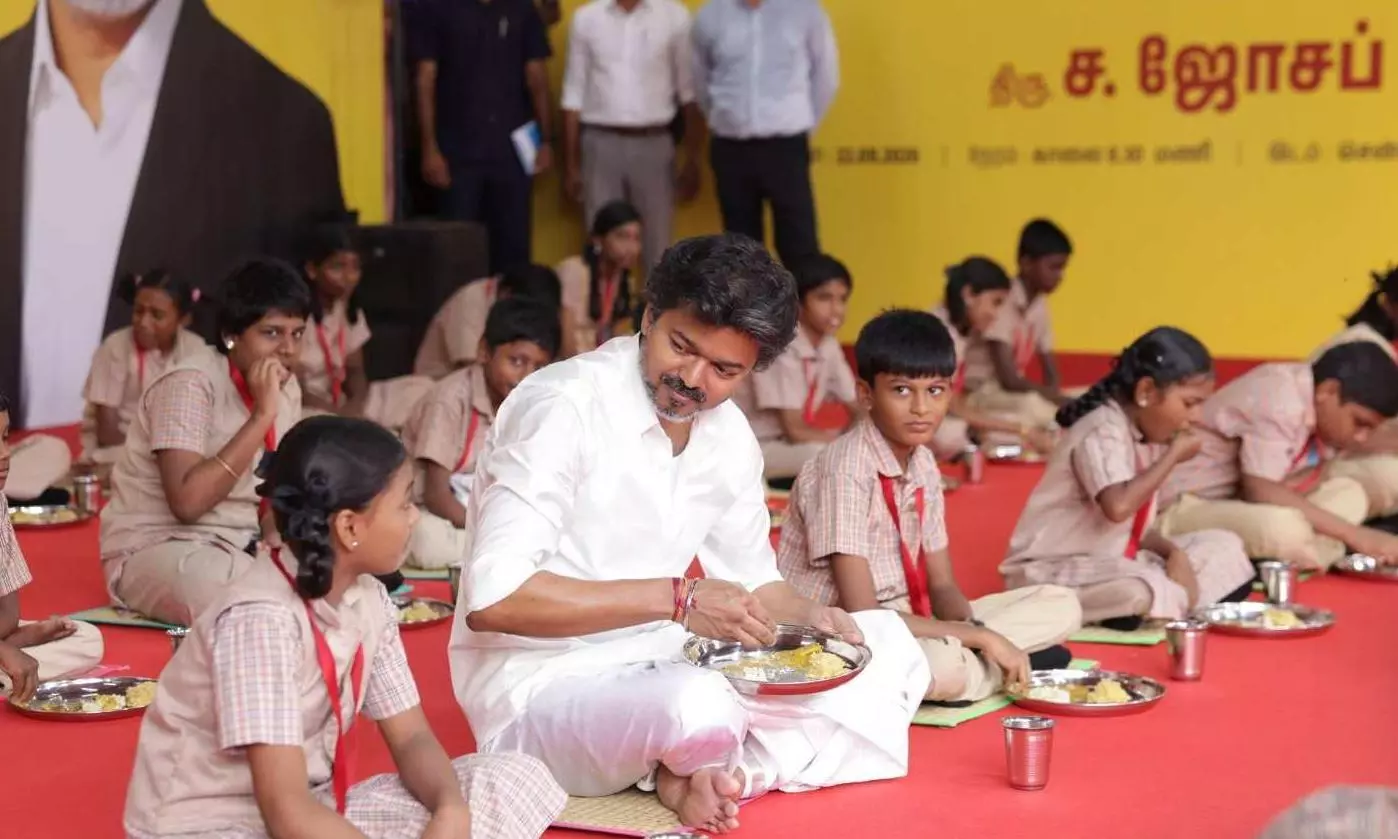
Tamil Nadu Chief Minister C Joseph Vijay eats with students at Gandhi Gramam Corporation Middle School in Thiruvanmiyur, Chennai on Tuesday (Sept 22) as he launched the expansion of the 'Perunthalaivar Kamarajar Breakfast Scheme'.
CM Vijay launches free school breakfast scheme expansion, shares meal with students
Rs 724-cr programme will cover 34.64 lakh students from Classes 1-8, but child-rights campaigners stress quality, local menus, balanced diet, and dignity over mere plate counts

Tamil Nadu Chief Minister C Joseph Vijay sat on the floor of a government school kitchen hall on Tuesday morning (September 22), served pongal, sambar, and a sweet to children, waited for a Class VII girl to finish her prayer, and then ate with them.
The gesture marked more than a photo opportunity. It was the formal launch of the State’s most significant expansion of its free school breakfast programme: the newly-renamed “Perunthalaivar Kamarajar Breakfast Scheme”, now extended from the earlier Classes I–V to Classes VI–VIII.
At Gandhi Gramam Corporation Middle School in Thiruvanmiyur, 217 students of Classes VI to VIII had breakfast with the CM. Ministers N Anand, Aadhav Arjuna, and Rajmohan accompanied him. After the meal, Vijay walked into classrooms, asked children their names and sections, questioned them about their studies, and inspected the school.
Class VII student S Tharshini later told reporters, “The CM asked me my name and my section, and enquired about my studies. He also waited patiently to talk to me till I finished my prayer before eating.”
‘Uncompromising quality control essential’
The government has also sent a message to parents’ mobile phones in the Chief Minister’s name. The SMS said nutritious and tasty breakfast would be provided to ensure that students come to school with enthusiasm.
Also Read: TN CM Vijay launches expansion of breakfast scheme for school children
Child-rights campaigners, however, immediately cautioned that a message is not a meal: daily delivery, kitchen infrastructure, and uncompromising quality control will decide whether the promise becomes routine.
34.64 lakh children will get free breakfast
Officials say the expansion will bring an additional 15.30 lakh students in 15,454 government and government-aided schools under the morning-meal net. Combined with the existing primary-school coverage, about 34.64 lakh children in 44,984 schools from Classes I to VIII will now receive free breakfast.
The state has set aside an extra Rs 217.63 crore for the current financial year, taking the breakfast programme’s total allocation to about Rs 724 crore. Implementation is being handled through the Social Welfare Department.
Also Read: TN breakfast scheme: Over 20 lakh students to benefit, says CM Stalin
The statewide rollout began on Tuesday, except in Chengalpattu and Tiruppur districts, where the Model Code of Conduct is in force because of the October 6 Assembly by-elections in Madurantakam and Dharapuram. The launch itself had been scheduled for September 17, and was postponed after Vijay’s official visit to London.
Centralised kitchens
How the food will be cooked is as important as what is cooked. In Greater Chennai Corporation, breakfast for 447 schools will come from centralised kitchens. Another 2,150 schools in other corporations, municipalities, and adjoining town panchayats will also be served through municipal centralised kitchens.
In the remaining 12,857 rural and adjoining schools, self-help groups affiliated to the Tamil Nadu Corporation for Development of Women will prepare and serve the meal.
Free meals over the years in TN
Tamil Nadu did not invent school feeding this week. As far back as 1920, the Madras Corporation under P Theagaraya Chetty approved tiffin for poor children at a Corporation school in Thousand Lights. In the 1950s, Chief Minister K Kamaraj turned mid-day meals into a statewide instrument of school enrolment. MG Ramachandran expanded the nutritious meal programme in 1982. Later governments added eggs, variety meals, and anganwadi coverage.
Also Read: Tamil Nadu’s new breakfast scheme pushing up school attendance: Report
The breakfast layer is newer. On September 15, 2022, then Chief Minister MK Stalin launched the Chief Minister’s Breakfast Scheme at a Corporation primary school in Madurai for Classes I–V, calling it not a freebie but “the duty of the State to feed its children”. The first phase covered a little over 1.14 lakh students in 1,545 schools. It later spread across government and aided primary schools.
After the TVK government took office, the programme was rechristened as the Perunthalaivar Kamarajar Breakfast Scheme, formally linking the morning meal to Kamaraj’s education legacy. Tuesday’s expansion takes that scheme into middle school for the first time.
Nutritional challenge
The government’s stated aims remain the same as in 2022: reduce classroom hunger, improve attendance, cut dropouts, and give children the nutrition needed to concentrate. The political framing has changed. The nutritional challenge has not fully gone away.
NFHS-6 data for Tamil Nadu still shows a mixed picture: stunting among children under five has fallen to 20.7 per cent, but wasting has risen to 17.4 per cent, and underweight remains a concern. Child-rights groups argue that a breakfast scheme for school-age children cannot be judged only by plates served; it has to be judged against that nutrition deficit.
Also Read: Breakfast scheme aimed at changing people’s lives, not freebie: MK Stalin
The prescribed weekly rotation circulated with the expansion is simple and familiar: upma on Monday, khichdi on Tuesday, pongal on Wednesday, upma on Thursday, and a sweet dish on Friday, with millet-based preparations to appear at least twice a week; the wider approved list also includes rava upma, semiya upma, vegetable khichdi, ven pongal, sakkarai Pongal, and semiya kesari. At Tuesday’s launch, the plate served was ven pongal, sambar, and sweet pongal.
‘Balanced diet, hot meals are important’
Founder-director of Thozhamai and a prominent child-rights activist A Devaneyan called the expansion of the breakfast scheme praiseworthy, and then listed the conditions that will make or break it.
“This is an important scheme, and expanding it is commendable,” he told The Federal. “But there is a problem in cooking outside and bringing the food to school on time. The infrastructure already available under the nutritious meal scheme in schools can be used. That way, noon-meal workers can be utilised properly.”
Uniform food, he said, is a mistake.
“Food must be given according to each region. For example, in areas where hill communities live, food suitable for them must be given, millet-based food can be provided. Just because it is called a nutritious meal, one should not ignore whether the government is actually giving a balanced diet.”
Also Read: TN: Stalin launches expanded breakfast scheme for school children
His sharpest warning was about temperature and dignity.
“If cooking is done next to the school, students get a chance to eat the food hot. It should not be turned into packet food.”
Devaneyan also noted an improvement that rarely makes it into launch speeches: “Problems such as insects or lizards falling into food have reduced now. Lessons were learnt from earlier incidents, and firewood stoves were changed to gas stoves, which reduced these problems. Compared with other States, infrastructure in Tamil Nadu schools is better. But quality food must be given.”
‘Investment in children’s growth’
Andrew Sesuraj, another child-rights activist who spoke to The Federal, placed the expansion in a larger frame than welfare optics.
“The extension of the school breakfast scheme up to 8th standard is a welcome move because it helps in nutrition beyond poverty,” he said. “The school breakfast scheme should be viewed not simply as a programme that provides a meal but as an investment in children’s growth, learning and health, along with dignity.”
Also Read: Midday meal: Can TN set an example with chicken biryani when even eggs go missing?
Citing Tamil Nadu’s NFHS-6 numbers on stunting and underweight, he argued that the programme “should go beyond feeding the child to enabling the child”. He said it should offer nutritious and locally appropriate food, create space for children to learn about nutrition, hygiene, and healthy choices, and let them take part in discussions about menus and food preferences.
“Children should not be treated as merely beneficiaries of a feeding programme. They are right holders and participants. Their dignity, their voice, their participation should be built into the way the programme is designed and implemented,” Sesuraj said. “The measure of success should therefore not only be on how many breakfasts are served but whether the programme helps the children to come to school ready to learn, participate with confidence, and develop healthy habits and grow with dignity.”
‘Menu is not frozen’
Greater Chennai Corporation Commissioner Dr GS Sameeran, IAS, told The Federal that the menu is not frozen.
“A special committee has been formed to study changing the food varieties and improving quality. Soon, the required studies will be taken up and the breakfast scheme will be implemented even better. Nutritious food items that students like will be provided,” he said.
