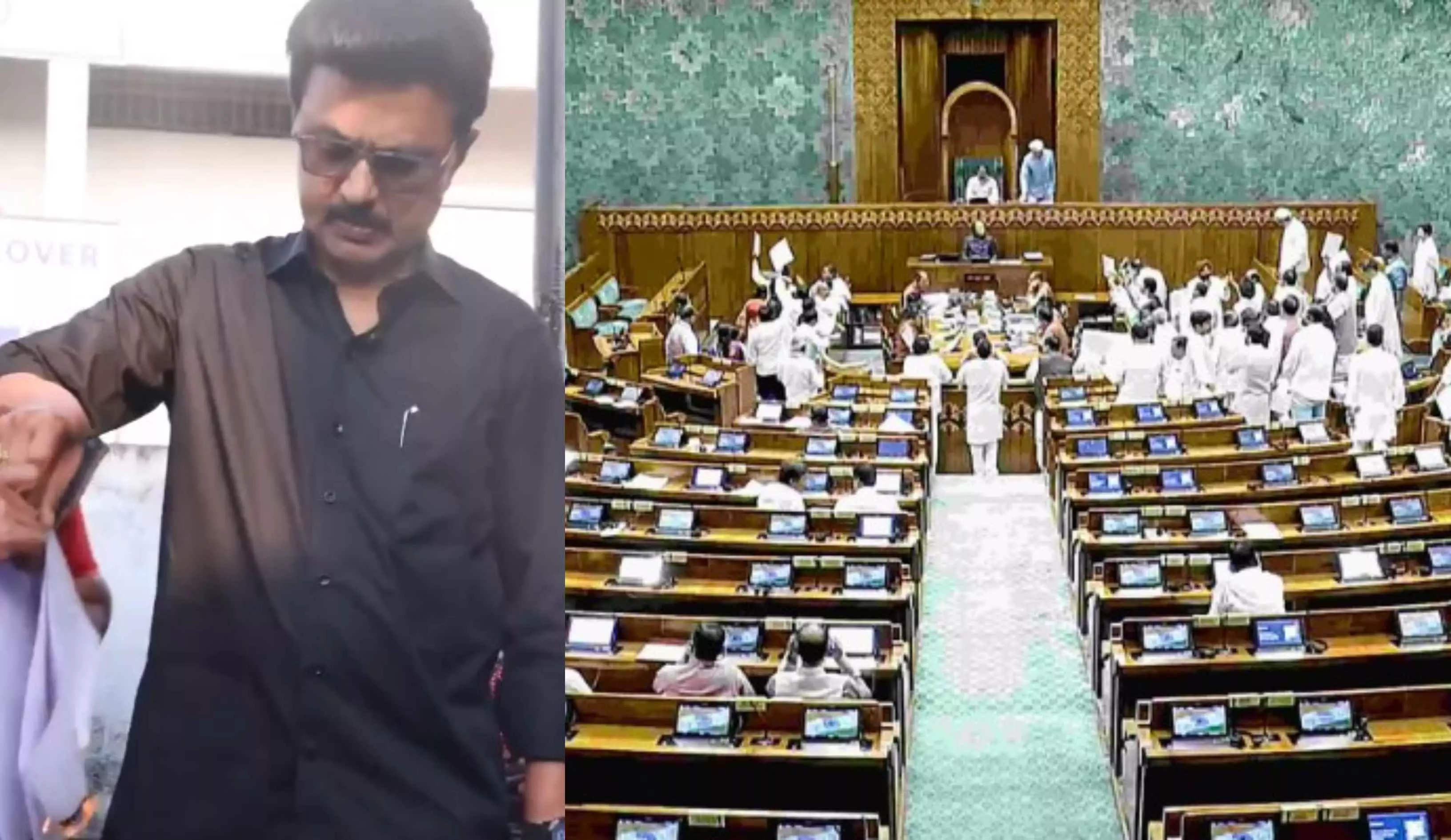
The DMK has strongly objected to the Centre's reported move to delink the Constitution Amendment Bill from the Delimitation exercise. Photo: PTI, Screengrab from ANI
Centre has sinister motive behind linking Nari Shakti with Delimitation Bills: DMK
DMK warns that delinking the Constitution Amendment Bill from delimitation is a BJP ploy to fast-track constituency redraws at the cost of southern states

The Dravida Munnetra Kazhagam (DMK) has raised strong objections to the Centre’s reported move to delink the Constitution Amendment Bill from the Delimitation exercise, warning that such a step could have far-reaching political consequences, particularly for southern states.
The development comes amid speculation that the Bharatiya Janata Party-led Union government may push forward with delimitation as a standalone measure, which can be passed by a simple majority in Parliament, instead of tying it to broader constitutional reforms.
Also Read: Will women’s quota stall if Centre’s amendment Bill falls in Parliament?
Speaking to The Federal, DMK spokesperson Saravanan alleged that the Centre’s approach reflects a “sinister motive” aimed at pushing through delimitation while using the women’s reservation plank as political cover.
'Sinister motive' behind the move
“There is a sinister motive behind the move by the BJP. Already the women’s reservation bill has been passed. So what is the necessity to club it with delimitation? This is nothing but a tool for propaganda,” he said.
Saravanan argued that the earlier framework, where women’s reservation would come into effect after the next Census and subsequent delimitation, was acceptable to the opposition. However, he claimed the current move attempts to “fast-track” delimitation in a way that could disadvantage states like Tamil Nadu that have successfully implemented population control measures.
The freeze that expires in December
DMK's Rajya Sabha MP and senior advocate P. Wilson warned that the DMK's objections go beyond the immediate legislative manoeuvre. He argued that even if the Constitution Amendment Bill is withdrawn, the passage of a standalone Delimitation Bill would still hurt southern states. The constitutional protection that has prevented population-based delimitation — contained in the proviso to Article 81(3) — is set to expire on December 31, 2026. If the Delimitation Bill is passed without extending this freeze, the Union government could conduct a fresh census in 2027, allowing the Delimitation Commission to redraw constituencies on that basis — once again disadvantaging states like Tamil Nadu that have kept population growth in check.
Backing Chief Minister M K Stalin's position, Wilson demanded that all three Bills introduced by the Union government be withdrawn and replaced with a new Constitution Amendment Bill that explicitly extends the freeze on population-based delimitation under Articles 81(3), 330(3), and 332(3B).
South fears losing its voice
Delimitation, which involves redrawing parliamentary constituencies based on population, has long been a contentious issue. Southern states, including Tamil Nadu and Kerala, have expressed concerns that population-based seat redistribution could reduce their representation in Parliament, while northern states with higher population growth could gain more seats.
Also Read: Three grounds on which delimitation laws may be challenged in court
Political analysts note that separating delimitation from a constitutional amendment lowers the legislative threshold, making it easier for the Centre to proceed despite opposition resistance. However, such a move risks triggering a wider political backlash, especially from regional parties.
Women's bill used as political cover
Saravanan also suggested that clubbing delimitation with women’s reservation was a calculated attempt to secure broader political support. “It is a way to facilitate this draconian act to portray as though parties opposing delimitation are against women’s reservation,” he said.
Opposition parties, including the Indian National Congress, have echoed similar concerns in recent debates, warning that delimitation without safeguards could alter the federal balance.
With the Bills expected to be taken up for voting Friday (April17), the issue is likely to sharpen political divisions, setting the stage for a larger confrontation between the Centre and opposition-ruled states.