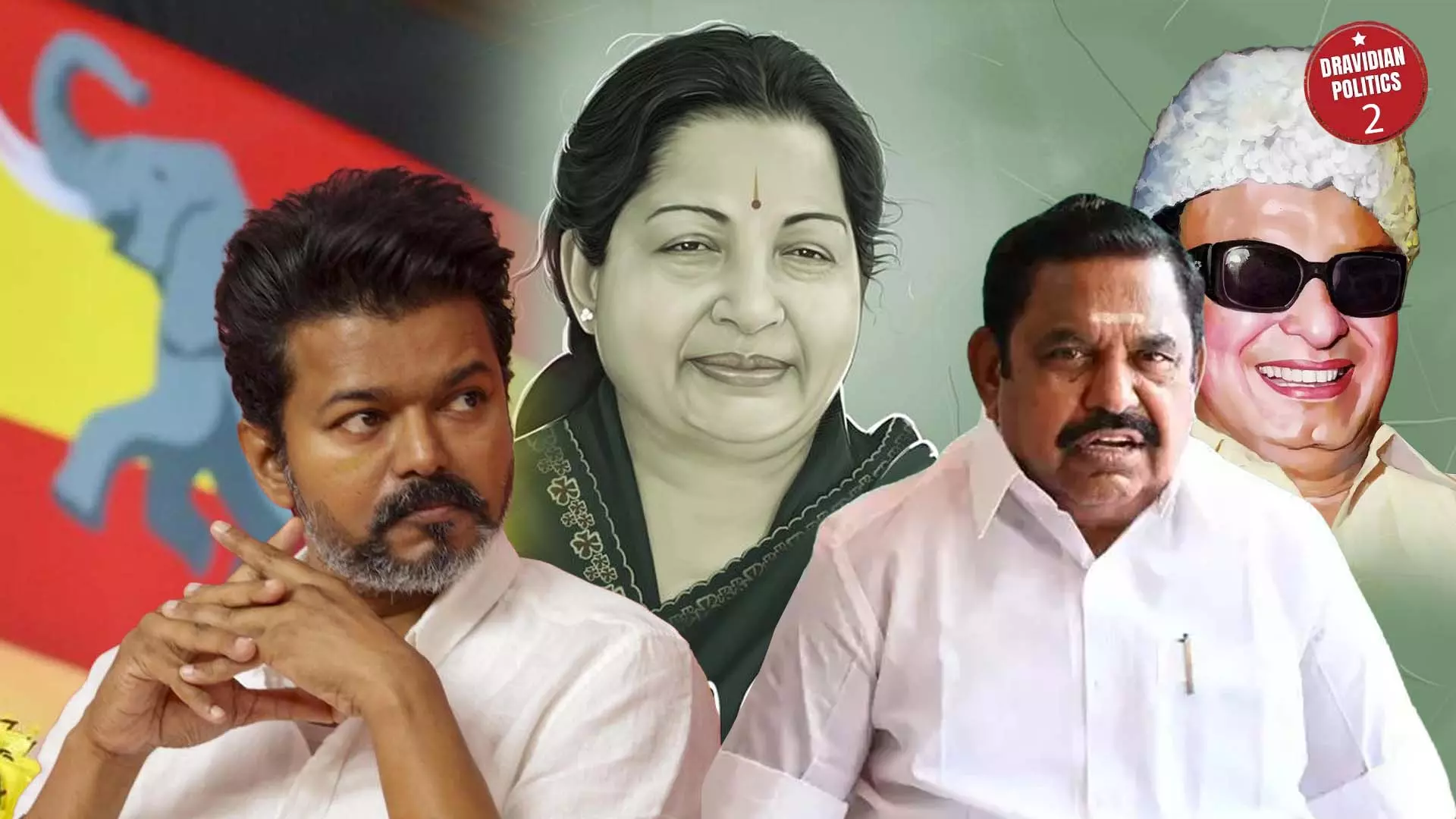
AIADMK’s post-Jaya slide: Internal rifts, youth drift and alliance trouble
After Jayalalithaa’s death, the party struggles with fading cadres, alliance dilemmas and youth drift — can AIADMK reinvent itself before 2026 polls?

For decades, the All India Anna Dravida Munnetra Kazhagam (AIADMK) stood as the principal bulwark against the DMK in Tamil Nadu politics. Built on charismatic leadership, welfare politics and strong cadre loyalty, the party dominated the state’s political imagination for years.
That dominance began to fracture after the death of J. Jayalalithaa in 2016. Since then, AIADMK has been plagued by internal splits, court battles and a gradual erosion of grassroots loyalty, raising questions about its future as the 2026 Assembly elections approach.
Jayalalithaa once proudly declared her party’s unmatched strength after a sweeping electoral victory. “This is a historic, unparalleled, unprecedented victory. The AIADMK has achieved this on its own, without any alliance,” she said, underlining the party’s self-reliance at its peak.
Post-Jayalalithaa phase
Today, the party struggles to attract alliance partners. Except for the BJP, widely perceived in Tamil Nadu as a Hindi-centric party, few are willing to align with AIADMK. Under Jayalalithaa, dissent was swiftly dealt with, and the party functioned under tight central control.
Also Read: 2026 Assembly polls: BJP’s long march meets its first major test
After her demise, changes in party functioning weakened internal structures and damaged cadre morale. Grassroots supporters told The Federal that while cadres remain energetic, they are anxious about declining youth support, internal rifts and emerging political challenges.
The core question now is whether AIADMK can reconnect with its base. Once proud of its strong cadre network built by M. G. Ramachandran (MGR) and Jayalalithaa, the party today relies largely on older, anti-DMK loyalists.
Youth drift
Actor-turned-politician Vijay’s Tamilaga Vettri Kazhagam (TVK) has emerged as a magnet for first-time voters and frustrated youth seeking political participation. Many AIADMK loyalists admit that younger members of their families are drifting towards TVK or other parties.
This trend has alarmed the leadership. Senior AIADMK leaders have publicly invited TVK to consider an alliance. Adding to the churn, Jayalalithaa loyalist and senior politician S. Semmalai recently joined TVK, signalling deeper cracks.
Despite over 50 years in Tamil Nadu politics, AIADMK’s eagerness to court TVK reflects its shrinking organisational confidence. Explaining this outreach, S. Semmalai said, “TVK leader Vijay should not be a spoiler. He can be our sponsor… We never believed that without you there is no future.”
Alliance dilemma
Efforts to revive youth participation, including launching a new youth wing in January 2025, failed to gain traction. The wing has remained largely inactive, with appointments pending for over a year.
After defeats in the 2021 Assembly elections and the 2024 Lok Sabha polls, party leader Edappadi K. Palaniswami (EPS) faces intense pressure to deliver a turnaround in 2026 and salvage both his image and the party’s future. This pressure has pushed AIADMK closer to the BJP, straining its Dravidian identity.
Within the party, opinions are divided. Some cadres view the BJP alliance as a tactical necessity, while others see it as a betrayal of AIADMK’s secular and rationalist roots. Addressing this, S. Semmalai argued, “If we push the BJP aside, we will lose the supportive votes that come with the BJP.”
Leadership vacuum
AIADMK was built on leader-centric trust. MGR and Jayalalithaa were larger-than-life figures who carried the party. After Jayalalithaa’s passing, an identity vacuum emerged.
EPS filled part of that vacuum, but critics allege he consolidated power by changing party bylaws—an issue still being contested in court. Dissenting leaders, including O. Panneerselvam, have challenged these changes legally, keeping internal conflict alive.
The BJP’s broader strategy of aligning with regional parties and expanding influence has seen limited success in Tamil Nadu. The state’s strong Dravidian identity remains resistant to Hindutva narratives, making AIADMK’s balancing act even more complex.
Caught between inclusive renewal and rigid control, ideological distance and tactical alliances, AIADMK stands at a crossroads. The 2026 Assembly election may ultimately decide whether the party adapts to changing political realities or continues to drift away from its once-dominant position.
The content above has been transcribed from video using a fine-tuned AI model. To ensure accuracy, quality, and editorial integrity, we employ a Human-In-The-Loop (HITL) process. While AI assists in creating the initial draft, our experienced editorial team carefully reviews, edits, and refines the content before publication. At The Federal, we combine the efficiency of AI with the expertise of human editors to deliver reliable and insightful journalism.