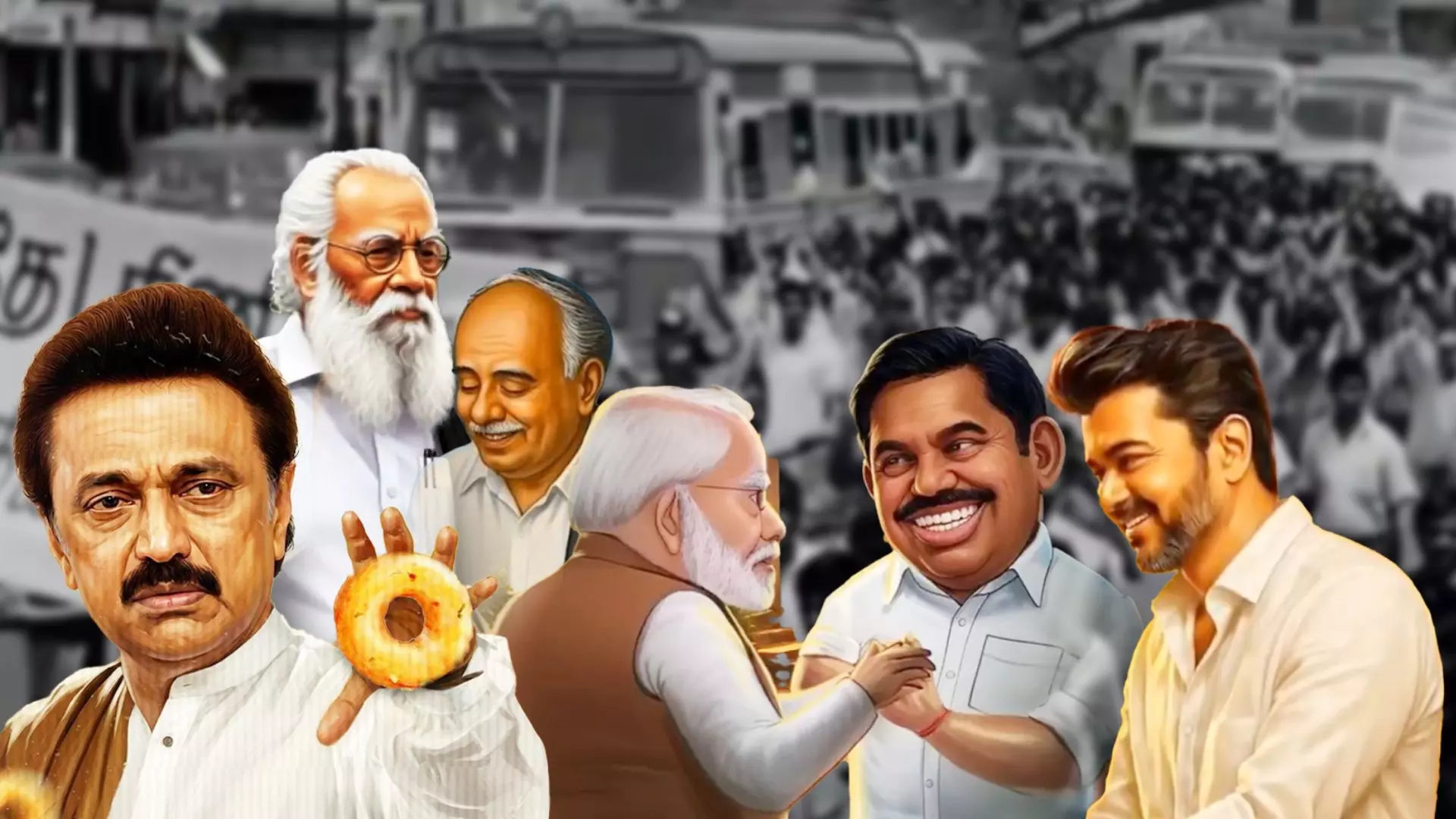
AI-driven political campaigns heat up Tamil Nadu 2026 election battle
AI-generated videos, deepfakes, and viral meme campaigns are reshaping political messaging ahead of the 2026 Tamil Nadu Assembly elections

Artificial intelligence is rapidly transforming political campaigning in Tamil Nadu ahead of the 2026 Assembly elections. From AI-generated speeches and deepfake videos to viral memes, political parties are turning social media platforms into digital battlegrounds to shape public opinion.
Parties across the spectrum have strengthened their IT wings and social media teams to run aggressive online campaigns. Platforms such as X, Instagram and YouTube are now key spaces where political narratives are created, amplified and contested.
The ruling DMK and the AIADMK, along with actor Vijay’s Tamilaga Vettri Kazhagam (TVK), are among the parties actively using AI-driven content to influence voters—particularly the younger, digitally connected audience.
Digital war
Political campaigns in Tamil Nadu have long been dramatic, but artificial intelligence has added a new dimension. The DMK has appointed Booth Level Digital Agents (BLDAs) in polling booths across the state to promote government schemes and major projects online.
The most intense online rivalry, however, is between the ruling DMK and Vijay’s TVK, which is contesting its first Assembly election. Vijay himself has framed the upcoming polls as a direct contest between his party and the DMK. Calling the election a clash of values, Vijay described the battle as one between a “pure force” and an “evil force.” Political analysts say this narrative is now playing out most aggressively on social media.
Both DMK and TVK IT teams are producing short AI-generated videos and memes almost daily. These clips often remix speeches, simulate voices, or present cinematic storytelling designed for maximum shareability and emotional impact.
Deepfake debate
One of the most controversial incidents involved an AI-generated video featuring the late former Chief Minister CN Annadurai. The video went viral online and sparked debate across political circles.
The clip recreated Annadurai’s voice through AI simulation and portrayed him as endorsing TVK leader Vijay as the future chief minister of Tamil Nadu. The use of the image and voice of the DMK founder to criticise the current party leadership drew strong reactions.
Within two days, the DMK IT wing responded with its own AI campaign. A video featuring the voice of MK Stalin highlighted the ideals of social reformer Periyar EV Ramasamy and was shared by the chief minister on social media.
Interestingly, Vijay has also said that his party will follow key principles of Periyar’s social reform ideology.
Virtual leaders
Artificial intelligence has also been used to recreate iconic political leaders from Tamil Nadu’s past. During the DMK’s 75th anniversary celebrations, AI technology was used to digitally recreate former Chief Minister M Karunanidhi.
At the event, an empty chair was placed beside Stalin’s seat while a projection showed Karunanidhi delivering a speech, giving the impression that he was virtually present on stage.
The DMK has also used AI-generated videos to criticise the AIADMK–BJP alliance. In one viral video, AIADMK general secretary Edappadi K Palaniswami was depicted as wanting to be a “slave” of the BJP.
The AIADMK has responded with its own AI campaigns, including videos showing alleged violent incidents involving women and youth in Tamil Nadu, aimed at criticising what the party calls the poor governance of the Stalin government.
AI characters
National parties are also experimenting with AI in their campaigns. The Congress has introduced AI characters to deliver political messages online. One such character, “Rakkamma,” appears as a young woman discussing politics and welfare programmes in Tamil Nadu. Through daily reels titled “Rakkamma Talks,” the character slams what it describes as anti-people policies of the BJP-led NDA government at the Centre.
Another character, “Pudhuvai Thatha,” addresses issues in Puducherry. In one video, the character points out points out the poor ambulance facilities in the Union Territory and argues that the BJP’s promises in the previous election to improve healthcare infrastructure have not been fulfilled.
These AI characters are also used to explain party positions on alliances and political developments.
Digital outreach
The BJP has reorganised its IT wing into two separate teams: one focusing on databases and booth-level information, and another dedicated to managing social media accounts and digital messaging.
The party has also set up a call centre where telecallers reach out to beneficiaries of central government schemes. According to sources in the BJP IT wing, the call centre contacts around 700 people a day.
Videos are also released highlighting infrastructure projects and special trains provided by the Union government for Tamil Nadu.
Big question
With deepfake videos, AI-generated speeches and meme warfare becoming central to political communication, the 2026 Tamil Nadu Assembly election could become India’s most AI-driven political campaign yet.
These digital tools are increasingly shaping political discourse, particularly among young voters who consume most of their news online.
But the rise of AI in politics also raises important questions. Where is the line between satire and misinformation? And can voters easily distinguish real footage from AI-generated content?
Algorithms, memes and artificial intelligence are now influencing political conversations more than ever. The real question, however, remains: will these digital campaigns actually change how people vote?
The content above has been transcribed from video using a fine-tuned AI model. To ensure accuracy, quality, and editorial integrity, we employ a Human-In-The-Loop (HITL) process. While AI assists in creating the initial draft, our experienced editorial team carefully reviews, edits, and refines the content before publication. At The Federal, we combine the efficiency of AI with the expertise of human editors to deliver reliable and insightful journalism.