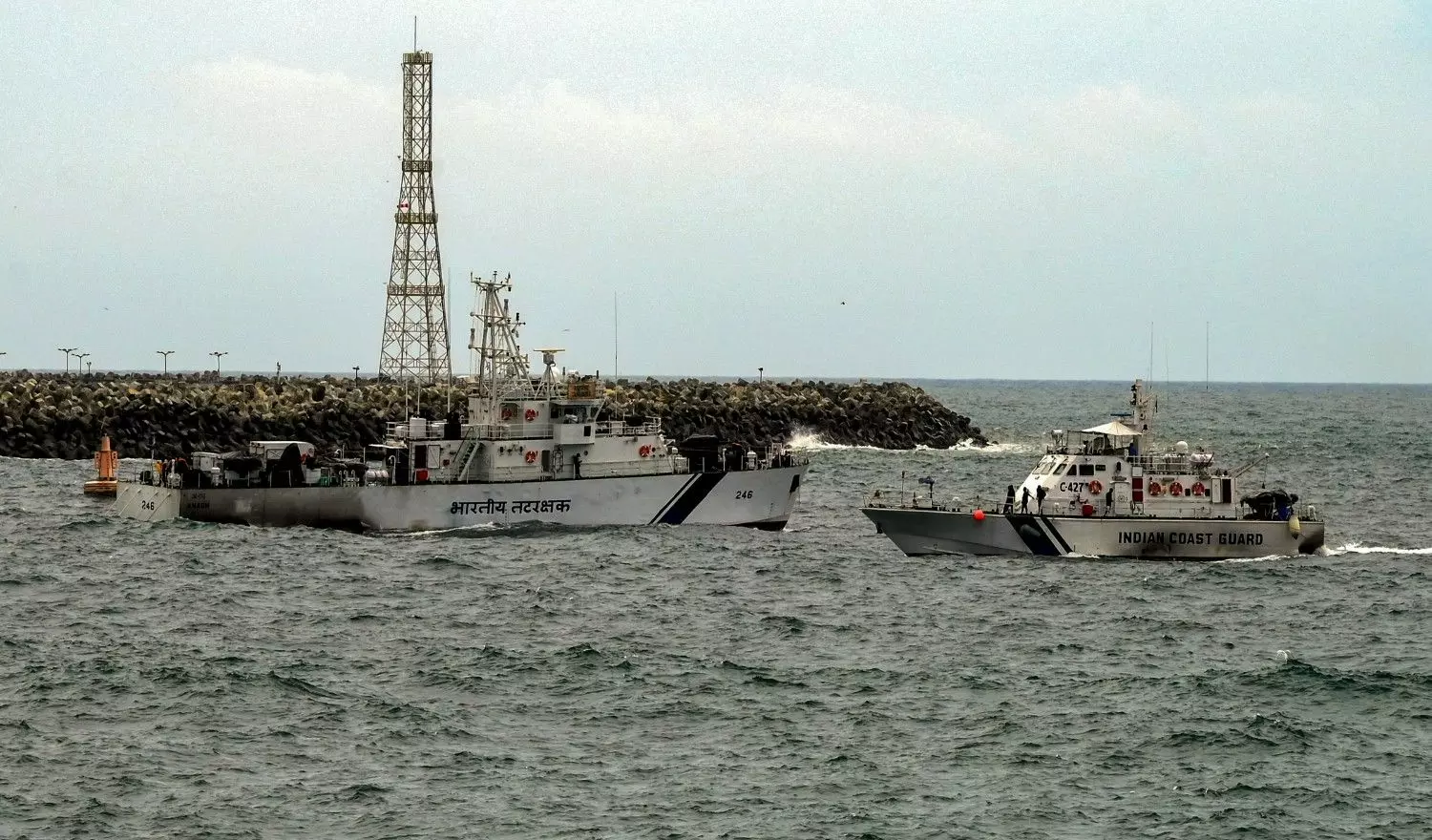
Indian Coast Guard ships during patrolling at Vizhinjam coast, in Thiruvananthapuram, Keralam. File photo: PTI
Vizhinjam port under fresh scrutiny as Kerala HC orders independent erosion study
For residents of coastal villages north of Vizhinjam, the October 30 verdict is significant because the earlier committee's findings had effectively ruled out the port's role in coastal erosion.

When The Federal visited fishing communities along the Thiruvananthapuram coast in late August as part of its reporting on coastal erosion, a common concern among residents was that the problem had been worsening for decades but had intensified after the Vizhinjam port construction began in 2016.
Fishers traced the erosion and sea incursion in Panathura and Poonthura, north of Vizhinjam, to around 1970, when the harbour breakwater was constructed. Subsequent attempts to contain the erosion through seawalls and groynes, they said, had pushed the problem further along the coast, extending beyond Valiyathura. They alleged that dredging and breakwater construction for the new port had further aggravated the situation.
What Kerala HC said
The Kerala High Court's decision to invalidate the government-appointed Kudale Committee and order a fresh, independent assessment of coastal erosion around the Vizhinjam International Seaport has reopened a crucial question for fishing communities along the Thiruvananthapuram coast over whether the port's construction has contributed to the loss of beaches, damage to houses and disruption of traditional livelihoods.
Also read: Why Keralam’s women fish vendors seem to be fighting a losing battle against changing retail
For residents of coastal villages north of Vizhinjam, the October 30 verdict is significant because the earlier committee's findings had effectively ruled out the port's role in coastal erosion. The High Court has directed that the report should not be acted upon and that a new panel of independent experts should examine the issue, taking into account the concerns of affected communities.
The judgment does not establish that the port caused the erosion. Nor does it halt port operations or new constructions. But it removes the earlier report as the basis for dismissing the complaints and creates an opportunity for a fresh scientific examination of the environmental and livelihood consequences of the project.
The petition was filed by 128 residents of fishing villages within 20 km north of Vizhinjam. They alleged that the construction of the port, particularly its breakwaters, had altered the natural movement of coastal sediments, resulting in erosion along the northern coastline and accretion on the southern side. Several residents claimed that their houses had been damaged or lost to the sea, while the shrinking shoreline had affected their traditional fishing activities.
Petitioners challenge Kudale Committee's independence
The Kudale Committee was constituted through a government order on October 6, 2022, following directions from the National Green Tribunal (NGT). It was tasked with examining whether port construction had caused coastal erosion, identifying its extent and suggesting remedial measures. Its terms of reference also included examining the impact of the project on fishing activities.
Also read: As PM Modi inaugurates Vizhinjam port, a fierce 'credit' war rages in Kerala
The petitioners challenged the committee's independence, pointing to the previous professional associations of some of its members with the port project and entities connected to its implementation.
Justice Harisankar V Menon found substantial grounds for concern over the inclusion of its chairman, MD Kudale, a former Additional Director of the Central Water and Power Research Station, Pune. Kudale had earlier served as an expert member of a technical sub-committee involved in the development of the Vizhinjam port. The respondents did not dispute this association.
The court observed that his earlier involvement in the project should have been a reason to avoid including him in a committee subsequently asked to examine its environmental consequences.
A significant aspect of the challenge concerned Kudale's own published scientific work. The petitioners relied on his 2010 paper, Impact of Port Development on the Coastline and the Need for Protection, published in the Indian Journal of Geo-Marine Sciences.
The paper acknowledged that port construction involving breakwaters and dredging could interfere with the natural longshore movement of sediments, resulting in accumulation on one side and erosion on the other. The committee's report, however, attributed the observed erosion substantially to natural factors, including Cyclone Ockhi.
The High Court noted the apparent contradiction between the two positions. The petitioners argued that the committee's conclusions were difficult to reconcile with the scientific observations made by its own chairman in his earlier publication.
'Judgment marks an important step'
Another issue concerned the inclusion of PK Chandramohan, whose professional association with Navayuga Engineering Company, a company with business connections involving Adani Enterprises, was questioned by the petitioners. The court examined these concerns while assessing the committee's independence. However, it declined to disqualify another member, Riji K John, observing that the quashing of his appointment as Kerala University of Fisheries and Ocean Studies (KUFOS) Vice-Chancellor did not by itself establish his ineligibility to serve on the committee.
Appearing for the complainants, senior advocate Prashant Bhushan argued that the committee's constitution itself compromised the credibility of its findings. “The judgment marks an important step towards ensuring independent scientific assessment of the environmental consequences of major coastal infrastructure projects. It underscores the importance of transparency, impartiality and scientific integrity in decisions affecting Kerala's fragile coastline and the livelihood and homes of fishing communities” Bhushan posted on X (Formerly Twitter) after the order was pronounced.
For fishing communities, the significance of the verdict goes beyond the validity of a government committee. Their concerns are rooted in the physical changes they say they have witnessed along the coast.
"The coastal erosion is a grim reality. We are not sure that our village will be on the map in the coming years. We have seen it submerging in recent times. We do not know whether it is directly related to the port. But there were some studies. Some studies said it was not. We cannot say, because these studies are all done by Adani's people only," said Dennis Rosario, a 70-year-old fisher, when The Federal spoke to him during its reporting on coastal erosion a couple of months ago.
His account reflects a recurring concern among residents that the erosion is visible to them, but they remain uncertain about its precise causes and question the independence of studies used to dismiss the port's role.
Will govt constitute independent panel?
The State and port authorities have maintained that erosion in several stretches predates the project and is influenced by high wave activity, cyclones, reduced sediment supply and the natural characteristics of the coastline. Studies commissioned by the port concessionaire have also examined shoreline changes using satellite imagery and beach profiles.
The fresh panel must undertake the studies envisaged in the October 2022 government order, with members free of conflicts of interest and after considering the court's observations and the views of relevant stakeholders.
For fishing families, the immediate expectation is that their experiences of losing homes, access to the shore and traditional fishing spaces will be examined alongside satellite data, coastal profiles and scientific modelling. The verdict does not promise compensation or establish liability. But it ensures that the question of what is happening to their coastline cannot be closed on the basis of the disputed Kudale Committee report.
The next test will be whether the government constitutes a genuinely independent panel and whether its investigation translates the concerns of coastal residents into credible scientific findings and meaningful remedial measures.