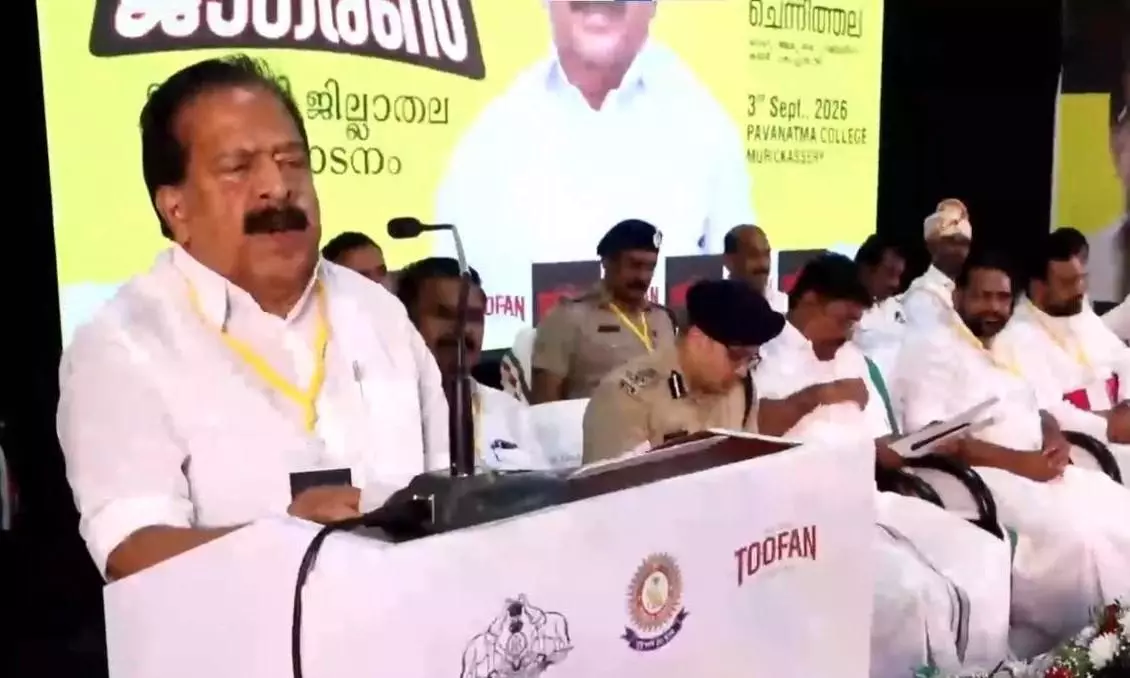
Keralam Home Minister Ramesh Chennithala said 'the storm of Toofan will sweep away the mafia that is spreading death'. Photo: X screengrab |@ians_india
Keralam’s war on drugs: UDF’s ‘Operation Toofan’ takes forward LDF’s ‘D-Hunt’
High-profile arrests and record seizures have put UDF govt’s narcotics crackdown in the spotlight, but data shows the war against drugs was well underway under the LDF regime

Three teachers, a Congress worker, and an alleged interstate drug network have given “Operation Toofan”, Keralam’s multi-agency narcotics hunt, an unexpectedly unsettling human face in the recent weeks.
In Kozhikode, the investigation into an MDMA network led the police to three young contractual teachers working at a Block Resource Centre (BRC) under the Samagra Shiksha Kerala initiative, KC Keerthana, K Kavya and VP Neeshma, who were earning around Rs 12,000 a month. Police said their alleged lifestyle and use of expensive cars raised suspicions. Their arrests followed the interrogation of an MDMA accused, which reportedly revealed a distribution network involving QR-code payments, a Gulf-based number, and concealed “dead-drop” locations.
In Kasaragod, the arrest of Youth Congress activist KH Mohammed Hussain, allegedly with 139.29 grams of MDMA, turned the drug probe into a political confrontation after his reported links with Chief Minister VD Satheesan became a point of contention.
An operation that has been in the headlines
Operation Toofan has been hitting the headlines with striking regularity since the UDF government launched its statewide narcotics crackdown on June 2, 2026. High-profile arrests, large seizures, and investigations stretching beyond Keralam have made it one of the government's most visible initiatives.
The latest police data available up to September 1, 2026 shows that Operation Toofan has resulted in 9,935 cases and 10,725 arrests since its launch. The operation has also yielded substantial seizures, including more than 21 kg of MDMA, over 1,154 kg of cannabis, 4.7 kg of hashish oil, and more than 524 grams of heroin.
Also Read: Keralam’s anti-drug drive expands overseas as police target fugitives
The biggest haul under Operation Toofan came in a Malappuram-led investigation, when a special team arrested three people in Coimbatore and seized 12.794 kg of MDMA. Police described it as the biggest drug haul in the state, alleging that the consignment was being smuggled into Keralam for distribution through drug networks across the state.
‘Storm of Toofan will sweep away the mafia’
“Operation Toofan is investigating the roots of a large mafia network involved in trafficking synthetic drugs into Keralam. The fact that the number of arrests under Operation Toofan has crossed 10,000 means that investigators have been able to identify an extensive network of links in the drug trade. The storm of Toofan will sweep away the mafia that is spreading death. That is the assurance I, and the Keralam government, give to the people of this state,” said home minister Ramesh Chennithala.
Contest over political credit
However, Operation Toofan has not been without its own claims and counterclaims. The political battle began when the Home Minister questioned the LDF’s record on tackling drugs. Taking a swipe at the previous government, Chennithala claimed that “after ruling for 10 years, they could not even seize 500 grams of MDMA”.
Leader of the Opposition Pinarayi Vijayan hit back sharply, rejecting the charge and questioning the Home Minister’s understanding of the previous government’s drug enforcement record.
“At the very least, if he had asked Telangana Chief Minister and Congress leader Revanth Reddy, the Home Minister could have understood the drug hunt during the LDF government’s tenure,” Vijayan said.
Also Read: Operation Toofan: Over 10,000 arrested in Keralam anti-drug drive
Vijayan pointed to the Keralam Police investigation into the 2.4 kg MDMA seizure in Thrissur in July 2024, which, he said, eventually led investigators to an international drug manufacturing laboratory in Hyderabad. He also cited Operation D-Hunt and the wider anti-narcotics work carried out jointly by the police and Excise Department.
“The LDF government’s anti-drug activities were exemplary,” Vijayan claimed, arguing that official data on arrests and convictions supported the record of the previous government.
The exchange turned Toofan into more than a policing story. It became a contest over political credit, with the Congress government presenting the operation as an intensified, multi-agency crackdown and the LDF arguing that much of the groundwork had already been laid during its tenure.
The numbers during LDF govt
The data from 2025, the last full year of the previous LDF government, shows that the Kerala Police and Excise Department were far from dormant in tackling drug-related offences. Toofan, therefore, looks less like the beginning of a new drug war and more like an expansion and repackaging of a policing effort that was already underway.
The numbers are important because the political debate over the drug menace has increasingly become a contest over who did more.
Also Read: Malayalam cinema’s rising stars, directors caught in a web of drug raids
In the first six months of 2025, Keralam Police had registered 25,262 cases under the NDPS Act. The corresponding figures for the two previous years were 27,530 cases in 2024 and 30,697 in 2023.
The Excise Department tells a similar story of sustained enforcement. In the first six months of 2025, it registered 8,622 NDPS cases. That was already higher than the 8,160 cases registered during the whole of 2024 and the 8,104 cases in 2023.
LDF’s Operation D-Hunt
In fact, 2025 saw the previous government also pushing Operation D-Hunt more aggressively.
“The D-Hunt was not a single operation confined to one dramatic police action. It evolved into a recurring mechanism for statewide special drives, intelligence gathering, checking suspected drug dealers, and monitoring those already identified as being involved in narcotics offences,” said a senior Excise official.
“Operation Toofan is going very well. They are making major breakthroughs. But there is no need to belittle the efforts of previous governments. The groundwork laid by those operations has also contributed to making the present crackdown more effective,” he continued.
Also Read: Illicit drug trade a challenge for India, also a global issue: Union Minister Amit Shah
The police registered more than 25,000 NDPS cases in just the first seven months of 2025. The Excise Department crossed 8,600 cases in the same period. D-Hunt alone had generated more than 12,700 cases by the end of March.
According to figures presented by Excise Minister M Liju in June 2026, the department had registered 41,946 NDPS cases and 4,18,403 COTPA cases in the last five years. During that period, the Excise Department seized 17,587.43 kg of cannabis, 33,419.996 grams of MDMA, and 65,943.8254 grams of hashish.
High-octane campaign around Operation Toofan
Those figures belong to a different enforcement agency and a much longer period, and therefore cannot simply be added to police figures. But they underline the extent of the enforcement machinery already operating before Toofan.
The difference is perhaps most visible in the political and public profile of the campaign. Toofan has become a brand around which police action, high-profile arrests, interstate investigations, and political messaging have converged.
“What this government did differently is that the Home Minister pursued it with conviction and, importantly, made sure the information was disseminated regularly. He has also been quite sincere in pushing the campaign. That is why Toofan has become the face of this government. I am not saying the previous government was not sincere. But they erred in not putting out the numbers regularly and presenting their anti-drug enforcement as a sustained campaign,” added the Excise official.
Also Read: Deadly narcotic tablets overtake ganja as choice drug of TN youth
The high-octane multimedia campaign, coupled with high-profile arrests like those in Kozhikode and Kasaragod, has helped keep Toofan firmly in the public eye. So have the seizures of synthetic drugs, particularly MDMA, and investigations into networks that operate across state borders.
For now, the available numbers support a more measured conclusion. Operation Toofan is a substantial continuation of Keralam’s anti-drug policing, rather than a clean break from what came before. But the optics it has generated have been highly useful for the UDF government, and particularly for Home Minister Ramesh Chennithala, giving the government a visible and politically-valuable law-and-order narrative. The anti-drug war, in other words, did not begin with Toofan. But Toofan has made it considerably harder to ignore.