







Keralam’s higher education battle: Reforms, resistance and a govt under pressure
A move to ease curbs on autonomous colleges and an escalating student protest at Kalady have brought commercialisation, university autonomy and student rights into focus

Higher education could emerge as a major political battleground for the UDF government in Keralam, with a policy shift on autonomous colleges coinciding with an escalating student hunger strike at Kalady.
The first development is the government's decision to exempt autonomous colleges from obtaining prior government No Objection Certificates (NOCs) to introduce new self-financing courses.
The government has projected the move as an administrative reform that grants autonomous institutions greater operational freedom. However, it also marks a significant shift in the state's regulatory approach to higher education.
Reduced government oversight
Until now, prior government clearance served as an essential checkpoint before colleges could introduce new self-financing courses. Removing that requirement gives institutions greater flexibility, but it also eliminates an important layer of government oversight.
Also read | Sanskrit varsity dispute turns political as V-C digs in heels over student suspensions
The decision has consequently revived deep concerns over the growing commercialisation of higher education. Course offerings could increasingly be driven by market demand and institutional revenue considerations, rather than broader academic and social priorities.
This transition is particularly significant in Keralam, where public investment in education and relatively affordable access to higher education have historically been vital elements of the state's social development model.
Tensions in Kalady
The decision also fits into the UDF government's broader policy push to attract private investment and participation across various sectors. While the government views this as a means to expand opportunities and improve institutional capacity, the expanding space for market forces in education is likely to invite strong political resistance.
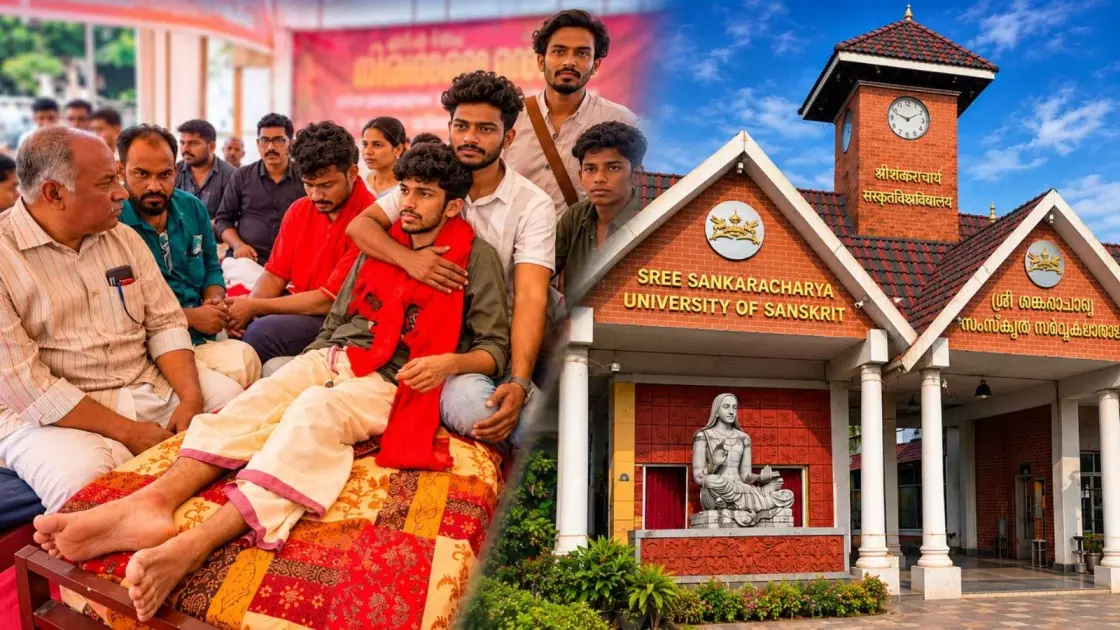
This policy debate is unfolding alongside an escalating confrontation at Sree Sankaracharya University of Sanskrit in Kalady. The agitation over the suspension of students has now reached a critical stage. Protesting students are currently on an indefinite hunger strike, which is entering its tenth day.
The dispute dates back to August 13, when students organised protests on the Kalady campus highlighting what they described as the lack of basic academic facilities, inadequate teaching staff, delays in issuing certificates and other administrative shortcomings. Their demands included better infrastructure, drinking water facilities and the filling of vacant teaching positions.
As part of the agitation, students staged a street play and held a symbolic funeral of defunct equipment and other properties in the theatre department to highlight the lack of academic facilities. The university administration, however, interpreted it as a symbolic funeral of V-C Ciza Thomas.
The university syndicate subsequently suspended 16 students on September 1, citing their alleged involvement in the incident. The suspension was initially intended to remain in force until the completion of an internal inquiry.
Unresolved campus standoff
The university administration had offered to revoke the suspensions "subject to an apology from the students and an assurance from their parents." However, the protesting students rejected these conditions, and the stand-off continues unabated.
The prolonged hunger strike has placed significant pressure on both the university administration and the state government. Although the government maintains that the matter is currently before the court, legal proceedings have failed to bring any immediate resolution to the crisis on campus.
The Kalady agitation has consequently become more than a dispute over disciplinary action. It has brought questions of student rights, institutional accountability, and the administration's handling of dissent directly into the political spotlight.
Imminent political storm
While the policy change and the campus strike represent two distinct challenges, their convergence could make higher education a particularly contentious issue for the UDF government.
Also read | Keralam college seat-hike norms spark row as Pinarayi flags ‘education for sale’ risk
The Opposition is likely to use both developments to challenge the government's higher education policy and its overall handling of universities. At the same time, student organisations are unlikely to retreat from the confrontation.
Keralam's campuses have historically been important sites of political mobilisation. With questions of commercialisation, institutional autonomy, and student rights now converging, the coming months could see a fresh wave of campus protests and political agitation.