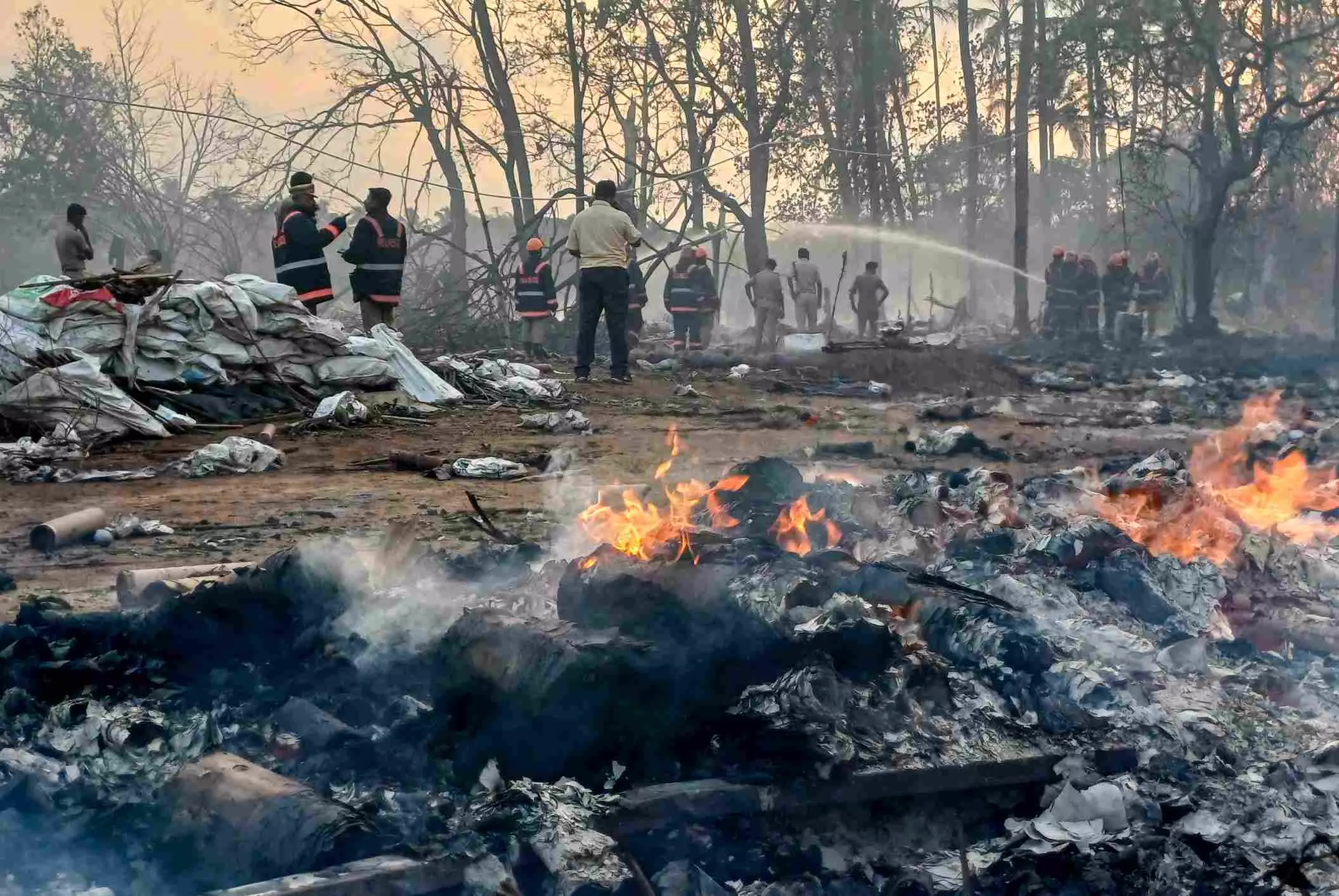
Firefighters trying to douse the blaze at a fireworks manufacturing unit at Mundathikode village, in Thrissur district, on April 21, 2026. 14 people died in the blast, 13 injured are currently undergoing treatment. Photo: PTI
Thrissur fireworks blast sparks renewed debate on Pooram festival safety
As rescue teams sift through debris and families grieve, Kerala confronts its long history of fireworks tragediesraising raising urgent questions about regulation at Pooram fests

A day after the devastating explosion at a fireworks storage unit near Thrissur, the scale of the tragedy is still unfolding, with more clarity emerging after the chaos of yesterday.
As of 11.30 am on April 22, it is assumed that at least 14 people have lost their lives. Of these, only seven bodies have been recovered intact, while the rest were found in fragmented conditions. So far, only five victims have been identified, and officials say DNA testing will be required to confirm the identities of the remaining dead, underscoring the intensity of the blast.
13 under treatment
At the site in Mundathikode, rescue teams continued their painstaking search through debris and charred remains well into the night and into the next morning. The repeated explosions that followed the initial blast had made immediate access difficult, delaying rescue efforts.
Even now, officials on the ground describe the recovery process as slow and distressing, with scattered human remains being collected for forensic examination.
Many of those injured, remain under treatment at the Thrissur Medical College Hospital and other facilities. Several are battling severe burn injuries. Health minister Veena George said, “There are 13 people currently under treatment. Two of them are on ventilator support with 98 per cent burns. Two have been discharged, and nine continue to receive care. The state government has moved to ensure that all possible medical support is made available, including the option of bringing in specialist doctors from outside Kerala if required.”
The Kerala government has ordered a judicial probe into the incident, alongside the already initiated magisterial inquiry. Financial assistance of Rs 14 lakhs has also been announced for the victims and their families, even as questions grow louder about how such a tragedy could occur despite existing regulations governing the storage and handling of explosive materials.
Also read: Kerala fireworks factory blast: SIT probe launched, cause to be determined soon, says DGP
The explosion occurred at a facility linked to the Thiruvambady devaswom, one of the two principal organisers of the iconic Thrissur Pooram. The unit was storing large quantities of explosive materials meant for both the sample fireworks display scheduled for April 24 and the main display on April 27.
Need for fireworks at Pooram
Fireworks are a central feature of Pooram, often seen as a defining element of its grandeur, drawing thousands of spectators each year.
But with lives lost yet again, calls for banning fireworks at large festivals are growing louder. The question, however, is whether prohibition alone can address the problem, or whether this is a deeper failure of regulation, enforcement, and oversight.
“This contains an unpardonable fault on the part of those who run this system. The same disaster repeats in different colours. When tragedy strikes, there is loud talk about safety laws, creating the impression that they will now be implemented. But as the memory of the dead begins to fade among their loved ones, everything is reset to the old ways”, poet PN Gopikrishnan told The Federal.
“Even if this year’s Pooram loses some of its spectacle, it can be endured. There will be another Pooram. But if any regulation is proposed on fireworks, it quickly turns into outrage and agitation, with political parties rushing to defend crackers. Anyone who reminds them of regulation becomes an enemy of the people," he added.
“This is something we in Thrissur have seen, the crowd, the frenzy, and political systems unable to rise above it. Fireworks are not a religious ritual. The disasters they cause should not be mixed with faith. This is about human rights. Why do we continue to glorify something that can turn into a bomb with a small error, that operates at decibel levels harmful to the elderly, children, and the vulnerable, when safer alternatives exist?,” asked the poet.
Subdued spectacle?
Amid this debate, festival organisers are signalling caution, raising the possibility that Thrissur Pooram may be observed with reduced spectacle this year.
Devaswom secretary K Gireesh Kumar said, “Thiruvambady Devaswom will not go ahead with fireworks this time and will abide by what the government and the people decide. This is not a situation to celebrate Pooram in a festive manner. Our focus is on supporting the families of the deceased and the injured,” said devaswom secretary K. Gireesh Kumar.
“Five members of the devaswom’s celebration committee were among those affected. We welcome any investigation. The contract for the fireworks had been given to Mundathikode Satheeshan. No banned explosives were used, and he may have taken up work for other festivals as well,” he added.
On the other side, G Suresh, representing the competing organiser Paramekavu, struck a similarly cautious note. “A decision on conducting Pooram will be taken in consultation with the district administration. We will adopt a balanced approach, considering public sentiment and tradition. We are in deep grief. All preparations had been completed, but the entire community is in mourning. This is an accident that should never have happened, and we will stand by the government’s decision.”
Also read: Elephant welfare vs temple traditions | Kerala divided over HC ruling
Kerala’s history with fireworks-related accidents suggests the latter. According to data from the Kerala State Disaster Management Authority, hundreds of such incidents have been reported in the state over the past two decades alone. The pattern is disturbingly consistent: lapses in storage norms, overcrowded venues, inadequate safety distances, untrained workers, and intense competition between festival committees.
History of firework disasters
Among the most devastating incidents was the Puttingal temple fireworks disaster of 2016, where over 110 people lost their lives after a fireworks storage unit caught fire. Earlier, in 1952, a blaze at Sabarimala killed 68 pilgrims in one of the state’s earliest recorded tragedies of this kind.
In 1990, an explosion at Poruvazhy Malanada in Kollam claimed 26 lives, while in 1987, 27 people were killed near the Thalassery Jagannath Temple when a train struck spectators gathered on railway tracks to watch fireworks.
More recently, in 2024, an explosion at Nileshwaram Veerarkavu in Kasaragod left over 150 people injured and resulted in six fatalities, once again highlighting how recurring these incidents have become. Thrissur itself has witnessed multiple accidents over the decades, including fatalities linked to Pooram-related fireworks in both 1978 and 2006.
Larger reckoning
Experts point to a familiar set of causes such as improper storage of explosive materials, failure to maintain safe distances in crowded areas, the use of inadequately trained labour, and the competitive escalation of fireworks displays between organising committees. Each incident triggers outrage, followed by discussions on stricter safety norms.
Yet, as critics argue, enforcement remains inconsistent, and memories of tragedy often fade before meaningful reforms take hold.
“There was nothing unusual this time, no rush, no lack of expertise. We were fairly relaxed, and most of the work had been completed well in advance. We were just doing the finishing touches. I was in the courtyard drying the threads when a spark occurred. It was like sunlight being focused to a single point, possibly due to the extreme heat. I barely had time to react before everything started exploding,” said Wilson, a worker who miraculously survived unhurt.
As investigations begin and accountability is sought, the tragedy has once again forced Kerala to confront a difficult question of whether a deeply-rooted cultural spectacle like fireworks be made safe through stricter regulation, or does its inherent risk demand more fundamental change?
For now, in Thrissur, the focus remains on identifying the dead, treating the injured, and supporting grieving families. But beyond the immediate aftermath lies a larger reckoning that will determine whether this tragedy becomes another entry in a long list of preventable disasters, or a turning point toward lasting reform.