



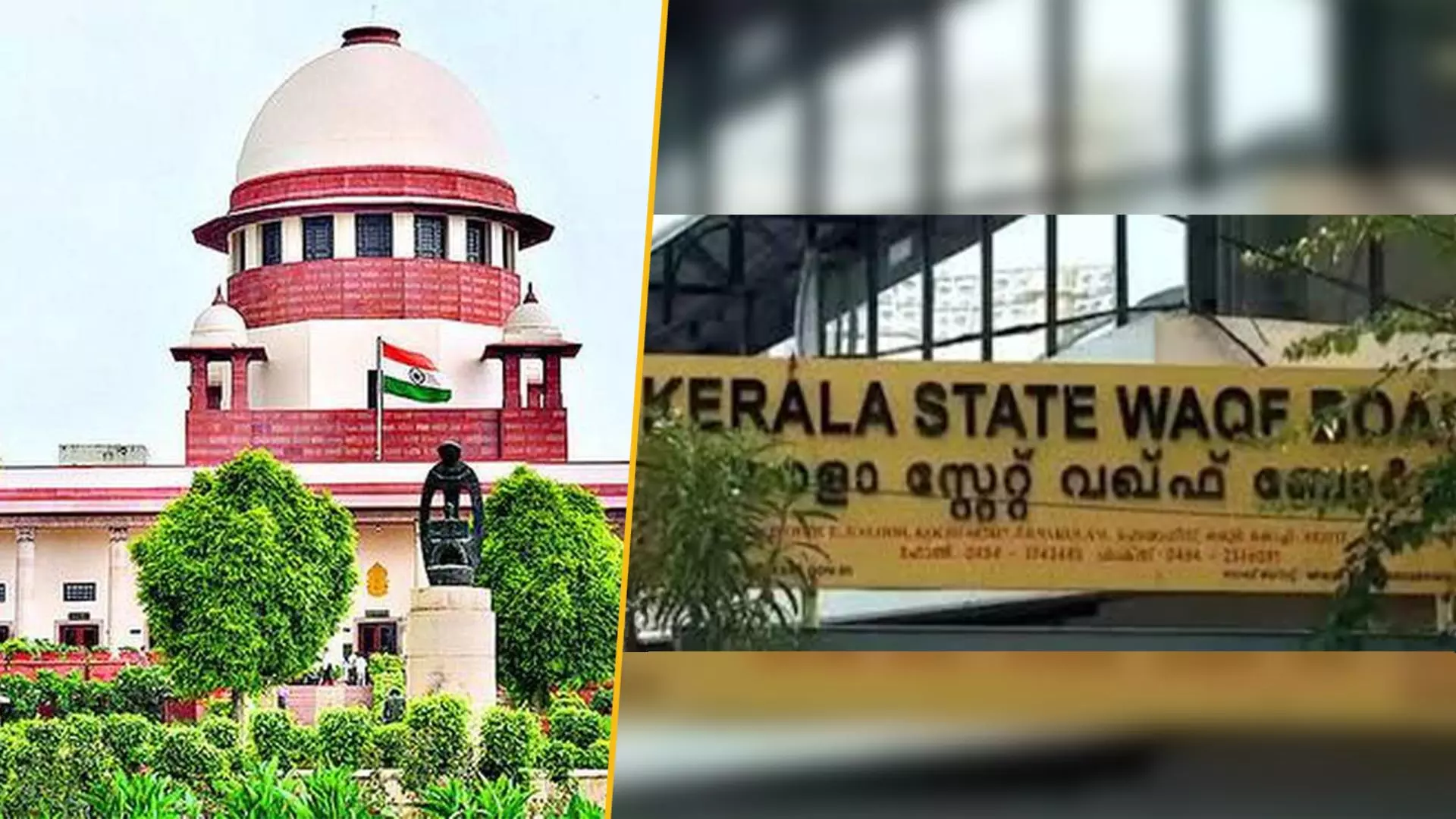
Supreme Court removed the direction placing the Waqf Board under administrative supervision but it allowed the joint or additional secretary to continue as an ex-officio member of the Board, leaving the larger constitutional questions unanswered
SC grants partial relief to Kerala Waqf Board, removes govt supervision; legal battle to continue
Apex court modifies HC order blocking direct state control over autonomous body, but leaves intense political, constitutional battle over its core composition unresolved

The Supreme Court has given partial relief to the Kerala State Waqf Board by modifying the Kerala High Court order that had placed the statutory body under the supervision of a senior government official.
While removing what it considered excessive governmental interference in the Board's day-to-day functioning, the apex court left the larger dispute over the Board's constitution unresolved, ensuring that both the legal battle and the political controversy will continue.
A three-judge Bench headed by Chief Justice of India Surya Kant modified the July 15 interim order of the Kerala high court, which had directed the Waqf Board to function under the supervision of the joint or additional secretary in charge of Waqf affairs. During the hearing, the Board argued that an autonomous statutory body could not be compelled to function under the command or control of a government officer.
Accepting the contention in part, Justice Joymalya Bagchi observed that if the high court's direction amounted to an "egregious interference" in the Board's day-to-day management, it required modification. The Supreme Court therefore removed the direction placing the Board under administrative supervision. However, it allowed the joint or additional secretary to continue as an ex-officio member of the Board.
Core of the controversy
The order provides immediate administrative relief to the Board. However, it does not settle the central issue before the courts, whether the present Kerala State Waqf Board has been constituted in accordance with Section 14 of the Waqf (Amendment) Act.
The controversy stems from amendments enacted by Parliament last year. Section 14 of the amended law requires every state Waqf Board to include two non-Muslim members. It also provides representation for different Muslim sects, including the Shia community.
The Kerala Waqf Board, constituted during the previous LDF government's tenure, does not include non-Muslim members. Nor was a representative from the Bar Council included because elections had not been held.
The Board's composition was challenged before the Kerala high court through a series of petitions, including one filed by BJP leader Shone George. Observing that there was a prima facie issue regarding the Board's constitution, the high court restrained it from taking major policy decisions or incurring substantial expenditure until the matter is decided.
Political row
While the legal dispute continues, the case has triggered an intense political confrontation between the ruling UDF and the Opposition CPI(M).
Leader of Opposition Pinarayi Vijayan welcomed the Supreme Court's decision to remove the high court's direction placing the Board under government supervision. He described the order as relief from what he called the state government's attempt to interfere in the Waqf Board's functioning.
However, he argued that the more significant issue remains the stand taken by the UDF government before the courts.
According to Pinarayi, the state government repeated before the Supreme Court the same position it had adopted before the Kerala high court, namely that the Waqf Board should be reconstituted in accordance with Section 14 of the amended Act.
He argued that this represents a complete departure from the stand taken by the previous LDF government.
Pinarayi pointed out that the LDF government had consciously decided not to appoint non-Muslim members to the Waqf Board because it had challenged the constitutional validity of the amended law before the Supreme Court. The Board was also constituted without a Bar Council representative because elections had not taken place.
No rational basis
In its intervention petition before the Supreme Court, the previous LDF government had argued that there was no rational basis for including non-Muslim members in Waqf Boards. It contended that such appointments violated Articles 14, 25 and 26 of the Constitution and warned that the amended law could reduce Muslims to a minority within a body created to administer Muslim religious endowments.
That constitutional challenge is still pending.
According to Pinarayi, implementing Section 14 before the Supreme Court decides its validity would weaken Kerala's own legal challenge. He argued that once the State itself proceeds on the assumption that the amended law must be implemented, it becomes much more difficult to argue before the apex court that the same law is unconstitutional.
Pinarayi also accused the UDF government of abandoning the resistance mounted by the previous government against the BJP-led Union government's Waqf amendments. He alleged that immediately after assuming office, the UDF changed its policy and accepted provisions that minority organisations and several Opposition parties continue to challenge.
He further claimed that the real objective was to gain political control over the Kerala Waqf Board. The previous UDF government-appointed Board was allowed to complete its term after the LDF came to power in 2016, he noted, accusing the present government of attempting political intervention in a statutory body.
Congress rebuts allegations
The Congress has rejected these allegations.
The party has described the CPI(M)'s claim that the government supported Shone George's petition as completely false. According to the Congress, the State had sought dismissal of the petitions challenging the Board's constitution and never supported the demand for appointing non-Muslim members.
However, the Opposition has sought to counter this defence by releasing portions of the government's submissions before the high court. Pinarayi argues that the documents indicate the State accepted the need to reconstitute the Board under the amended Act. According to him, the contradiction lies not in political statements but in what the government argued before the courts.
The issue has placed the Indian Union Muslim League in a particularly difficult position.
The League was among the strongest opponents of the Waqf Amendment Act in Parliament and remains one of the petitioners challenging the law before the Supreme Court. At the same time, as a key partner in the UDF government, it now has to defend a government accused of accepting implementation of provisions that the party continues to oppose nationally.
Several Muslim organisations have also expressed concern. They argue that implementing Section 14 before the Supreme Court decides the constitutional validity of the amended law and could weaken the broader legal challenge mounted against it.
Another layer to dispute
Meanwhile, the legal battle has acquired another dimension. A Shia organisation has approached the Kerala high court seeking representation on the Waqf Board under the amended law, adding another layer to an already complex dispute.
For now, the Supreme Court has relieved the Waqf Board from functioning under direct government supervision. But the larger constitutional questions remain unresolved.
Until the apex court decides the validity of the Waqf (Amendment) Act, Kerala's Waqf Board will remain at the centre of a legal and political battle involving constitutional rights, minority autonomy and coalition politics.
Next Story