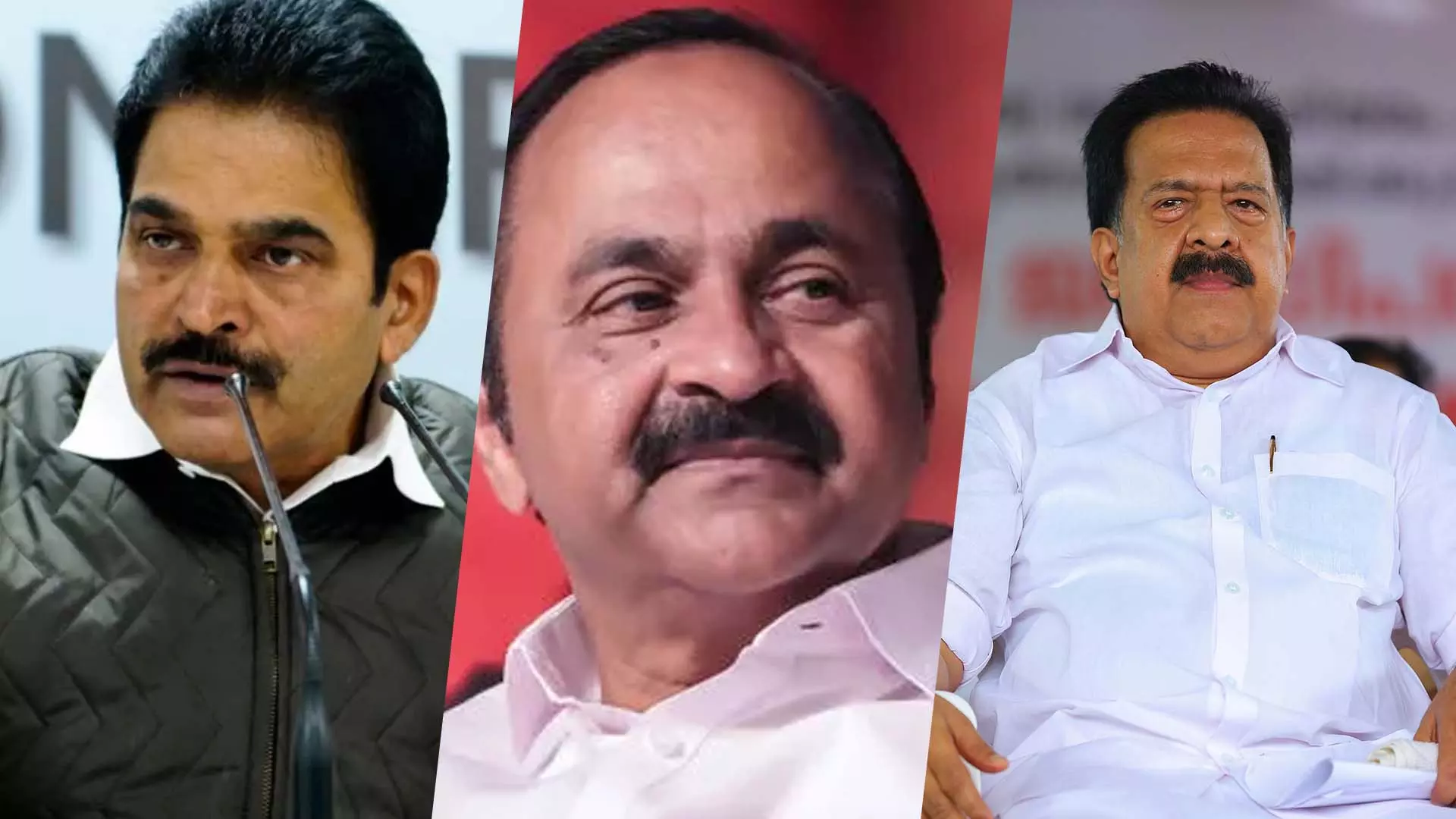
KC Venugopal, VD Satheesan and Ramesh Chennithala (File pictures)
Kerala CM: Why is Congress struggling to make a decision?
Days after the Congress-led UDF’s massive victory in Kerala, there is still no clarity on who will become the next Chief Minister.

It has been 10 days since the United Democratic Front (UDF) secured a historic mandate in the 2026 Kerala Assembly elections, yet the Congress party — which won 63 seats — remains locked in a selection process for the next Chief Minister. Following a decade of Left rule, the UDF achieved its best-ever tally, winning 102 seats in the 140-member Assembly. Despite this resounding victory, the party has faced a protracted internal stalemate.
The Federal's Political Editor, Puneet Nicholas Yadav, Associate Editor, Rajeev Ramachandran and senior journalist M Sarita Verma discuss the escalating leadership tussle of the Congress-led UDF in Kerala.
''It looks like they are finding it more difficult to handle a major victory than a crushing defeat,” senior journalist Sarita Verma said, as the Congress continued its failure to announce a Chief Minister for Kerala even 10 days after the election results.
What was expected to be a smooth post-election transition has instead turned into a public contest between competing power centres, exposing deep factional divides within the party and its allies.
Delayed decision
Congress leaders in Kerala and Delhi had anticipated a final announcement after a crucial meeting between party president Mallikarjun Kharge and Leader of Opposition Rahul Gandhi. However, no decision emerged, extending the suspense over the Chief Minister’s post.
Also Read: Kerala CM post: Protests in Wayanad against Rahul, Priyanka
Sarita Verma said the party appeared unprepared for victory. “It looks as if they were not prepared for such a mandate. They are now facing an agony of abundance,” she said, pointing to what she described as a lack of internal consensus even after a strong electoral performance.
She added that the delay itself has become a record of sorts, with 10 days passing without clarity on who will lead the government.
Three-way contest
At the centre of the leadership battle are three names: VD Satheesan, Ramesh Chennithala, and KC Venugopal.
Rajeev Ramachandran noted that while factionalism is not new in Kerala Congress politics, the current situation is more complex. “What we are seeing now is not part of that tradition. It has multiple dimensions,” he said, pointing to the rise of social media mobilisation, internal surveys, and visible public displays of support.
He added that the traditional structure of group politics has evolved into a more fragmented and volatile system, especially after organisational changes at the national level.
IUML influence
A major factor influencing the power balance is the stance of the Indian Union Muslim League (IUML), a key ally in the UDF. Rajeev Ramachandran said the party’s position has significantly impacted the negotiations, as it has publicly leaned towards supporting V. D. Satheesan at different points.
Also Read: In Kerala CM stalemate, a familiar Congress predicament, and a test for Rahul Gandhi
He noted that internal discussions in Delhi suggested shifting support dynamics, with some reports indicating Rahul Gandhi’s preference for Venugopal, while a significant number of MLAs appeared divided.
The IUML’s intervention, he said, has added another layer of complexity to an already tense situation.
Social media pressure
Sarita Verma highlighted how modern political mobilisation has changed internal party dynamics. Unlike earlier factional battles, today’s conflict is being shaped heavily by social media campaigns, posters, and public mobilisation.
She pointed to aggressive campaigning by supporters of V. D. Satheesan, including flex boards and online narratives that have amplified pressure on the party leadership.
“Whatever happens on the street is now reflected instantly on social media,” she said, adding that the high command appears disconnected from these ground realities.
MLA equations
According to discussions cited in the panel, around 40–43 MLAs are believed to be supporting K. C. Venugopal, although no official confirmation has been made.
Puneet Nicholas Yadav noted that Venugopal’s proximity to Rahul Gandhi and his organisational role in Delhi have significantly strengthened his position, even though he has not been directly involved in Kerala’s on-ground politics in recent years.
Sarita Verma, however, suggested that this support could be influenced by institutional proximity rather than independent political strength, pointing to concerns among MLAs about future political equations.
Power imbalance
The discussion also touched on how internal communication within the Congress has shaped perceptions of loyalty. Sarita Verma said MLAs were aware that their feedback during internal consultations could be relayed directly to the central leadership, influencing their choices.
This, she suggested, created an environment where political positioning is closely tied to perceptions of future power rather than purely ideological alignment.
Rajeev Ramachandran added that Venugopal’s organisational influence and ability to manage resources have also played a role in shaping MLA support.
Leadership uncertainty
The panel agreed that the prolonged delay has created uncertainty not just about the Chief Minister’s selection, but also about governance stability in Kerala.
Rajeev Ramachandran warned that whichever candidate is eventually chosen will face internal resistance and factional pressures. “Whoever comes to power is not going to have a walk in the park,” he said.
He added that V. D. Satheesan is attempting to build a mass leadership image, while Venugopal would face greater challenges due to his central positioning and lack of grassroots mobilisation in the state.
As the Congress continues to delay a final decision, the leadership vacuum has exposed deep fissures within the party and its alliance structure in Kerala.
The content above has been transcribed from video using a fine-tuned AI model. To ensure accuracy, quality, and editorial integrity, we employ a Human-In-The-Loop (HITL) process. While AI assists in creating the initial draft, our experienced editorial team carefully reviews, edits, and refines the content before publication. At The Federal, we combine the efficiency of AI with the expertise of human editors to deliver reliable and insightful journalism.