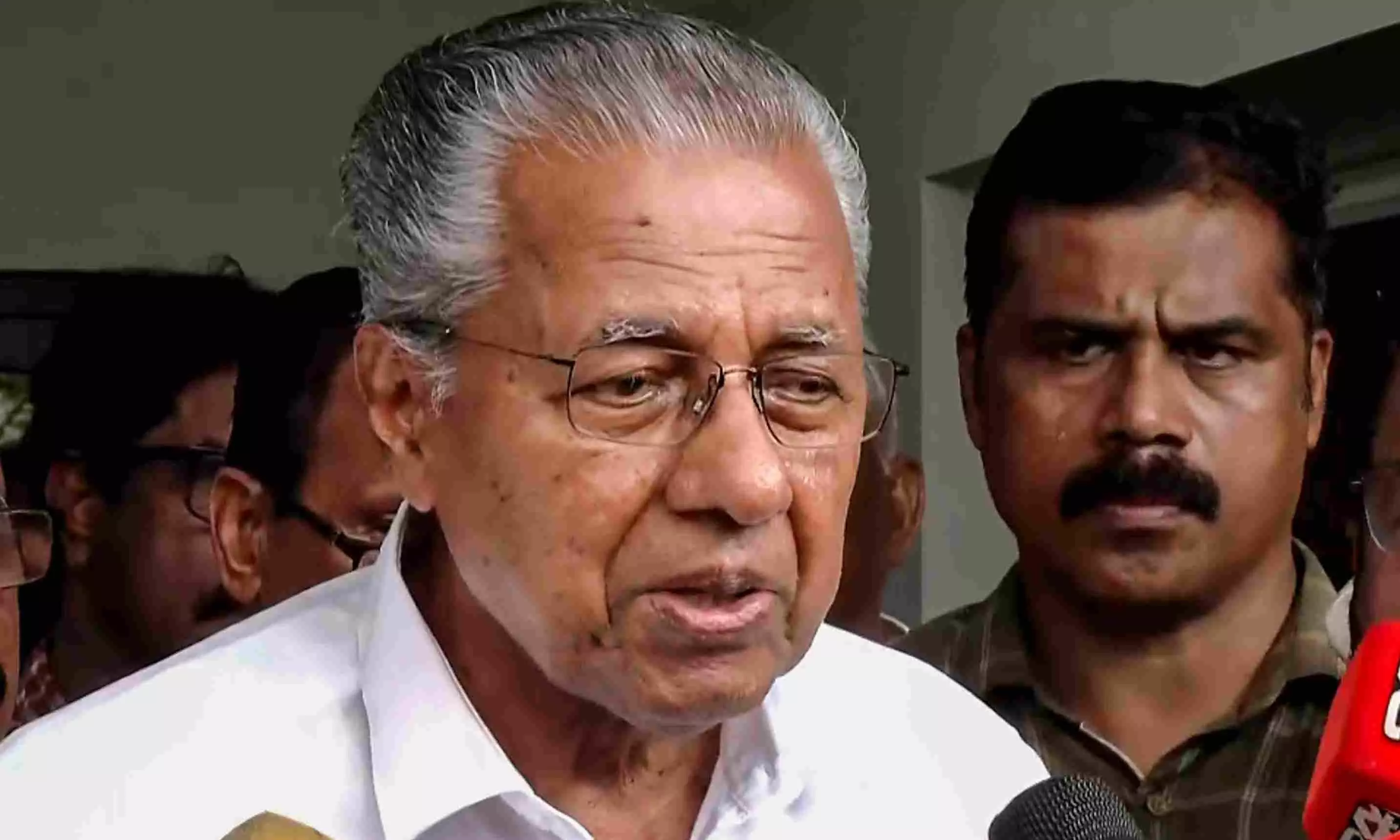
Former Kerala Chief Minister Pinarayi Vijayan speaks to the media after the Enforcement Directorate (ED) conducts a raid at his residence as part of ED's investigation in the CMRL money laundering case, in Thiruvananthapuram. Photo: PTI
How the ED raid saved Pinarayi Vijayan from internal party dissent
The ED crackdown halts CPI(M)’s post-defeat introspection, triggering an organic groundswell of support that unites CPI(M) cadre

The Enforcement Directorate’s raid on Pinarayi Vijayan has triggered an unexpected political shift in Kerala, strengthening the very leadership it appeared to target.
The controversy has unfolded at a vulnerable time for the Communist Party of India (Marxist).
After a significant electoral setback, the party had entered a phase of uneasy introspection. District and area committee meetings have become unusually candid. In this meetings, questions were raised about leadership style, centralisation of power and political direction. There was visible strain within the organisation, and the leadership was on the defensive, navigating a terrain marked by electoral loss and internal criticism.
The growing internal dissent process was abruptly interrupted. The first signs of change came not from the leadership, but from the ground.
Collective dissent
In Pandyalamukku, near Pinarayi Vijayan’s residence, people began gathering early in the morning as news of the raid broke. There had been no call from the party or a directive. Party workers stood in small groups, and women members were present in large numbers. Bhaskaran, a CPI(M) sympathiser from Ancharakkandy in Kannur, was among the first to arrive.
“I came on my own. Nobody asked me to come,” he said. “This is an attempt to finish off Pinarayi Vijayan and the party. At a time when we are already politically weak, we have to defend him and defend ourselves. We have seen worse. This is nothing compared to the Emergency.”
His words captured the mood that spread quickly across northern Kerala.
In Kannur and Kozhikode, the mobilisation was organic. The cadre did not wait for organisational orders. The response was instinctive, due to a looming sense of political threat.
Left Democratic Front (LDF) activists vandalise the vehicle carrying Enforcement Directorate (ED) officials outside former Kerala CM Pinarayi Vijayan's residence after a raid conducted at Vijayan's residence as part of ED's investigation in the CMRL money laundering case, in Thiruvananthapuram on May 27. Photo: PTI
In Thiruvananthapuram, the capital, the mobilisation followed a more structured pattern, but the sentiment remained the same. What had been a period of internal questioning turned, almost overnight, into a moment of collective defence.
What raid yielded
The timing of the raid also came under scrutiny. It came when Kerala Chief Minister V D Satheesan was in Delhi, meeting the Prime Minister and the Union Home Minister. CPI(M) leaders pointed to this coincidence, suggesting that the broader context could not be ignored. The raid was not seen as a routine investigative step, but it appeared to be more of a politically loaded action.
There were no major seizures beyond bank statements linked to Veena T. More significantly, a written acknowledgement was given that no incriminating documents or devices were recovered from key locations in Kozhikode and Kannur. At the same time, this did not close the matter. The absence of immediate findings does not place Veena T beyond scrutiny, nor does it end the investigation.
“During the search, several incriminating records, accounts, digital evidence, investments and bank fixed deposits were found. ED has frozen approximately Rs 18.36 crore across around 242 accounts. The evidence is under analysis,” read the ED press release after the raid.
Though several media reports claimed that Veena T had as much as ₹18.6 crore in frozen accounts, ED sources clarified that the figure pertains to multiple accounts linked to various persons of interest. These include one personal HDFC account of Veena T, which has a balance of around ₹1.5 lakh.
Pinarayi's position strengthens
However, many see that, instead of weakening Pinarayi Vijayan, the raid consolidated his position in the party.
The CPI (M) quickly framed the action as political targeting. The cadre who had been critical of the leadership days earlier now rallied behind it. The shift was visible on the streets and within the organisation.
Pinarayi Vijayan reinforced that narrative. He remarked that Rahul Gandhi must be happy now, recalling his earlier questions about why the ED had not acted against him.
Congress silent
Support also emerged from outside Kerala. Leaders across the Opposition spectrum criticised the raid, questioning the use of central agencies and backing Vijayan. The issue was quickly absorbed into a larger national conversation.
The Congress’s silence was striking. Apart from Health Minister K Muraleedharan, who raised questions about the ED's credibility, the party largely stayed quiet. Despite repeated questions from the media, V D Satheesan did not take a clear position. This hesitation became more striking as details from the ED’s own communication indicated that the case might not be limited to Veena T alone.
References from a seized diary linked to CMRL suggested that financial transactions could involve figures across political lines, including leaders associated with the UDF such as Ramesh Chennithala and P K Kunhalikutty.
A senior Congress leader acknowledged the uncertainty. “The ED’s intentions cannot be trusted. I do not see any rationale in the raid as far as Veena’s involvement is concerned. They already have all the documents against her, I suppose. So this raid must be something else, a testing of waters. They may intend to come after the UDF as well. It will not be a surprise if they go after Chennithala or Kunhalikutty,” he said.
CPI (M) unity
For the CPIM cadre, the raid was seen as an attack rather than an investigation. The lack of strong evidence reinforced that perception. The written confirmation of no incriminating findings became a point of assertion, strengthening the belief that the action was driven more by politics than proof.
The CPI(M) leadership, which had been managing internal unease, now found itself leading a united response.
In a matter of days, the CPI(M) moved from introspection to mobilisation. The internal debate that had begun after the electoral defeat was pushed aside by a stronger, more immediate political impulse.
The raid became the trigger for that shift. For Pinarayi Vijayan, a moment of vulnerability has turned into one of consolidation. For the CPI(M), a phase of internal strain has been replaced, at least temporarily, by unity.