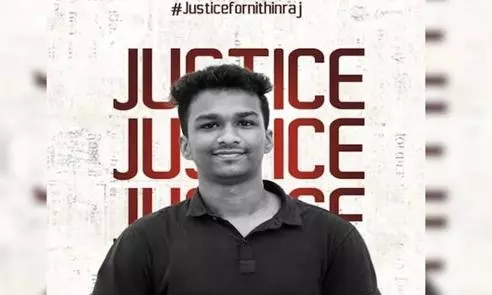
How caste and class prejudice probably led to Kannur student Nithin Raj's death
After first dismissing Nithin Raj's death as 'suicide', allegations of caste abuse has surfaced sparking a new political awakening in Anjarakandy Dental College

Six days after the death of first-year BDS student, Nithin Raj in Kerala, the Anjarakandy Kannur Dental College management dismissed faculty member Dr MK Ram, even as questions continued to mount over how the 19-year-old lost his life on the campus on April 10.
Found critically injured around 1.30 pm after a fall from a height within the college premises, he was rushed to the medical college hospital and declared brought dead. Initially, his death was recorded as a suspected suicide but now this is being widely contested.
The campus is simmering with student protests.
An institution that had, until now, kept student politics outside its gates is witnessing an abrupt shift. Groups of students gathered across the campus, raising slogans and holding discussions that were once confined to private conversations. An Student's Federation of India (SFI) unit has begun to take shape in the college, signalling a collective assertion in a space where organised student presence had been largely absent.
Also read: Loan app booked for extortion in BDS student suicide case in Kannur
In the days following his death, Nithin Raj’s family, based in Thiruvananthapuram, alleged that he had been subjected to sustained harassment. They spoke of caste-based discrimination, colour-based insults, and repeated humiliation by faculty and management of the college.
According to the family, these were not isolated incidents but part of a pattern, and complaints raised earlier had not led to any meaningful action.
Verbal abuse, casteist remarks
Two faculty members, Dr MK Ram and Dr Sangeetha Nambiar, have been named in the FIR and are reported to have been absconding since April 10.
Dr MK Ram, head of the department of oral pathology, who was initially suspended and later dismissed, had been accused by multiple students of similar behaviour. Allegations include verbal abuse and remarks targeting caste, class, and skin colour. Some students describe a climate where humiliation was routine and where raising concerns came with the risk of academic consequences.
“Dr Ram has a tendency to look down on students and ridicule them over their appearance, and even their religion and caste. He would often question our beliefs, and also body-shame students. I have been called ‘fatty’ many times. It was humiliating,” said a third-year girl student.
She added that he would mock students who wore inexpensive sandals by calling them “colonies,” and refer to very thin students as “cancer patients".
“Nobody dares call him out because he threatens us with internal marks and attendance. For the first two days after Nithin’s death, none of us even had the confidence to visit his home. You know, even a dog gets a funeral, but we couldn’t bid our friend a proper goodbye," said another girl who broke down in front of TV cameras on the third day.
An audio message, believed to be Nithin’s, has added to the scrutiny. In the recording, the speaker describes being insulted by a teacher, his mother being mocked, and threats being issued. He recounts repeated humiliation in class and punitive marking, describing incidents that appear to have unfolded over time rather than in isolation.
Students enraged
As these details emerged, the atmosphere within the college changed.
Students who had largely remained silent began speaking out, first in small groups and then in larger gatherings. The protests have since grown, with demands for accountability and assurances of safety. The formation of a student unit has given these demands a more organised shape.
Also read: Caste abuse in focus as Kerala student dies on campus; Shashi Tharoor reacts
Outside the campus, Dalit organisations have described Nithin Raj’s death as an institutional murder, arguing that responsibility extends beyond individuals to the systems that allowed such alleged behaviour to continue.
They have also said that the state cannot distance itself from the incident. Even though the college is privately managed, they argue that regulatory oversight rests with government authorities, who must be held accountable if failures are established.
Caste prejudice allegations
“The college management that is protecting these accused has committed a serious offence. There is also reason to suspect that the principal is a co-accused in Nithin Raj's killing. Despite the emergence of crucial evidence regarding Dr Ram’s alleged criminal involvement, the reluctance of police officials to arrest him and the other accused reflects caste prejudice,” said TS Shyamkumar, academic and Dalit rights activist.
“When Dalits are named as accused, even without committing a crime, the Kerala Police act swiftly to arrest them. But when members of the upper-caste and affluent sections are accused, there is hesitation. This stems from a caste bias that sees Dalits and marginalised communities as naturally subject to violence," he said adding that Nithin Raj’s killing, therefore, is not an isolated incident.
Further, he continued, "It points to an education system that continues to function as a caste stronghold within higher education institutions, and that system, they contend, bears the real responsibility for his death,” added Shyamkumar.
Online loan pressure
The police investigation has also come under scrutiny.
The Chakkarakkal police have recorded statements from relatives and from those who found Nithin after the fall, with a more detailed statement from the family.
However, concerns have been raised about the pace of the investigation, particularly after the investigating officer indicated that a loan taken by Nithin in the name of a teacher of the college, at a high rate of interest is also being probed. Nikita, Nithin Raj’s sister, told reporters that the family would not allow the investigation into his death to be diverted towards a loan taken through a mobile app. She said the loan had no connection to any teacher and did not involve a large amount.
“The loan was taken through an app, it was not in the name of any teacher, and it was not a large amount. Nithin had taken around Rs 14,000 and had already repaid Rs 1,000, but they were pressurising him to pay nearly Rs 18,000 within a month. Recovery agents did make repeated calls, even to a teacher, but Nithin himself contacted them and asked them not to disturb others. This cannot be projected as the reason for his death,” she said.
Call for structural reform
For many students, the issue has moved beyond a single incident. It has opened up a broader conversation about the conditions within the institution, about how complaints are handled, and about whether students feel secure to raise concerns. On April 14, while marking Ambedkar Jayanthi, even Chief Minister Pinarayi Vijayan described the death as extremely painful and said that a progressive Kerala would not forgive those who drove Nithin Raj to it.
The statement reflected the growing public sentiment, even as it raised expectations of further action.
The discussion has also revived calls for structural reform. There is renewed attention on the demand for a law often referred to as the Rohith Act, named after Rohith Vemula, aimed at addressing caste-based discrimination in higher education institutions through enforceable accountability mechanisms.
“It was only after mothers like Radhika Vemula approached the courts that the UGC brought changes within the equity guidelines, revising the 2015 framework and introducing new regulations in 2026. But look at what followed. In the name of protests by a small group of students, often aligned with Brahmanical and Hindutva ideologies, there was a rollback from within those very regulations, with even the Supreme Court stepping in with a stay,” said Dinu Veyil, researcher and Dalit rights activist.
“Mothers who had to go all the way to the Supreme Court to ensure that no other child loses their life fought to secure those protections. Yet, the logic that prevails today is that those very safeguards can be undone if a small, privileged group decides to push for it,” argued Dinu.
Nithin Raj had arrived at the college less than a year ago, one among many students filled with expectation and hope, as he embarked on his journey towards a professional education.
What followed in the months after, and what led to the moment he was found injured on campus, is now being pieced together through testimonies and investigation. And, it does point towards many uneasy truths, including caste and class discrimination.