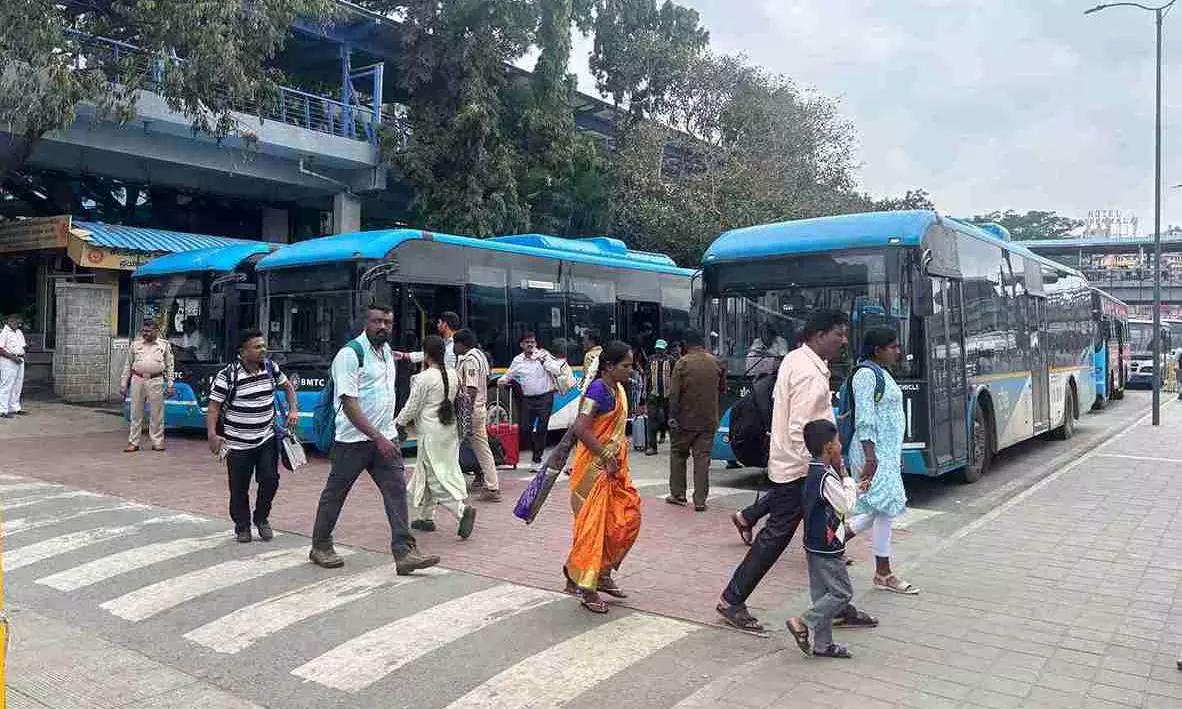
With bus rides costlier than Metro, Karnataka women question price of ‘free’ travel
Karnataka’s bus fare hike prompts even women beneficiaries to question Shakti scheme, as families grapple with rising commuting costs and crowded buses

While Karnataka’s flagship Shakti scheme continues to offer women zero-fare bus travel, the state government’s latest fare hike has triggered an unexpected ground reaction: Women commuters themselves are beginning to question the sustainability of the free ride.
Across bus terminals in Bengaluru, the sharp revision in Bangalore Metropolitan Transport Corporation (BMTC) and Karnataka State Road Transport Corporation (KSRTC) tickets, which has now made taking a bus costlier than riding the Namma Metro on several corridors, is stirring unease among families where men, boys, and other paying passengers are left shouldering a double financial burden.
For Roopa, a commuter from Hassan, the welfare math has clearly tipped over. “The government must stop free travel for women. It has created a lot of problems on the ground, and the buses are completely packed,” she told The Federal. “Men are bearing the brunt of these steep price hikes. This scheme will last only as long as this government remains in power, and eventually everyone will have to pay for their tickets.”
Family budgets feel the pinch
The policy contrast is felt most acutely by lower- and middle-income homes, where a woman’s free ride is often offset by the mounting travel expenses of male earning members.
Also read: 9 states that offer free bus travel to women: Eligibility and documents required
“I had no clue the fares had gone up because I travel using my Aadhar card,” said Sundari, an everyday commuter. “I realised it only when a conductor asked a passenger for Rs 10 instead of Rs 6. The one-day pass has touched Rs 100 now. My son takes multiple buses to reach his workplace, and this price hike has become a heavy burden on our family expenses.”
Yet, for thousands of working-class families across the city, abandoning the bus for cheaper rail transit is not an immediate option. “Metro fares are cheaper now, but my father and grandfather still believe buses are much safer and more reliable,” said Archana, a daily commuter. “They have been commuting by bus for decades. Even though the bus takes longer and costs more than the Metro today, our family stays with the bus out of sheer habit and comfort.”
Under the revised structure, BMTC base fares have jumped from Rs 6 to Rs 10, with upper-distance tickets touching Rs 45.
Rails cheaper than roads
Under the revised structure, BMTC base fares have jumped from Rs 6 to Rs 10, with upper-distance tickets touching Rs 45. Outstation students and office-goers speaking to The Federal pointed out that the road network has suddenly become a premium commute.
“When I last travelled from Shantinagar to Majestic, it was Rs 12. Now it has more than doubled to Rs 25,” said Hansika, a Bengaluru college student from Tamil Nadu. “As students, we run on tight monthly allowances. We are actively looking at switching to the Metro because short hops start at just Rs 10.”
State transport authorities have defended the steep revision, arguing that the hike was inevitable due to escalating fuel costs and mounting operational overheads incurred by the road transport corporations. However, daily commuters point out that the financial hit landed without warning.
Also read: Crorepati MLAs, free cars: Why Vijay govt's Rs 100-crore move has TN baffled
“Looking at fuel charges, an increase was expected, but for daily commuters, it is an immediate shock that eats into our monthly budget,” said Floyd, an everyday commuter. “I would switch to the Metro wherever lines exist, but large parts of Bengaluru still lack rail links, leaving us no choice but to pay up.”
Conductors caught in the middle
At bus bays across the city, ticketing staff find themselves answering routine questions and explaining decisions they did not make. Speaking to The Federal, Venkatswamy, a KSRTC conductor, noted the passenger confusion: “Fuel prices rose gradually over months, but ticket prices jumped overnight, creating immediate questions from passengers. We have to keep telling them that fares are fixed by the government, not the crew.”
BMTC conductor T Sunil echoed the sentiment, observing that commuters are largely resigned to the revision: “The hike was all over the news, so people knew what was coming. They are unhappy, but they know we have no say in the policy.”
As ticket machines spit out costlier slips each day, Karnataka’s public transport debate is no longer just about diesel costs and balance sheets. It is about an everyday mobility divide where free rides for one half of the family cannot mask the pinching reality of the other.
(This article was originally published in The Federal Karnataka.)