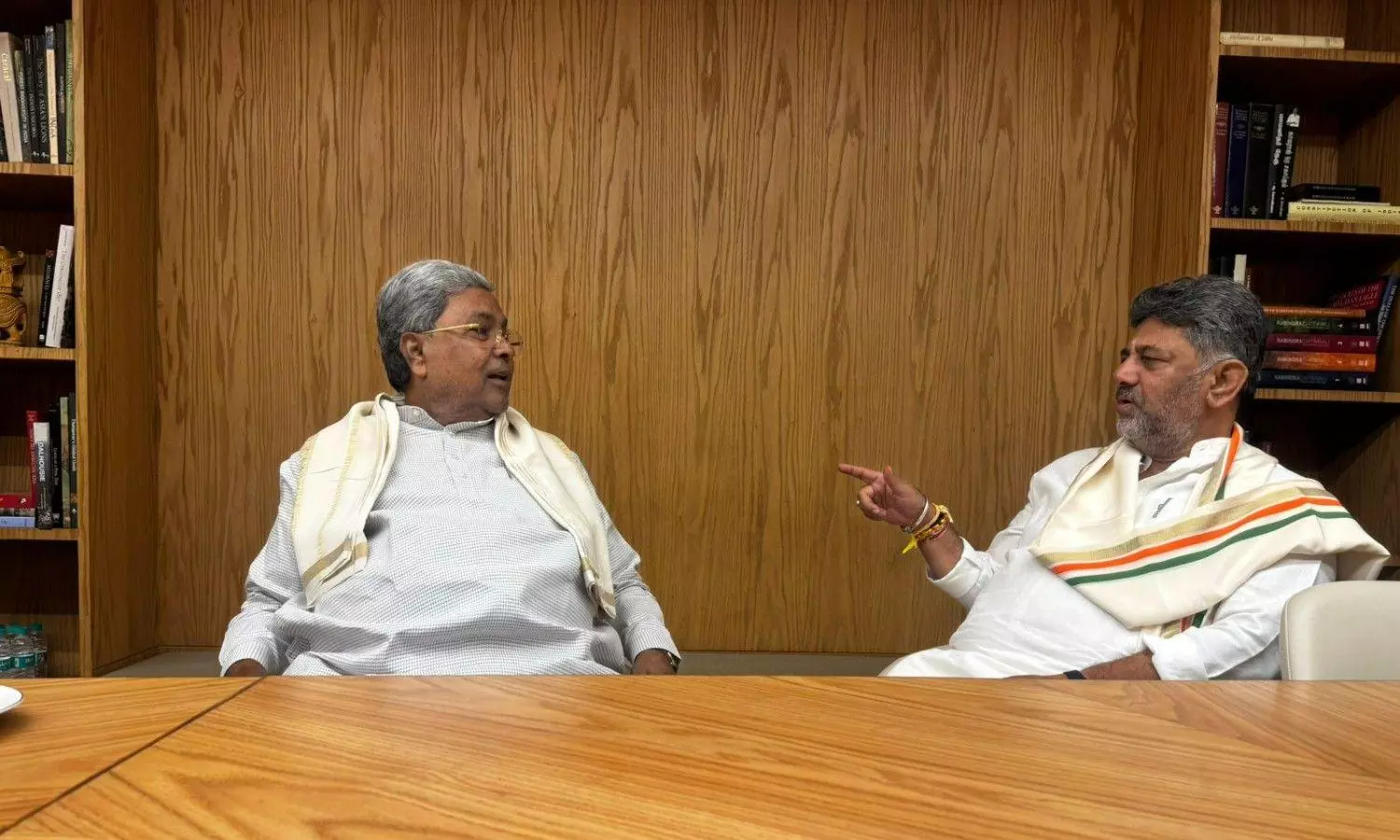
Karnataka Chief Minister Siddaramaiah (left) and his Deputy CM DK Shivakumar during a meeting in Delhi on Tuesday (May 26).
Why Congress chose not to change Karnataka CM Siddaramaiah, for now
The Congress' national leadership is understood to be weighing multiple political calculations before taking any decision on leadership change

The Congress high command finds itself in a leadership dilemma in Karnataka. The party is balancing pressure over a possible change in Chief Minister amid concerns about protecting the party’s AHINDA social coalition, addressing emerging SIR-related electoral challenges, and ensuring administrative stability ahead of the 2028 Assembly elections.
Congress sources indicate that if Chief Minister Siddaramaiah retains his position amid speculations, AHINDA leadership considerations and concerns over Special Intensive Revision (SIR) of electoral rolls-related challenges to the party’s voter base in Karnataka could emerge as among the key factors behind the high command’s decision.
Marathon meetings in Delhi
Tuesday’s (May 26) marathon meetings in Delhi appeared to end not with a full stop, but with a comma — leaving Congress workers and political observers continuing to speculate over Karnataka’s future power-sharing arrangement.
Also read: No discussion on Karnataka CM change, says Congress after big meeting
The Congress's national leadership is understood to be weighing multiple political calculations before taking any decision on leadership change, including concerns over retaining the AHINDA vote base — minorities, backward classes and Dalits — safeguarding welfare-driven voter support, and countering emerging political challenges from the BJP.
For nearly a year, Deputy Chief Minister DK Shivakumar’s repeated Delhi visits and lobbying efforts for the Chief Minister’s post had kept leadership discussions alive. However, the latest round of meetings has strengthened Siddaramaiah’s position, indicating that the party leadership is unwilling to risk political uncertainty at a time when it is preparing for a tough electoral battle in 2028.
Congress leaders are understood to have conveyed to both Siddaramaiah and Shivakumar that their immediate responsibility is ensuring the party returns to power again in Karnataka despite growing political challenges.
Why Congress prefers Siddaramaiah
Party sources indicate Siddaramaiah’s administrative experience, financial management of guarantee schemes, ability to politically counter the Centre on issues involving southern states, and his role in holding together the AHINDA coalition have become major factors behind the high command’s cautious approach.
Also read: Siddaramaiah meets Congress leaders in Delhi
A leadership transition is also being viewed through Congress’ national social justice positioning, with Siddaramaiah remaining one of the party’s tallest OBC leaders and an important face of Rahul Gandhi’s emphasis on backward-class representation.
Amid intense discussions over a possible leadership change in Karnataka, Siddaramaiah and Shivakumar were urgently called to Delhi for crucial meetings with Congress high command leaders, including party’s national president Mallikarjun Kharge, Rahul, KC Venugopal and Randeep Surjewala.
Focus on Rajya Sabha polls
The closed-door discussions were held under strict secrecy, with efforts made to prevent information leaks. Rahul separately met Siddaramaiah, while no separate meeting was held with Shivakumar. Before the meeting, both Karnataka leaders interacted publicly to signal unity.
Sources indicate leadership change is unlikely now due to upcoming Rajya Sabha and Legislative Council elections, where MLA unity remains crucial.
However, a senior minister in the Siddaramaiah government told The Federal that discussions in Delhi were primarily focused on SIR-related concerns, Rajya Sabha elections, Cabinet reshuffle plans and strengthening the Cabinet to prepare the Congress for the 2028 Assembly elections under Siddaramaiah’s leadership.
According to the minister, the party high command is currently not in a mood to change the leadership at this juncture.
Also, the Muslim community in Karnataka, which currently does not have a strong Muslim leadership face within the state Congress but has firmly backed Siddaramaiah, is not seen shifting its support to another leader like Shivakumar at this stage. This factor, along with concerns over SIR-related challenges, has also strengthened Siddaramaiah’s position, the minister added.
No OBC leaders other than Siddaramaiah
The Congress high command’s dilemma is also linked to its larger social coalition strategy. Party leaders are understood to be weighing whether changing Siddaramaiah and handing power to Shivakumar could weaken the AHINDA formula — minorities, backward classes and Dalits — that has remained central to Congress politics in Karnataka.
Congress leaders are aware that in several Congress-ruled states, leadership positions are largely held by upper-caste leaders, making Siddaramaiah’s position politically significant as one of the party’s tallest OBC faces nationally. A leadership change, party insiders believe, could raise questions over Congress’ social justice positioning and Rahul’s repeated emphasis on strengthening OBC representation within the party structure.
Political circles have also discussed another possible scenario — if Siddaramaiah were eventually replaced, senior Dalit Congress leader Dr. G Parameshwara could emerge as a consensus option to preserve the AHINDA social balance. However, internal questions remain over whether such an arrangement could maintain organisational stability and leadership control within the state unit while balancing the influence of powerful leaders like Shivakumar.
Consolidation of Vokkaliga votes
Congress strategists are also evaluating electoral arithmetic beyond AHINDA. While Siddaramaiah is viewed within the party as capable of consolidating backward-class, minority and Dalit support, questions remain whether Shivakumar can independently bring a decisive consolidation of Vokkaliga votes towards Congress in the Old Mysuru region, where the community holds political influence and where the JD(S), led by former Prime Minister HD Deve Gowda and his son and Union Minister HD Kumaraswamy, continues to remain a significant political force.
The Congress leadership is also said to be worried about electoral vulnerabilities arising from SIR-related concerns and voter-base consolidation. Internal assessments reportedly suggest nearly 30 Congress MLAs won narrowly in 2023 with margins between 2,000 and 5,000 votes, making voter retention crucial before 2028.
The party is simultaneously focused on converting welfare guarantees into long-term political support. Schemes such as free bus travel for women and direct cash transfers are being viewed as instruments to strengthen Congress’ grassroots voter base.
No changes in KPCC
Congress strategists are also aware that, despite leadership challenges within the BJP’s Karnataka unit, the BJP central leadership has already begun preparations for 2028. Recent signals from BJP leadership have reinforced the message that Karnataka remains a key southern battleground.
While backing Siddaramaiah, the Congress is also not willing to weaken Shivakumar’s role. No changes are expected in the Karnataka Pradesh Congress Committee (KPCC) leadership structure, with the party leadership viewing both Siddaramaiah and Shivakumar as critical to preparing ministers, MLAs and party workers for the next Assembly election.
Meanwhile, internal discussions are also understood to be taking place regarding senior Congress leader BK Hariprasad, with possible responsibilities being considered in the run-up to future organisational and Cabinet decisions.