Siddaramaiah: The shepherd who rewrote Karnataka's political history
From a poor village boy to Karnataka's most consequential CM, his story is one of grit and socialist fire, peppered with controversies and scam charges

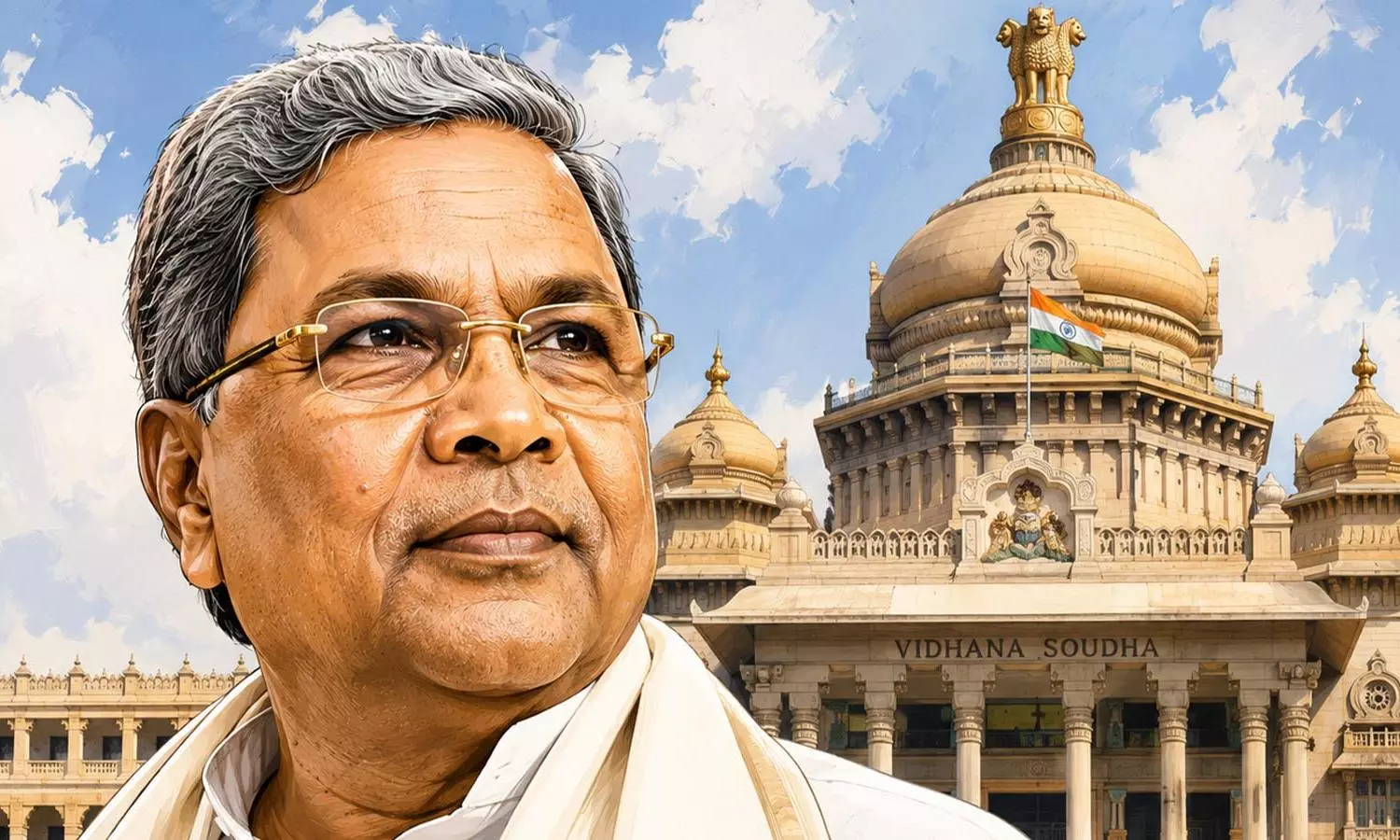
Many leaders have shaped the political landscape of Karnataka, but only few have managed to dramatically change the course of an entire state.
One of them happens to be the veteran politician Siddaramaiah, who rose from the depths of poverty to reach the topmost chair in the state. His journey is not merely that of a successful politician; it is the personal triumph of a village shepherd boy who dared to stand against an entrenched system.
Even in a fiercely polarised political arena, Siddaramaiah’s growth as a statesman has transcended party lines, earning him deep respect from ideological rivals in both the BJP and JD(S).
As Siddaramaiah steps down from the CM post, handing over the baton to his deputy DK Shivakumar, here is a look at his political legacy.
Childhood days
Siddaramaiah was born in Siddaramanahundi, a small village in Varuna Hobli of Mysore district. His childhood was not easy, and he did not step inside the portals of a school until the age of ten.
As a young boy, he is said to have wandered through the dry lands of Mysore, herding a flock of sheep with a stick in hand. He may not have known he would later write the fate of crores of people, but a strong sense of determination to achieve something was always there.
Young Sidda joined school a little late in his life, but he soon mastered it. Realising that education is not just a way of life but a weapon against exploitation, the ambitious village boy completed his law degree in Mysuru and donned the lawyer’s garb.
Socialist ideals
When Siddaramaiah entered politics, he had no money and no support from a large caste. But what fired him was the ideology of socialism; he believed that even the most marginalised person in society should get justice.
The ideologies of Dr Ram Manohar Lohia form the basis of his politics. His association with farmer leaders, socialist leaders, and writers like MD Nanjundaswamy, Prof Ramdas, and Devanur Mahadeva made Siddaramaiah a fierce fighter. His attire was never complete without a white towel draped on his shoulders.
Also read: Karnataka's power shift: Will Siddaramaiah go quietly or fight back? | AI With Sanket
Siddaramaiah, who was trained under the guidance of politicians like Ramakrishna Hegde and Shantaveri Gopalagowda, rose the ranks after becoming an MLA and a minister, and then a deputy chief minister. His political work was recognised, and he became a respected figure in the corridors of power.
Siddaramaiah had to face cruel jibes about his poverty-stricken past. Years ago, when he was the Deputy Chief Minister in the Janata Party government in Karnataka, he had presented the budget. And a cartoon was published in a national daily, which asked sarcastically, "Can a sheep herder present the budget?".
The ironies
Siddaramaiah refused to be cowed down and, soon, the same newspapers had words of praise for him, on the front page. And, he went on to create history by presenting the state budget for a record 17 times, not just as the Chief Minister but also as the Finance Minister. An apt rebuttal to the cartoon.
His grip on the finance department and his eye on the state's economic situation is no less than that of any professional economist.
What is, however, ironic is that Siddaramaiah, who began his political career fighting against the family politics of Indira Gandhi's Congress, finally served as the Chief Minister twice in the party led by the same family. Moreover, he also made his own son an MLA, who later became a minister.
Pushing AHINDA
Unwavering in his ideological principles, he is still at the forefront of fighting for the rights of the exploited Dalits and minorities and the establishment of a "welfare state" envisioned by Buddha-Basavanna-Ambedkar. Although he grew up in the shadow of George Fernandes of the Praja Socialist Party and then Deve Gowda in the Janata Party, Siddaramaiah had carved out his own personal identity.
Also read: Siddaramaiah may step down, but uphold AHINDA interests
What gave the biggest turn to his political career and transformed him from a mere leader into a "people's leader" was the 'Ahinda' (minority, backward, Dalit) movement. Believing that ideology was more important than power, he raised his voice for the rights of the oppressed communities. He brought together crores of people who were marginalised by caste politics and gave them a political identity.
Ahinda was not just about bringing in the votes; it was about stoking and awakening self-confidence in those who had been oppressed for centuries. The ‘Ahinda’ (minorities, backward classes and Dalit) alliance he formed in 2006 was a highlight of his career.
But his Ahinda politics challenged Deve Gowda’s family politics and the very existence of the Janata Dal (S). As a result, he was expelled from the JD(S). But that expulsion transformed Siddaramaiah from a regional leader to a state-level leader.
Political peaks
Joining the Congress in 2006 in the presence of Sonia Gandhi was a defining moment in Siddaramaiah’s political career. He managed to gain the trust of the high command in a short period of time.
The 2010 Bellary Padayatra, which marked his fight against the illegal mining of the Reddy brothers, created a stir across the state. The illegal mining of the Reddy brothers in Bellary was at its peak under the then BJP-led government.
The then Minister Janardhana Reddy challenged him in the assembly, saying, 'If you can, visit Bellary'. Siddaramaiah accepted the challenge and, from July 25 to August 9, 2010, he undertook a 320-km padayatra from Bengaluru to Bellary. It was not just a padayatra, it turned into a huge people's movement.
Also read | Naidu and Siddaramaiah: Latest examples of ‘self-acquittal’ by chief ministers
The Congress victory in 2013 led to the elevation of Siddaramaiah as the Chief Minister. His first term as CM can be considered administratively successful as the Annabhagya, Ksheerabhagya and Shadibhagya schemes reached the most vulnerable people in society and are linked to him.
However, during this period, the issues of Tipu Jayanti and the demand for a separate religion for Lingayats were interpreted by the Opposition parties as tactics secure his vote bank.
Controversies aplenty
As Siddaramaiah rose to political heights, the controversies he faced were equally big. The Hublot watch (he was seen wearing one — the starting price of this brand is Rs 6 lakh) controversy questioned the mask of simplicity donned by the socialist leader. This controversy dealt the first blow to his 'clean image'.
Siddaramaiah finally had to declare the watch as government property and hand it over to the Speaker of the Legislative Assembly.
Watch | Siddaramaiah Karnataka MUDA scam explained: The allegation against Siddaramaiah and his explanation
His biggest challenge appeared in his second term. The allegation that Mysuru Urban Development Authority (MUDA) site allotted in his family's name has become a weapon against him by Opposition parties. It drew the attention of investigative agencies and put Siddaramaiah's political loyalty to the test.
There have been allegations that Siddaramaiah's wife Parvati was illegally given replacement MUDA sites worth crores of rupees. When Lokayukta and ED investigations were initiated against the Chief Minister in the case, the Opposition parties demanded his resignation.
A political force
However, there are many reasons why Siddaramaiah is called an 'indispensable leader' in Karnataka.
Lakhs of people gather at his call, for example, thousands participate in the Siddaramaiah festival, a demonstration of his popularity. When he was in the Opposition, his strategy of planting the 40 per cent commission allegation against the BJP government in the minds of the common people was a master-stroke. Currently, the Congress party has no other leader with such charisma except Siddaramaiah.
He is also the pioneer of the “guarantee schemes” which brought the Congress back to power in Karnataka in the 2023 assembly elections.
Siddaramaiah's rationality, administrative grip and connection with the common people have kept him in politics for decades. Although controversies have dogged him, he has gained a lot of goodwill.
Veera Kunita forever?
Future political twists and turns will determine his journey in the future. However, there is no doubt that he has left an indelible mark on Karnataka politics.
At the Siddaramaeshwara fair held once a year, when Siddaramaiah puts aside the trappings of power as the Chief Minister, and ties a leg brace, holds a sword in his hand, and dances the Veera Kunita to the beat of the drum, the entire village is transfixed.
Will the Veera Kunita surface in Siddaramaiah's next move after resigning as the Chief Minister? One can only speculate at this stage but this is one leader who may not quietly fade into the sunset.