







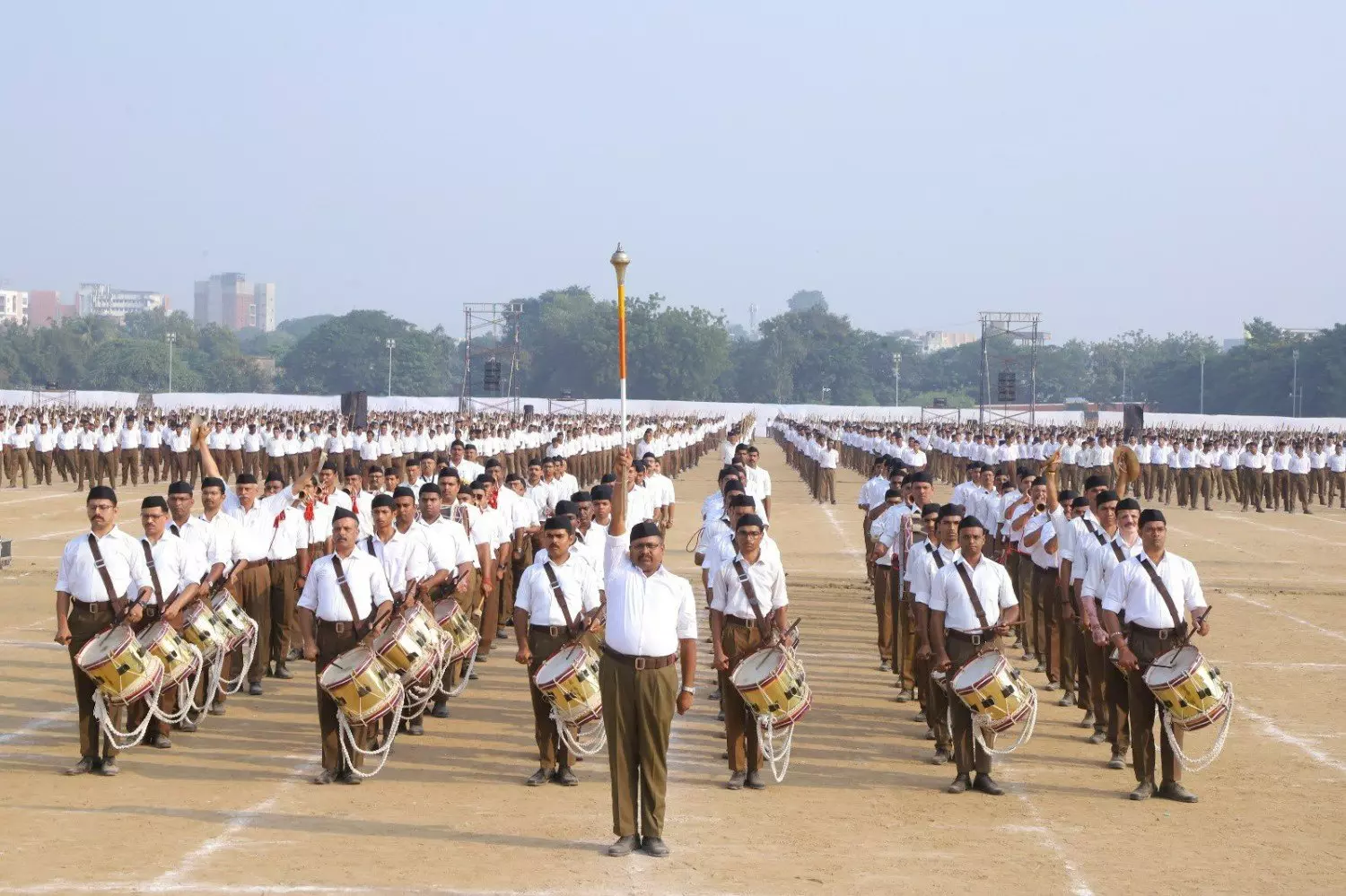
RSS Vijayadashami route marches: Priyank Kharge tells RSS to seek approval first
Karnataka Home Minister says merely informing the Home Department or asking officials to make necessary arrangements for route marches does not mean official permission

Political debate over the Rashtriya Swayamsevak Sangh’s (RSS) route marches has intensified once again in Karnataka. RSS volunteers planning to organise Vijayadashami route marches in Bengaluru on Sunday (October 25) have been reminded that “merely informing” the state Home Department or requesting officials to make arrangements does not amount to official permission, Home Minister Priyank Kharge said.
In a post on his X (formerly Twitter) account, Kharge insisted that, like all other organisations, the RSS must submit the prescribed application and obtain formal approval from the competent authorities before conducting such events.
RSS's letter to police
“My dearest Swayamsevaks of the RSS, Hope the Dasara festivities are in full swing! Not to be a wet blanket, but a gentle reminder, merely “informing” or telling the Home Department to “cooperate” or “make necessary arrangements” is not the same as obtaining permission. Please submit your application in accordance with the prescribed procedure applicable to all organizations and await formal approval from the competent authorities (sic),” he wrote along with copies of RSS’s letters written to police stations in Bengaluru over the route marches.
Also read: Is RSS registration mandatory? What a legal expert has to say
As per the RSS’s letter dated October 15, the route marches will be held in various areas of Bengaluru starting from 9 am.
The latest development comes against the backdrop of last year’s controversy over the denial of permission for an RSS route march in Kharge’s Assembly constituency Chittapur, Kalaburagi district, the Karnataka government rules governing the use of public spaces, discussions in the state legislature over cases registered against the organisation and questions surrounding the RSS’s registration and legal status.
Kharge's written reply in the Legislative Council, stating that no cases had been registered against the RSS, also triggered a political war of words. With permission for route marches back in the spotlight, the confrontation between the Congress and the BJP has taken a new turn.
Kharge mentions RSS's 562 route marches
On Tuesday (October 20), Kharge addressed RSS volunteers and outlined his position in his post on X. He maintained that the organisation must strictly follow legal procedures even amid the celebrations surrounding Dasara.
He stressed that merely informing the Home Department or asking officials to make the necessary arrangements would not constitute official permission. Like every other organisation, the RSS must submit an application, provide the required details and obtain approval from the competent authority, he insisted.
Also read: Protests are inevitable, but regime change is no solution: Mohan Bhagwat
Referring to the 2025-26 annual report of the RSS’s Akhil Bharatiya Pratinidhi Sabha, the Congress minister noted that the organisation had conducted 562 route marches in the state so far, involving a total of 2,21,963 uniformed volunteers. If lakhs of people were to participate in route marches across different parts of the state on a single day, the police department would face a substantial logistical burden.
Managing such large gatherings would require considerable personnel, time and public resources for police deployment, traffic management, security, transportation, food and other arrangements. Therefore, Kharge argued, it was essential to provide the necessary details in advance, including the date of the route march, its proposed route and the exact number of participants, and obtain permission before proceeding.
Earlier controversy in Chittapur
The confrontation between Kharge and the RSS took a significant turn in October 2025, when a dispute erupted over a route march in Chittapur. When the RSS planned to organise the march in Chittapur, questions of permission and law and order became major flashpoints.
The RSS had planned to hold the route march on October 19, 2025. On the same day, other Dalit organisations, including the Bhim Army, also submitted applications seeking permission to hold processions. Considering the possibility that events organised by different groups along the same route could disturb peace and public order, the local administration denied permission for the RSS march. The removal of banners and cut-outs that had been put up before permission was granted further escalated the controversy.
The BJP strongly condemned the state government’s decision, with its leaders alleging that the government was deliberately obstructing RSS activities and turning Chittapur into a centre of political confrontation. In response, Kharge defended the view that every organisation using public spaces must follow the rules. He maintained that the permission process applied equally to the RSS and other organisations.
The dispute eventually reached the courts, following which the Karnataka High Court allowed the route march subject to certain conditions. In accordance with the court’s directions, the march was held in Chittapur on November 16. The event took place under conditions imposed by the administration, including limiting participants to 300, allowing a band of only 50 members, and requiring strict adherence to the designated route and schedule.
Rules governing the use of public spaces
Following the Chittapur controversy, the Karnataka government introduced stricter rules governing the use of public property. Instructions were issued to ensure that prior permission was obtained before conducting any event on government premises.
Implementing these rules carried considerable political significance, especially after a letter Kharge wrote to then Chief Minister Siddaramaiah urging the government to regulate RSS activities in public spaces.
Uproar over RSS in legislature
Amid ongoing political criticism of the RSS, Kharge's written reply in the Karnataka Legislative Council in August 2026 triggered another controversy. Opposition leader Chalavadi Narayanaswamy had sought information on cases registered against the RSS in the state, the organisation’s role in communal riots, and untoward incidents reported during route marches or daily shakhas.
In his written response, Kharge categorically said that no cases had been registered against the RSS. BJP leaders seized on the fact that the minister’s own department had officially stated that there were no cases against an organisation he had repeatedly criticised, using it to launch a sharp political attack. The BJP argued that the government’s own records did not substantiate the allegations levelled against the RSS.
Kharge, however, defended his position by distinguishing between the organisation’s registration status and its legal standing. He argued that since the RSS was not a registered organisation, cases might not be directly registered in its name. Instead, if individuals associated with the organisation were involved in unlawful activities, cases would be registered against them in their individual capacities.
RSS registration controversy
Alongside the dispute over permission for route marches, the question of whether the RSS is a registered organisation has become a key issue in Kharge’s political campaign. He has repeatedly raised questions about the organisation’s legal status, property details, sources of funding, auditing practices and accountability.
In June 2026, Kharge wrote to RSS chief Mohan Bhagwat, urging the organisation to make its legal and financial details public.
RSS leaders responded by expressing displeasure over what they described as attempts to politicise the issue. They maintained that the organisation had nothing to hide and that the question of registration was being raised solely for political purposes. BJP leaders, too, strongly argued that the organisation’s existence and social activities could not be dismissed merely because it was not registered.
(This article was originally published in The Federal Karnataka)