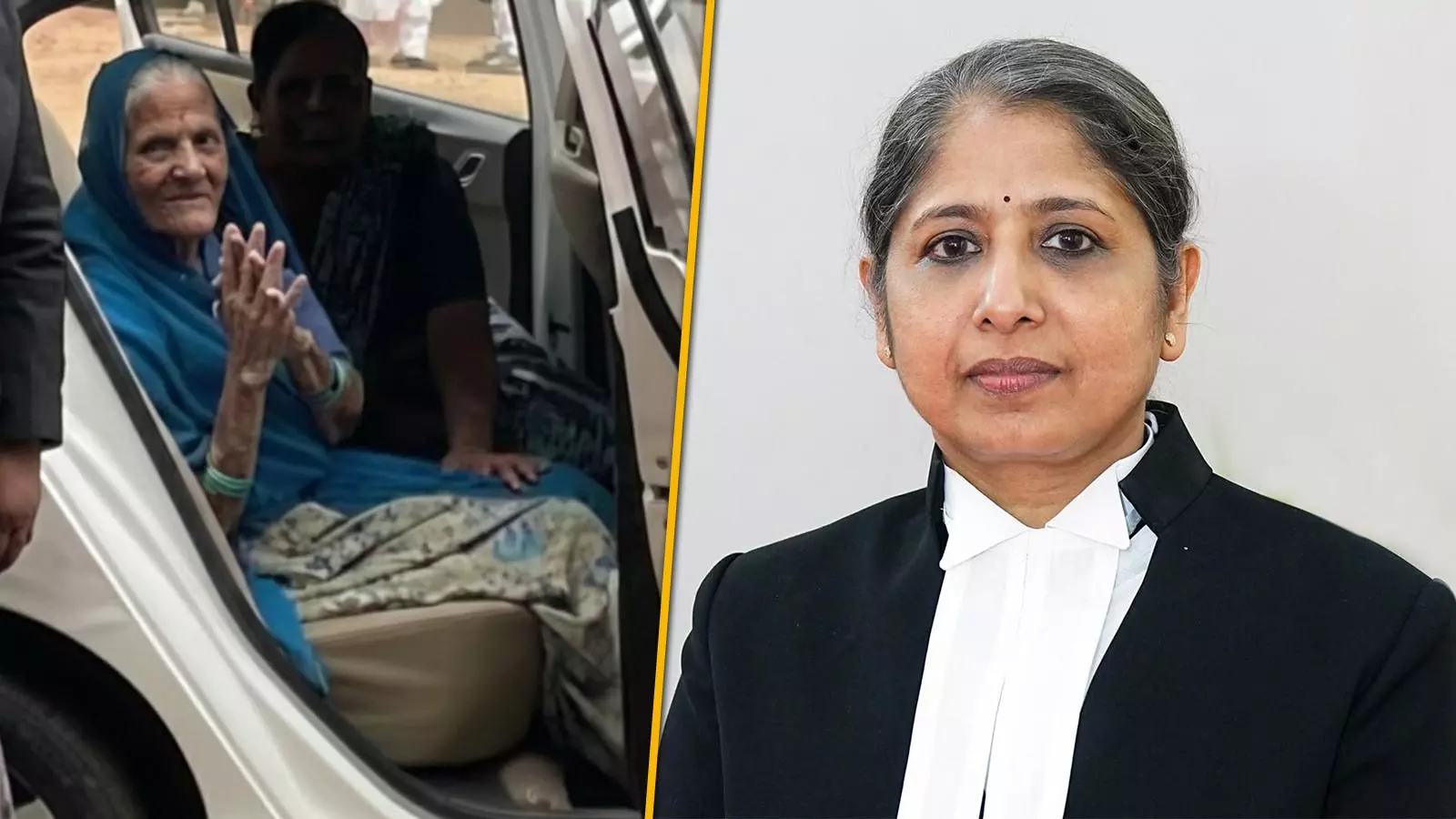
Ninety-two-year-old P Girija (left) received relief as a Lok Adalat judge in Ramanagara helped settle her six-year-old property dispute with her son with the help of a video call; Karnataka High Court judge Justice Anu Sivaraman, executive chairperson of the Karnataka State Legal Services Authority (right)
How a Lok Adalat used technology to deliver speedy justice to a 92-year-old woman
The case from Ramanagara highlighted how courts are using technology and empathy to settle long-pending disputes, even when parties are separated by distance and age

At the National Lok Adalat held in Bengaluru on December 13, where more than one crore cases were settled, people witnessed something unusual. In one of the cases that were resolved, technology was blended with human compassion to give relief to a nonagenarian woman who had been facing prolonged delays in the judicial process. The case arose from a property dispute in Ramanagara.
Court reaches out to an ailing mother
A local judge, who presided over the case under the Lok Adalat, evinced special interest in resolving it quickly. The dispute involved the 92-year-old woman as the petitioner and her London-based son as the defendant. Since both the mother and her son found it difficult to be physically present at the court together due to health and geographical reasons, respectively, the court decided to reach them with the help of technology, especially with the intention to reduce the elderly woman’s pain.
Also read: Why Karnataka 'Mangalya Bhagya' mass-marriage scheme fails to take off
The judge and the case's conciliator decided on the spot, and it proved to be quite effective. To give relief to the mother who doesn’t have the strength in her to appear before the court regularly and her son, the time to visit the country repeatedly, they decided to hold a video-conference involving both to ensure that the six-year-old case is fast concluded.
“If the parties cannot come to court, the court should reach them through technology,” is what the judge and conciliator said. Soon after, the mother and son got to see each other through the video call, accompanied by the courtroom and the judge.
The scene did not have just legal dimensions but also emotional ones since it was a family affair. The differences were amicably settled with the mediator’s help, and a compromise was reached, something the case’s regular progress might not have otherwise seen in the near future.
The incident earned accolades from across Karnataka.
Compassion beyond the courtroom
In 2019, Girija moved the court alleging that her ancestral property had been sold in 2006 without her consent. The case dragged on since then, and the woman, 92 now, found it immensely difficult to make regular visits to the court. Suffering from physical challenges, she arrived at the court in a car on the day the Lok Adalat met and remained seated inside. Learning about her condition and the case, the judge herself walked up to Girija, listened to her plea and conducted the legal proceedings right there.
Video hearing bridges Ramanagara-London gap
The case involving Girija and her son became special as it proved that legal incidents involving NRIs can also be settled quickly. Generally, such cases go on for years as the parties cannot often come home to appear for the case due to various reasons, such as distance, lack of time, and the availability and costs of flight tickets.
Also read: Karnataka CM 'battle': Siddaramaiah, DKS differ over power-sharing 'agreement'
But the judge in Ramanagara showed the way forward by arranging for a video call, erasing the distance between Ramanagara and London in a flash. Both time and money were saved through a simple initiative.
Swift settlement brings relief to elderly litigant
The case also caught headlines because it succeeded in giving a 92-year-old woman peace of mind. Under the normal circumstances of knocking on the court’s door, Girija’s physical and mental health would have taken a toll by the time the verdict was delivered. The use of technology made her life much easier by ensuring speedy justice.
The use of technology in this case strengthened the call for its use in judicial proceedings. The Supreme Court and high courts of the country have stressed e-courts and virtual hearings more in recent times. The system, which became popular during the COVID-19 pandemic, has now emerged as an integral part of the administration of justice. Ramanagara showed once again why it is a prudent move to make.
Former cricketer settles eviction dispute
Besides the common man, the Lok Adalat also came to the rescue of noted people. Sadanand Vishwanath, a former national cricketer, also saw a year-old case involving him meet a happy ending. The case in Bengaluru revolved around him and his tenants, D Chandrasekhar and others, involved in a dispute over eviction from the former’s residential apartment. The tenants filed a case in 2024. Such cases related to rent and eviction generally take years, but Vishwanath and the other side went for a settlement through the Lok Adalat.
Also read: Chinese GPS tracker found on seagull near Karwar naval zone
A practical solution was found through negotiations, and the former cricketer agreed to return the rent he had received from the tenants. Following talks, he agreed to pay around Rs 35 lakh to the tenants who vacated the house without further dispute. It saved both parties’ time, money and prestige.
Lok Adalats showcase speedy justice
The settlement of these cases reiterated the power and importance of the Lok Adalat as an alternative dispute-resolution system. More than victory or defeat, compromise and harmonisation are identified more with these Adalats. The use of technology to mediate between a mother and son made their cases even stronger. The Lok Adalat held on December 13 saw more than a crore cases getting disposed of, which makes evident the kind of people’s trust they enjoy.
Justice Anu Sivaraman, a judge of the Karnataka High Court and executive chairperson of the Karnataka State Legal Services Authority, which organises Lok Adalats, said the December 13 Adalat succeeded in resolving a large number of cases, including traffic, matrimonial and other disputes, not only because of the use of technology but also due to cooperation from lawyers and wide publicity.
(The article was first published in The Federal Karnataka)