



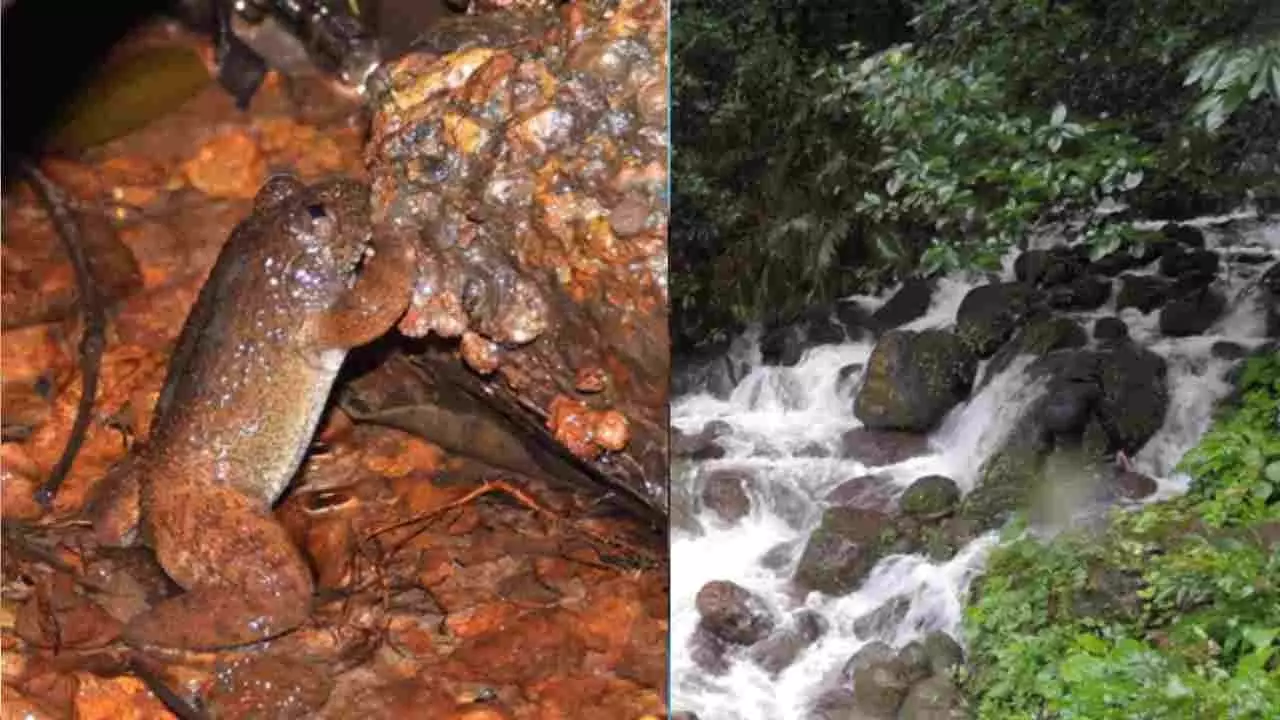
The newly discovered 'Kali Night Frog' species (left) in Karnataka's Western Ghats region, and the Kali River after which it has been named. Photo: Gururaja KV
'Kali Night Frog' that makes 'wood-chopping' sound discovered in Karnataka's Western Ghats
The amphibian, scientifically called Nyctibatrachus kali, was found in the state's Kali Tiger Reserve after forest officials and researchers tracked an unusual 'tock' sound

In a development that would excite zoologists, a new species of frog has been discovered in the Western Ghats, a hotbed of biodiversity, in a joint mission conducted by researchers and frontline staff of the Karnataka forest department.
The new species, Nyctibatrachus kali, is more commonly called 'Kali Night Frog', after it was found in the Kali Tiger Reserve in Uttara Kannada district, bordering Goa. It was named after the nearby Kali River (the reserve is also named after the river which flows through it). The scientific discovery was published in PeerJ, a prestigious international biological, medical and environmental sciences journal, this week.
Also read: How Assam’s Kaziranga National Park became a stronghold for the vulnerable fishing cats
The discovery of the new species also represents a notable enhancement to India's biodiversity, which presently is home to more than 470 amphibian species and accounts for around 5.3 per cent of the worldwide total.
Collaborative effort from researchers, forest officers
The research team, which made the discovery, was led by Dr Preeti Hebbar, assistant professor at Manipal Institute of Technology (MIT), Bengaluru, and included Professor Gururaja KV of Srishti Manipal Institute, Bengaluru, and Arvind CK, a PhD scholar from MIT.
Forest officials Ramesh Badiger, beat forester of Yellapura zone in Uttara Kannada, and CR Naik, deputy range forest officer of Ankola zone, also played key roles in the crucial scientific discovery.
Also read: Unscientific capture, release of tigers: Expert Dr Ullas Karanth slams Karnataka govt
Kumar Pushkar, principal chief conservator of forests (wildlife), Karnataka forest department, and Nilesh Devoba Shinde, field director, Kali Tiger Reserve, praised the forest officials for playing a key role in the identification of the new frog species, thus contributing to scientific research, besides carrying out regular forest protection and development responsibilities.
Frog's wood-cutting sound led to its discovery
The new frog species is known to be a 'cryptic' one, which has similarities with the 'Kumbara Night Frog' (Nyctibatrachus kumbara) discovered in 2014. However, the researchers concluded after examining the amphibian’s sound and evolutionary lineage that it is a completely new species. According to the researchers, the animal’s sound resembles that of wood-chopping in the forest.
It was this unusual sound made by the amphibian that led to its discovery. Naik reported hearing a distinctive “tock” sound while he was riding his motorcycle in heavy rain. He recorded it and sent it to Gururaja out of curiosity. Later, Badiger also saw the frogs in the Castlerock region of the Western Ghats and gave inputs to the researchers to aid their study.
Also read: From 10 to 42: How a Telangana forest quadrupled its tiger count in 9 years
The fact that the newly discovered amphibians were found in a range located much further from the area where the Kumbara frog is found also confirmed their distinct identity.
Conservation is key
However, since amphibian species worldwide are also known to be vulnerable to threats, such as habitat destruction, climate change, and diseases, the discovery of ‘Kali Frog’ also puts an added responsibility on the shoulders of the researchers and forest officials to ensure that it is also given due protection. However, besides policies and regulations, the local people's cooperation and practices would also be needed to ensure that the new-found species survives long.
(This article was originally published in The Federal Karnataka.)