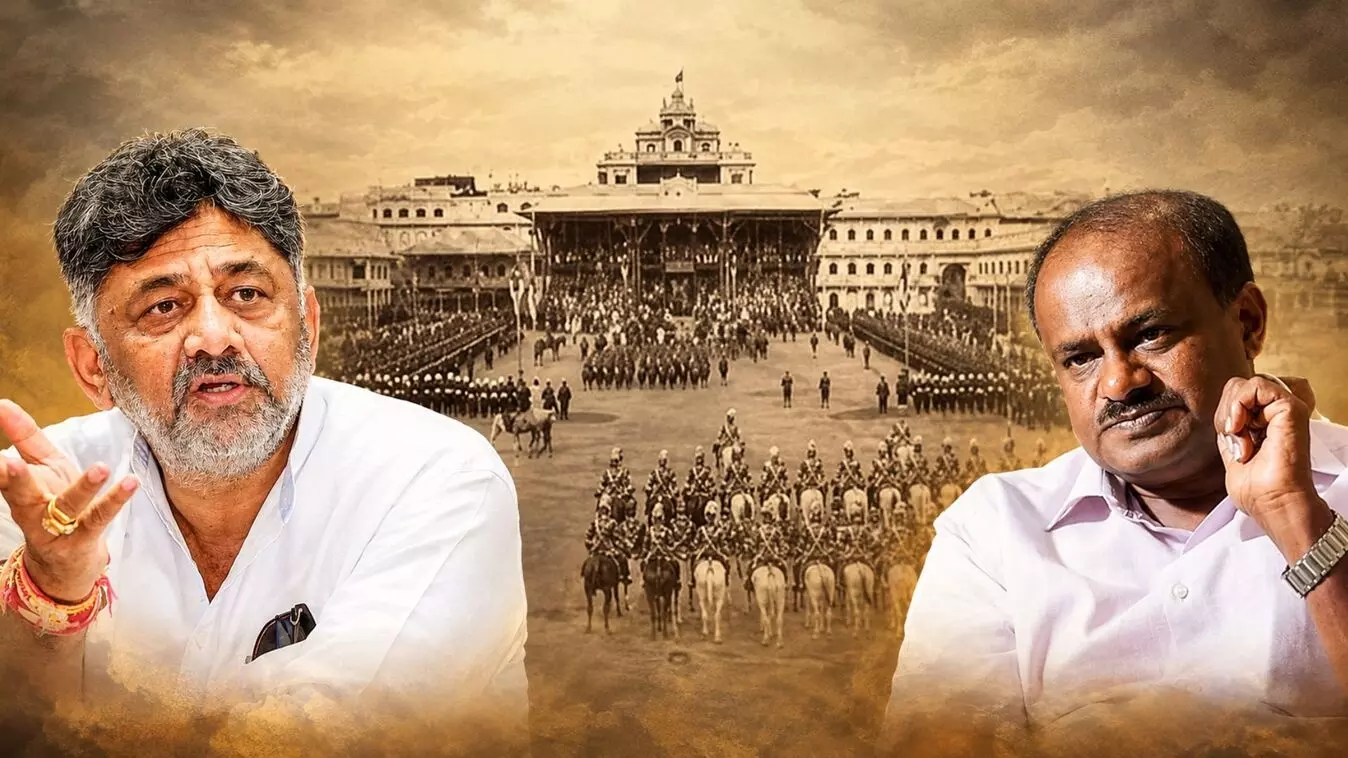
Shivakumar vs Kumaraswamy: Vokkaliga rivalry reshapes Karnataka politics
As 2028 nears, Kumaraswamy is trying to rebuild JD(S) while Shivakumar seeks to expand Congress’ hold over the Vokkaliga heartland. Who will own Old Mysuru?

A four-decade-old political rivalry is entering a new phase in Karnataka, with Chief Minister DK Shivakumar and Union minister and JD(S) leader HD Kumaraswamy competing for influence over the Vokkaliga community ahead of the 2028 Assembly elections.
At the centre of this contest is Old Mysuru, the traditional stronghold of the Deve Gowda family and the region that has long formed the backbone of JD(S) politics. But the political landscape has changed, with Congress making significant gains among Vokkaligas, and Shivakumar emerging as a powerful leader from the community.
Kumaraswamy, meanwhile, has been steadily sharpening his attacks on Shivakumar and the Congress government. The contest is no longer simply about Congress versus JD(S), but about political space, community influence and who gets to shape the future of southern Karnataka.
Kumaraswamy’s challenge
For Kumaraswamy, the immediate task is to revive a JD(S) that has lost substantial ground in its traditional stronghold. The party’s 2023 performance exposed the extent of that erosion, as the Vokkaliga vote was no longer consolidated behind JD(S).
Also read: BJP’s Bellary padayatra: Fight against govt exposes cracks in Opposition unity
In the 2023 Assembly election, Congress won 23 Vokkaliga seats, compared with 11 for the BJP and 10 for JD(S). Overall, JD(S) was reduced to just 19 seats in the Assembly.
The result raised a larger question for the Deve Gowda family: Can it retain its political influence in southern Karnataka when the Vokkaliga vote is increasingly divided between Congress, BJP and JD(S)?
That question has become more pressing with Shivakumar at the top of the state government. His organisational influence within the Congress and his strong base in Ramanagara have made him a formidable challenger in precisely the territory where the Deve Gowda family built its political dominance.
Rivalry since 1985
The roots of the rivalry go back nearly four decades. In 1985, a 23-year-old Shivakumar contested his first Assembly election from Sathanur against HD Deve Gowda and lost. Gowda later vacated the seat after winning from two constituencies, allowing Shivakumar to win the subsequent by-election.
For decades, the Deve Gowda family remained synonymous with Vokkaliga politics in the Old Mysuru belt. JD(S) built a formidable network across Mandya, Hassan, Ramanagara, Bengaluru Rural, Tumakuru and surrounding areas.
But the 2023 election showed that this consolidation had weakened. Congress made significant inroads into traditionally JD(S)-dominated Vokkaliga areas, while Shivakumar’s rise gave the party a prominent Vokkaliga face at the highest level of state politics.
The 2028 calculation
Kumaraswamy does not necessarily need JD(S) to become Karnataka’s largest party. His calculation could be to rebuild a sizeable bloc of MLAs that becomes decisive if the 2028 election produces another fractured mandate.
Also read: Karnataka minister B Nagendra resigns amid Valmiki Corporation row
If neither Congress nor BJP wins a clear majority, a strong JD(S) contingent could determine who forms the next government. Kumaraswamy’s alliance with the BJP also gives him a potential bargaining position within the NDA.
Recent political assessments have even suggested the possibility of Kumaraswamy being projected as an NDA chief ministerial face in 2028, although that remains a political possibility rather than a settled decision.
The strategy, therefore, is straightforward: Rebuild JD(S), strengthen the alliance, win enough seats and ensure that no government can be formed without Kumaraswamy’s bloc.
Filling BJP’s gap
Kumaraswamy is also attempting to exploit another opening — the BJP’s opposition space.
As Karnataka’s principal opposition party, the BJP would normally be expected to lead the campaign against the Congress government. But internal factionalism has created space for Kumaraswamy to become a more visible critic of Shivakumar.
Kumaraswamy led attacks over the Valmiki Corporation controversy, an issue that eventually saw B Nagendra resign from the Karnataka Cabinet amid allegations of financial irregularities. He has also targeted the KPSC recruitment process, alleging irregularities in the recruitment of Assistant Executive Engineer Grade-I posts and demanding action against Priyank Kharge.
Going after Kharge allows Kumaraswamy to attack the Congress government while simultaneously strengthening his anti-Congress credentials.
Alliance politics
That positioning has also helped Kumaraswamy build bridges with sections of the BJP.
Karnataka BJP is headed by BY Vijayendra, son of former chief minister BS Yediyurappa, but differences within the party over how to take on Shivakumar have created opportunities for Kumaraswamy to find common ground with BJP leaders.
Also read: Bidadi protests intensify; Deve Gowda slams CM Shivakumar, asks him to 'speak truth'
BJP MP Tejasvi Surya, for instance, has led protests against the Karnataka government's plans involving park land and the proposed Bengaluru tunnel road. Surya has argued against the diversion of park land and criticised the government's approach to the project.
For Kumaraswamy, such issues provide another route to challenge Shivakumar’s government while strengthening his position within the broader BJP-JD(S) alliance.
Bidadi battleground
Then there is Bidadi — perhaps the sharpest political flashpoint between the two camps.
The proposed Greater Bengaluru Integrated Township has triggered protests from farmers over land acquisition. The project covers about 7,481 acres across nine villages and has become a major political issue in Ramanagara, Shivakumar’s home turf.
Kumaraswamy has backed the protesting farmers and strongly opposed the project. The political calculation is clear: he is taking the fight directly into Shivakumar’s backyard and presenting himself as a defender of farmers and the Vokkaliga heartland.
Shivakumar, meanwhile, has pushed back against the criticism, insisting that there will be no forced acquisition, while the government has indicated that the project will be reviewed. But politically, Bidadi gives Kumaraswamy an opportunity to attack Shivakumar simultaneously on development, land and regional interests.
Four fronts
Bidadi is only one part of the larger campaign. The Bengaluru tunnel-road controversy, the KPSC recruitment issue and the Valmiki Corporation controversy have given Kumaraswamy multiple fronts from which to attack the Congress government.
Bidadi. Tunnel road. KPSC. Valmiki Corporation. Four separate controversies, but one larger political campaign against Shivakumar.
Also read: Bidadi land row: HD Kumaraswamy backs protesting farmers, promises legal aid
For Kumaraswamy, the calculation is ultimately about four objectives: Rebuilding JD(S), preventing Shivakumar from becoming the undisputed Vokkaliga voice, occupying the Opposition space, and strengthening his bargaining position within the NDA.
Shivakumar’s stakes
For Shivakumar, the stakes are equally high. His political journey has taken him from Congress organiser to Karnataka chief minister, giving Congress something it had long lacked in the Old Mysuru contest — a powerful Vokkaliga leader at the top of the state government.
For years, Karnataka’s political arithmetic was often described through a broad social division: the BJP’s strength among Lingayats and the JD(S)’s influence among Vokkaligas in Old Mysuru.
Shivakumar’s rise disrupts that equation. Congress has already made significant gains among Vokkaligas, while Shivakumar's political stature gives the party an opportunity to consolidate that support. Analysts have noted that the community’s support is now likely to remain divided rather than automatically returning to JD(S).
2028 questions
The questions ahead of 2028 are, therefore, no longer theoretical.
Will the Vokkaliga vote continue to fragment? Can Kumaraswamy rebuild JD(S)? Can Shivakumar establish himself as the community’s dominant political voice? And if Karnataka again produces a fractured mandate, who will have enough numbers to become the kingmaker?
The groundwork is already being laid, with Kumaraswamy increasingly visible across the Vokkaliga belt and Shivakumar using his position in government and Congress to consolidate his influence.
This is ultimately not just a contest between two men. It is a clash between two political projects — one trying to reclaim territory that JD(S) once dominated, and another trying to ensure that Congress' expansion into that territory becomes permanent.
Whoever wins the Old Mysuru belt may well decide who runs Karnataka in 2028.