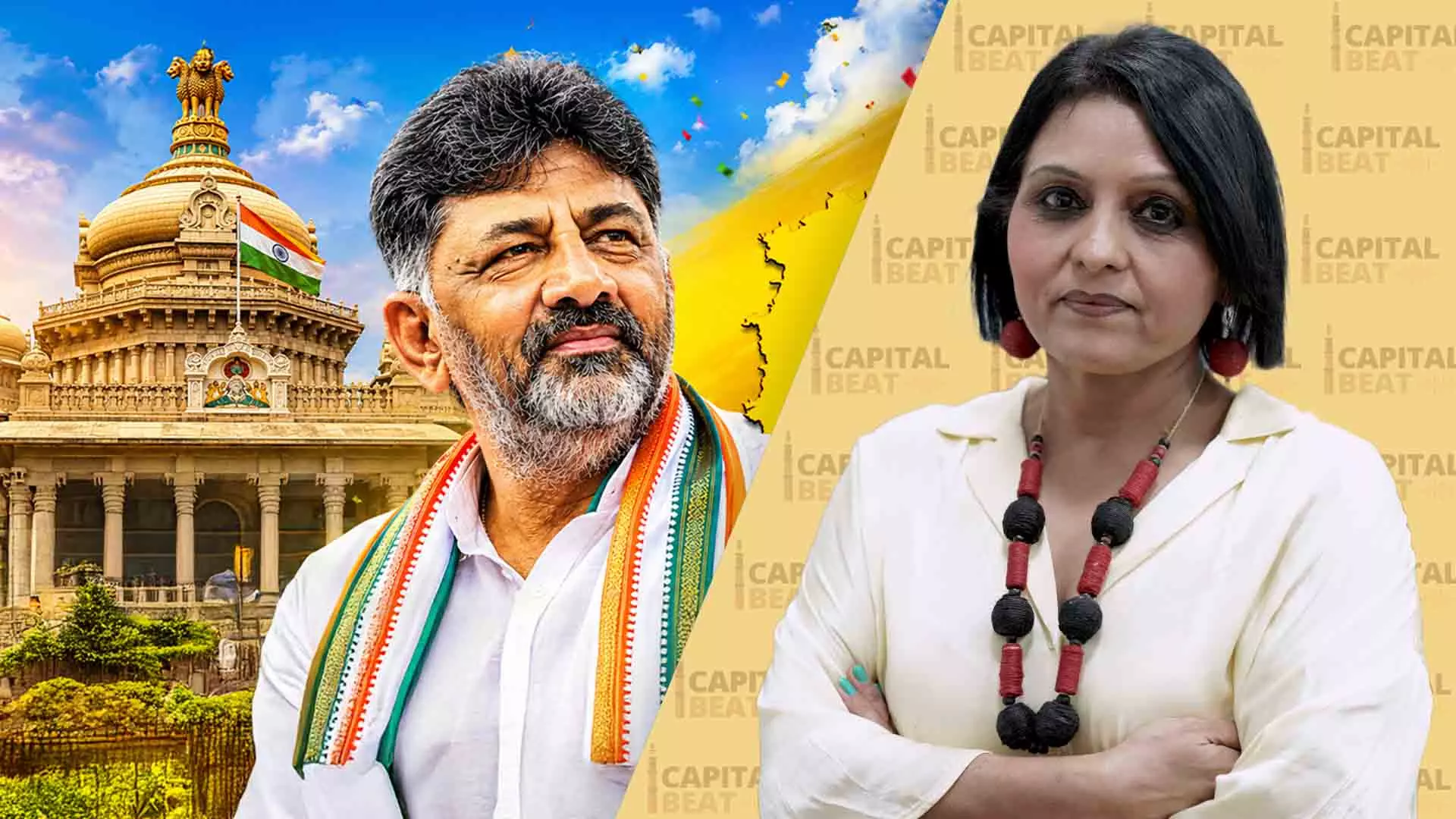
Can new CM DK Shivakumar deliver for Congress in 2028, 2029? | Capital Beat
From caste arithmetic and Bengaluru’s urban challenges to national ambitions and electoral strategy, the Shivakumar era is already being viewed as a critical turning point for Congress in Karnataka

DK Shivakumar was on Wednesday (June 3) sworn in as Karnataka’s 34th Chief Minister, completing a key leadership transition in the Congress government. With G Parameshwara as Deputy CM and a new Cabinet in place, attention now shifts from internal politics to governance and strategy.
In the latest episode of Capital Beat, senior journalists D Umapati and Preeti Nagaraj discuss Shivakumar’s immediate challenges managing power centres within the party, delivering on governance, and addressing Karnataka’s economic and infrastructure priorities. The panel also explores whether his regional strength and national profile can help Congress in the 2028 Assembly and 2029 Lok Sabha elections.
Swearing-in moment
An eight-time legislator and Karnataka Pradesh Congress Committee (KPCC) president Shivakumar took oath as Chief Minister, completing a leadership transition that began last week from outgoing CM Siddaramaiah.
Also read: India's richest CM: DK Shivakumar tops wealth chart
Along with Shivakumar, 13 Cabinet ministers, Parameshwara, MB Patil, UT Khader, KJ George, KH Muniyappa, Satish Jarkiholi, Ramalinga Reddy, Krishna Byregowda, Priyank Kharge, Byrathi Suresh, Yathindra Siddaramaiah, Eshwar Khandre and Sharanprakash Patil took oath.
The Cabinet expansion is expected after the Rajya Sabha elections, signalling that the political realignment is still in progress within the state unit.
Cabinet lineup
The new Cabinet reflects a mix of experienced leaders and regional balance, with Congress attempting to consolidate its internal factions.
Alongside Shivakumar, key leaders were seen attending the event, including Rahul Gandhi and Mallikarjun Kharge, as well as chief ministers from several Congress-ruled states.
Also read: DK Shivakumar as Lord Shiva in Kannada newspaper: Editor faces backlash
The event also saw participation from religious leaders, farmers’ representatives, Dalit leaders, student groups, and Kannada activists, reflecting the broad political messaging of the ceremony.
Sonia Gandhi also reportedly spoke to Shivakumar over the phone, with the new CM stating that she expressed trust in him and urged him to take everyone along.
Regional equation
One of the key themes of the discussion was Shivakumar’s political positioning in Karnataka’s caste and regional dynamics.
Nagraj said Shivakumar’s elevation could reshape the Vokkaliga political space, which has traditionally been influenced by the JD(S).
Also read: DK Shivakumar takes oath with Constitution copy in hand
She noted that the community has often been seen as having a distinct leadership identity, and Shivakumar’s rise as CM could challenge that balance.
She also pointed to the importance of Greater Bengaluru development, where Shivakumar is expected to play a key role in shaping infrastructure and urban governance.
BJP challenge
The panel also discussed the BJP’s early response, including an AI-generated video targeting Shivakumar over Bengaluru’s waterlogging issues.
Nagraj said BJP’s social media messaging may differ from ground reality, and Karnataka politics often evolves differently from northern political narratives.
However, she acknowledged that governance challenges, especially in Bengaluru, will test the new CM, particularly given that this is the second half of the government’s term.
She added that Shivakumar “loves challenges” and has built a reputation as a crisis manager within the Congress.
Congress strategist
Umapathi described Shivakumar as a “wartime general” for the Congress party.
He said Shivakumar brings “aggressiveness” that was necessary for the party, especially in strengthening its organisational structure and electoral competitiveness.
According to him, Shivakumar’s combination with experienced leaders like BK Hariprasad represents a strategic balance within the Congress ecosystem.
He also described Shivakumar as a potential “Chanakya-like strategist” for the party, though without the backing of central investigative agencies that Opposition leaders often accuse the BJP of using.
Caste and politics
A major immediate challenge identified in the discussion is maintaining the Congress’s “Ahinda” vote base — minorities, backward classes, and Dalit communities.
Umapathi said Siddaramaiah had consolidated this base, and Shivakumar now faces the challenge of retaining it while also managing caste sensitivities around the caste census issue.
He noted that both Vokkaliga and Lingayat communities have expressed concerns over caste enumeration, making it politically sensitive ahead of future elections.
The BJP-JD(S) alliance in Old Mysore was also identified as a major electoral challenge for the Congress in the coming years.
Anti-incumbency factor
The panel discussed whether leadership change would neutralise anti-incumbency within the Congress government.
Umapathi pointed out that Karnataka rarely sees consecutive re-election of governments, except in rare historical cases.
He said leadership transition itself may help slow down anti-incumbency sentiment, particularly given welfare schemes and guarantees already implemented.
However, he cautioned that the real impact will depend on how effectively Shivakumar runs his administration.
National ambition
The discussion also focused on whether Shivakumar could become a national-level figure within Congress, similar to senior party strategists in the past.
Nagraj noted that Shivakumar is widely seen as a strategist and troubleshooter, often deployed by the party in difficult political situations across states.
However, she said it is too early to label him as a national “Chanakya”, as he is still transitioning into the Chief Minister’s role.
She added that Shivakumar’s leadership will likely be seen as a “fresh phase” of governance in Karnataka rather than a continuation of the previous administration.
Electoral outlook
Umapathi argued that Shivakumar’s leadership could bring Congress back into a strong position for 2028, especially given the absence of strong Opposition leadership in Karnataka.
He said the BJP currently faces a leadership vacuum, with limited mass leaders on the ground compared to earlier years.
According to him, Shivakumar’s entry into the top post has “brought Congress back into the fight” for the next election cycle.
As Shivakumar begins his tenure as Karnataka’s 34th Chief Minister, the conversation around him extends far beyond governance.
From caste arithmetic and Bengaluru’s urban challenges to national ambitions and electoral strategy, the DKS era is already being viewed as a critical turning point for Congress in Karnataka.
Whether he can translate organisational strength and political aggression into electoral victories in 2028 and 2029 remains the central question shaping Karnataka’s political future.
(The content above has been transcribed from video using a fine-tuned AI model. To ensure accuracy, quality, and editorial integrity, we employ a Human-In-The-Loop (HITL) process. While AI assists in creating the initial draft, our experienced editorial team carefully reviews, edits, and refines the content before publication. At The Federal, we combine the efficiency of AI with the expertise of human editors to deliver reliable and insightful journalism.)