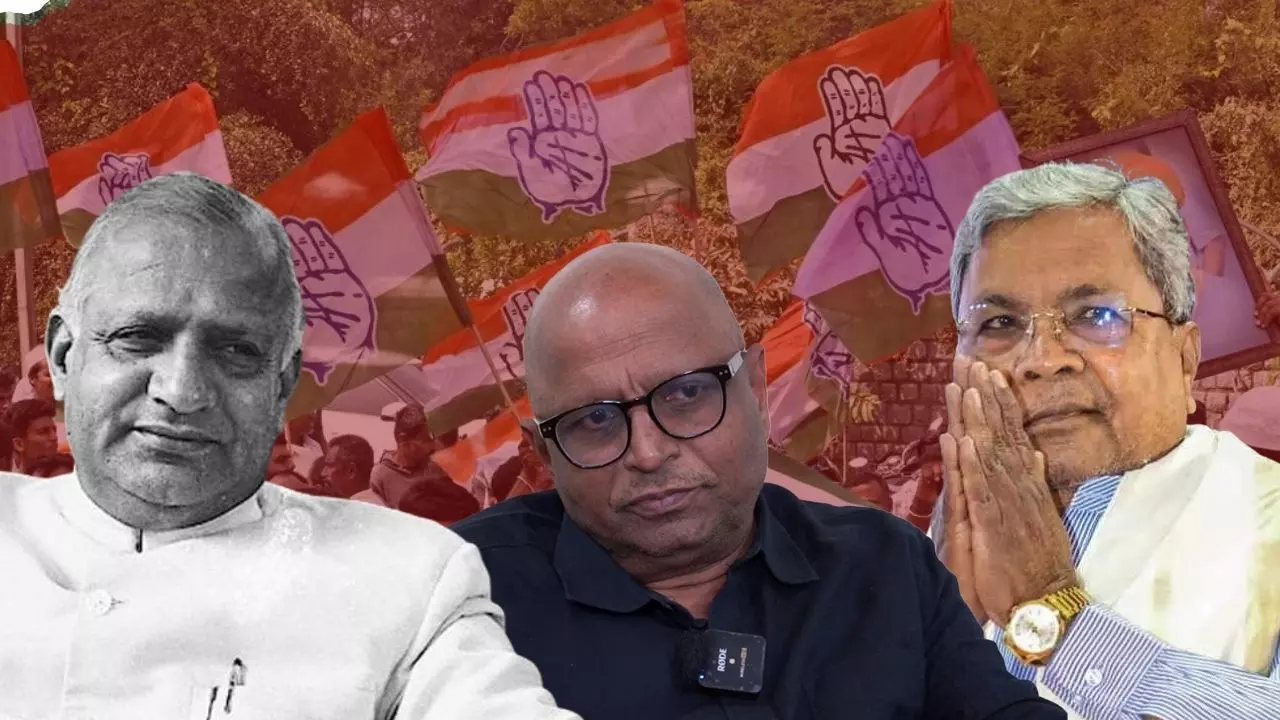
Dinesh Amin Mattu on Siddaramaiah vs Devaraj Urs: Why this record could define a legacy
As Siddaramaiah breaks Devaraj Urs’ record, Dinesh Amin Mattu explains why caste census politics, federal strain, and legacy debates now define his tenure.

Siddaramaiah overtaking Devaraj Urs as Karnataka’s longest-serving chief minister has reopened an old political debate with new urgency. In this interview, Dinesh Amin Mattu, former advisor to Siddaramaiah, unpacks why the comparison goes beyond numbers, how today’s political conditions are far harsher than Urs’ era, and why the caste census has become the ultimate test of Siddaramaiah’s social justice legacy.
Why is Siddaramaiah being compared to Devaraj Urs after breaking his record?
There are many similarities between Devaraj Urs and Siddaramaiah. Both come from the Mysore region, both are deeply committed to social justice, and both emerged from the Congress party. These are the core similarities that naturally lead people to compare them.
Also read | Siddaramaiah no Devaraj Urs, yet a cut above the rest
However, they belong to completely different political eras. When Siddaramaiah entered the Karnataka Assembly in 1983, Devaraj Urs had already passed away. He was no longer alive at that time. So the comparison is not personal or contemporaneous, but based on political programmes and ideological orientation.
Most comparisons focus on the kind of social justice interventions associated with both leaders. In Urs’ time, land reforms and the implementation of the Havanur Commission — which expanded reservations in education and employment — were the two main instruments of social justice.
These two programmes were essentially the weapons of social justice in that era. The beneficiaries were Dalits, minorities, and OBCs. Naturally, these programmes went against dominant upper-caste groups in Karnataka, such as the Vokkaligas and Lingayats.
Despite this opposition, Urs implemented both land reforms and reservation policies. Siddaramaiah is similarly identified with backward class empowerment, which is why the comparison keeps resurfacing after he broke Urs’ record.
What makes Siddaramaiah’s political moment tougher than Devaraj Urs’ era?
The challenges Siddaramaiah faces today are very different and far more complex. One major difference is communalism. Urs did not face this level of communal polarisation. Today, communal politics has become a dominant force and a major obstacle.
There is also open caste resistance now, especially to the caste census report. Siddaramaiah cannot easily accept or implement the caste census report in Karnataka because of strong opposition in the current political environment.
During Urs’ time, even RSS-linked Lingayat political and social leaders eventually accepted land reforms and reservations. Urs did not lose power because of opposition from these communities. He lost power due to differences with the Indira Gandhi regime at the Centre.
Another major difference is the state of the bureaucracy. Urs succeeded in implementing his programmes because he had a strong team of officers. Administrators like J.C. Lee and Chiranjeevi Singh played a crucial role in ensuring effective implementation.
Today, that kind of administrative strength is missing. There has been a clear degeneration in the bureaucracy, as well as in public life and politics. This degeneration itself has become a major challenge for governance.
Urs also had the advantage of strong support from the Centre. Indira Gandhi was at the peak of her power, and her national programmes — bank nationalisation, abolition of privy purses, the 25-point programme, and the ‘Garibi Hatao’ slogan — all favoured the poor and oppressed. These programmes aligned perfectly with Urs’ agenda in Karnataka, allowing him to implement reforms smoothly with high-command backing.
Siddaramaiah’s experience has been the opposite. He became chief minister in 2013, and in 2014 the BJP came to power at the Centre. Since then, there has been non-cooperation from the Union government.
For example, under the current tax system, if Karnataka pays one rupee in tax, it gets back only around 15 paise. This shows how the federal structure has weakened and how Centre–state relations now pose a serious constraint on state governments.
Why has Siddaramaiah’s record-breaking tenure become politically decisive now?
The primary reason Siddaramaiah is being compared so intensely with Devaraj Urs today is the caste census report. There is a strong expectation that Siddaramaiah will accept the caste census report and implement its recommendations.
For Siddaramaiah, this has become the defining benchmark of his tenure. If he succeeds in implementing the caste census, he can legitimately say that just as land reforms and reservations defined earlier phases of social justice, he too carried forward that legacy.
Also read | Siddaramaiah becomes Karnataka's longest-serving CM, breaks Devaraj Urs’ record
He can proudly state that he accepted the caste census report and stood by policies benefiting the most backward and marginalised sections. But if he fails to do this, the stigma will remain. According to me, this is the biggest challenge he faces today.
This moment is also decisive because there is an ongoing debate about leadership change in Karnataka. At this juncture, if Siddaramaiah is removed, it will be seen as a major setback for the Congress government and the Congress party.
Recently, Rahul Gandhi himself has acknowledged that the Congress has not adequately addressed OBC concerns. At an OBC conference in Delhi, he openly said that the party must produce OBC chief ministers like Siddaramaiah.
All these developments have gone in Siddaramaiah’s favour. Because he has broken Devaraj Urs’ record, there is renewed discussion around Urs’ policies and social justice politics. That legacy, in turn, strengthens Siddaramaiah’s political position and helps him retain both power and credibility.
The content above has been transcribed from video using a fine-tuned AI model. To ensure accuracy, quality, and editorial integrity, we employ a Human-In-The-Loop (HITL) process. While AI assists in creating the initial draft, our experienced editorial team carefully reviews, edits, and refines the content before publication. At The Federal, we combine the efficiency of AI with the expertise of human editors to deliver reliable and insightful journalism.