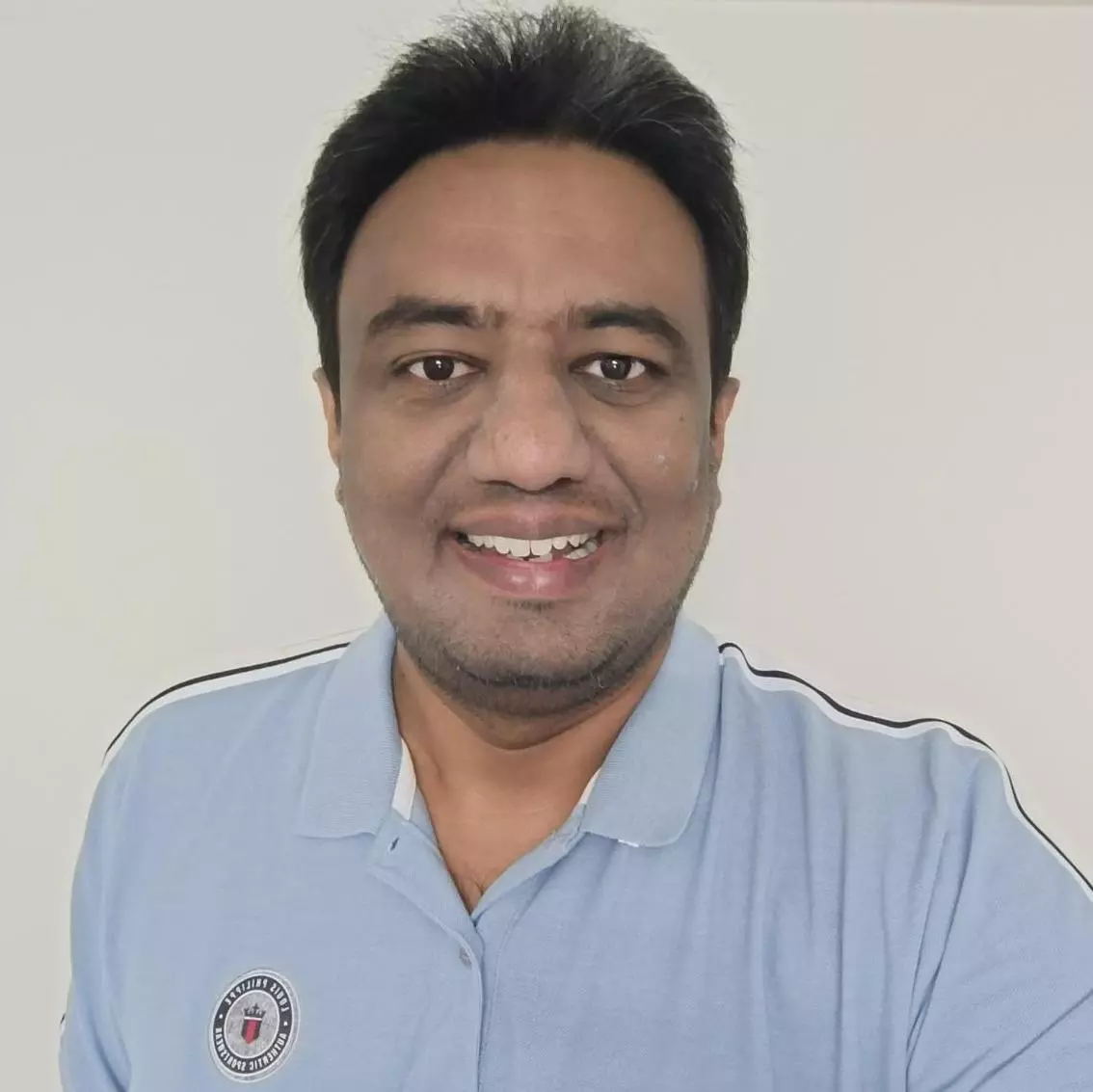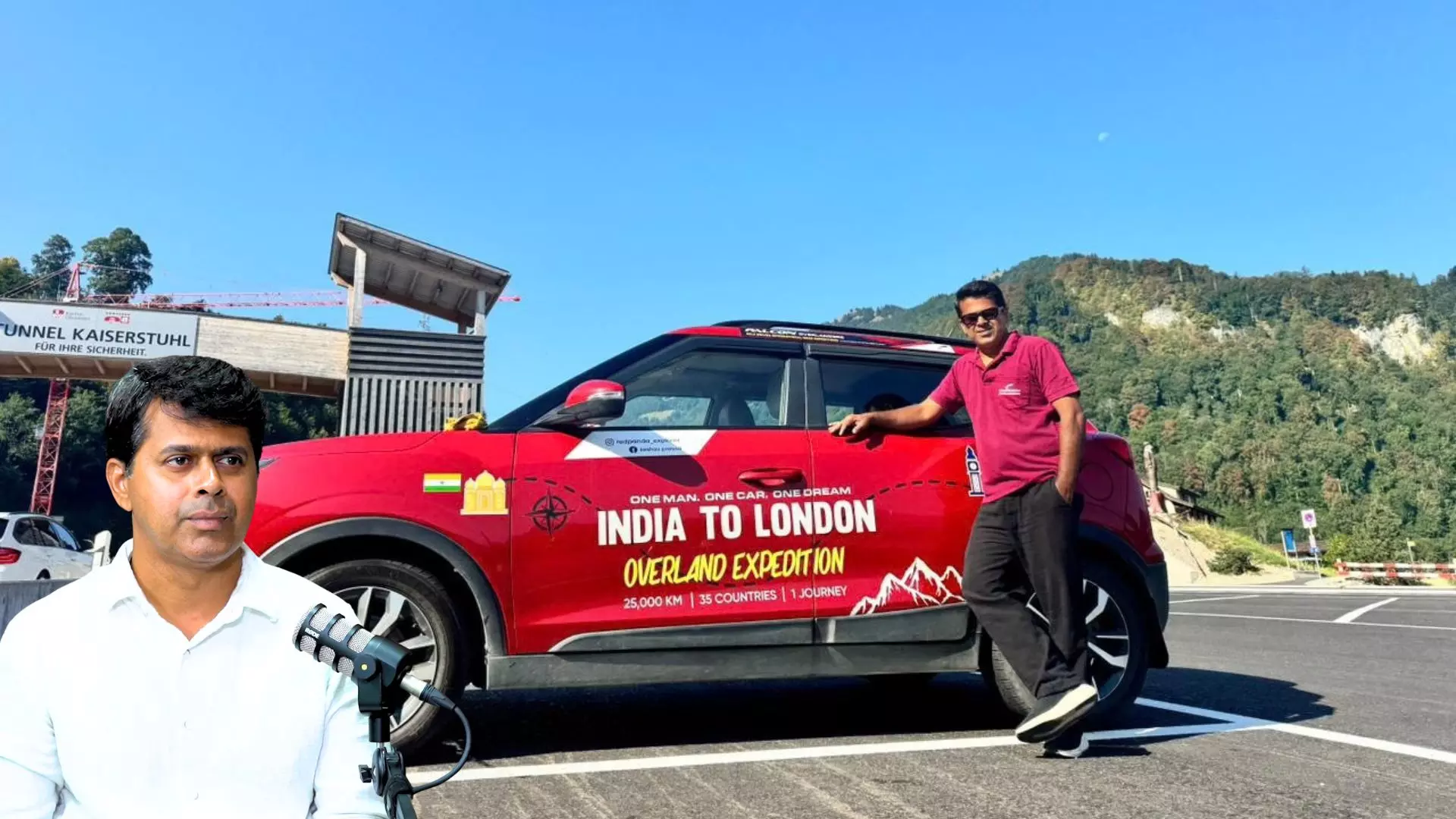
Keshav Prasad with his SUV during his 25,000-km Bengaluru to London road trip.
How an Ayush doctor drove 25,000 km from Bengaluru to London and back
Bengaluru-based Keshav Prasad recounts his 85-day road trip, from -5°C nights at 18,000 feet in Tibet to border checks and fuel shortages in Russia

Driving 25,000 km across 27 countries in 85 days in a single vehicle is an extraordinary feat, but surviving -5°C temperatures inside a car at 18,000 feet in Tibet without a heater, waiting out border inspections with sniffer dogs inside the vehicle, and spending ₹25 lakh on paperwork, visas, and fuel make it a once-in-a-lifetime expedition.
An overland journey from Bengaluru to London and back demands meticulous financial planning, months of visa processing, and immense physical endurance. The Federal spoke to Keshav Prasad, an Ayush doctor and traveller from Bengaluru, about his remarkable drive across two continents, the extreme logistics involved, and the memorable moments along the way.
What drove your passion for driving, and why did you choose the route from Bengaluru to London?
From the beginning, I have been very passionate and obsessed with driving. I am not particular about needing a luxurious vehicle; even if you give me a Maruti 800, I will drive it. Once, I drove from Bengaluru to Mangaluru and returned on the same day.
I chose the India to London route because, if you look at the world map, this is the longest continuous road trip you can undertake without the hassle of shipping your vehicle multiple times. Except for a short 55-km ferry ride from France to the UK, the entire journey is on the road. That gives you the comfort of being in your own car full-time while covering many countries.
What went into the preparation for such an extensive journey, and which vehicle did you drive?
The active preparations started six to eight months before the departure date, though background planning had been going on for three to four years. When researching the itinerary, I found that China and Tibet do not allow solo travelers or single vehicles to drive through independently. You must hire an authorized tour agency and a guide for overland travel.
I inquired with agencies and found one that helped organize the permits. The ideal travel window for this route is only once a year during July, August, and September due to weather conditions. Two other vehicles—a car and a motorcycle—were planning the same route, so we combined forces. We scheduled our departure from Bengaluru for June 5 and aimed to complete the trip by the end of August.
I drove my own Mahindra XUV300, a BS6 diesel model.
The visa process is complex because you need around eight to ten different visas. You must apply starting from your final destination backward so that every country knows you have a valid entry onward. We started with the UK visa, which is very strict about financial documentation. They look for consistent monthly transactions rather than sudden large deposits. Once the UK visa was secured, obtaining the Schengen, Russian, Kazakh, and Chinese visas became much easier.
In addition to personal visas, you need a document called a Carnet de Passages for the car. Issued by international automobile associations, it acts as a passport for the vehicle. You must keep a bank deposit equivalent to the car's value in India to ensure you do not sell the vehicle abroad and that you bring it back. Customs at every border stamp this carnet, and the deposit is released only after the car is officially re-imported into India.
What are the requirements regarding driving licenses and documentation across international borders?
An Indian driving licence is accepted in around 160 countries, but you must carry an International Driving Permit (IDP) alongside it.
Exact name matching across all documents is critical. Your name on your passport, visa, driving license, IDP, and car RC must match to the letter. Even a minor spelling mismatch can cause major problems.
Driving your own car across borders carries constant responsibility because you cannot abandon the vehicle anywhere along the way due to legal restrictions and the carnet deposit.
How was the transition from driving a right-hand drive car in India to driving in left-hand drive countries?
Once you cross Nepal, almost the entire route up to the UK uses left-hand drive traffic. Out of the 25,000 km, about 20,000 km were driven on the left-hand drive setup.
When we entered Tibet, China, and switched to driving on the right side of the road, the first two days were slightly confusing, especially when making left turns.
What was the total expenditure for this trip, and where was fuel the most expensive?
Outside of India, Nepal, and China, diesel is generally more expensive than petrol across most countries. In India and Kazakhstan, diesel was around ₹170 equivalent per liter, whereas in European countries it ranged between ₹200 and ₹250 per liter. The United Kingdom had the highest diesel prices, touching around ₹250 per liter.
The total expenditure came to approximately ₹25 lakh. Major costs included the Chinese agent and guide fees (around ₹3 lakh), the Carnet documentation and car insurance (around ₹1.18 lakh), third-party insurance at various borders, and shipping the car back to India from the UK, which cost around ₹3 lakh to ₹3.5 lakh for freight and customs clearance.
Which stretch of the trip was the most scenic and the most challenging?
Tibet was both the most beautiful and the most challenging stretch. We drove on China's National Highway 318, a 5,000-km highway that runs from Shanghai to Lhasa. We covered nearly 1,000 km along this route.
The primary challenge in Tibet was the extreme altitude and thin air. We carried small portable oxygen cylinders in the car, taking a few puffs whenever altitude sickness, headaches, or giddiness set in. Hotels in high-altitude regions of Tibet even have piped oxygen supplies right next to the beds, similar to hospital setups, and guests are advised to wear oxygen masks while sleeping.
Did you face any major bureaucratic hurdles or difficulties at border checkpoints?
Border crossings were strict and nerve-wracking. At several borders, particularly in China and Central Asia, border security used large sniffer dogs to inspect the vehicles. The dogs would jump inside the car, sniffing every corner for contraband. Waiting inside or beside the vehicle while the dogs conducted their search was intense.
Physical infrastructure at some border zones was minimal. While crossing from Kazakhstan into Russia, we waited for four hours in a no-man's-land stretch with a 1-km traffic queue, with no shade or restroom facilities available. However, drivers remained disciplined and patient without cutting in line.
Did you encounter any hospitality or hostility along the route?
People in Asian and Central Asian countries, such as China, Kazakhstan, Uzbekistan, Turkey, and Georgia, were exceptionally friendly and welcoming. In Uzbekistan, when our car had a minor issue on a hot afternoon, a local restaurant owner invited us inside, offered us soup, and refused to accept payment, saying it was a gift. In Turkey, when we stopped at a Bosch service center for minor car maintenance, the staff serviced the vehicle for free as a goodwill gesture for our long road trip.
We did notice some tension and hostility toward foreigners in parts of Western Europe, particularly in Italy and France, which seemed tied to local political issues surrounding immigration. Overall, however, most places were welcoming to travelers.
As an Ayush doctor, how did you prepare physically for the journey?
Back strength and posture are critical because you are sitting and driving for up to eight hours a day for nearly 60 to 70 days. You do not always get regular breaks on long expressways.
For anyone planning a similar trip who takes regular medication, it is essential to carry a three-month advance supply along with official doctor prescriptions and purchase bills. Border officials inspect medical supplies thoroughly before allowing them into a country. Maintaining digestive health and adaptability to varied food is also important.
What was your daily driving schedule, and how reliable was navigation?
We maintained a strict rule to drive only during daylight hours, starting after breakfast and stopping by sunset. We avoided night driving for safety, except for one or two occasions in China due to unexpected road conditions.
Google Maps worked smoothly and accurately across almost all countries, except in China and Russia. In Europe and the UK, navigation apps provided real-time speed limit updates.
What were the most memorable highlights and the toughest moments of the expedition?
One of the toughest yet most memorable moments occurred in Tibet. Due to heavy road construction, high altitude, and a broken-down truck blocking a narrow mountain pass, we were stranded overnight in our car at an altitude of nearly 18,000 feet. The outside temperature dropped to -5°C. A local truck driver warned us about freezing, but we had no option. We periodically turned the engine on to run the heater briefly to stay warm. Waking up at 4:00 AM to watch the sunrise over the high-altitude meadows of Tibet was an unforgettable experience.
Another major challenge occurred in Russia. A few days before we entered, drone strikes on oil refineries caused severe fuel shortages across the region. Fuel stations had 2-to-3-km queues and were rationing diesel to 15 liters per vehicle. Because of this, we had to cancel our planned 3,000-km drive through Moscow and St. Petersburg. Additionally, GPS signals were jammed across parts of Russia, requiring us to navigate manually using offline maps. Local ISKCON followers in Russia helped us find accommodation during that stretch.
Despite the challenges, completing the drive from Bengaluru to London remains a deeply fulfilling lifetime achievement.