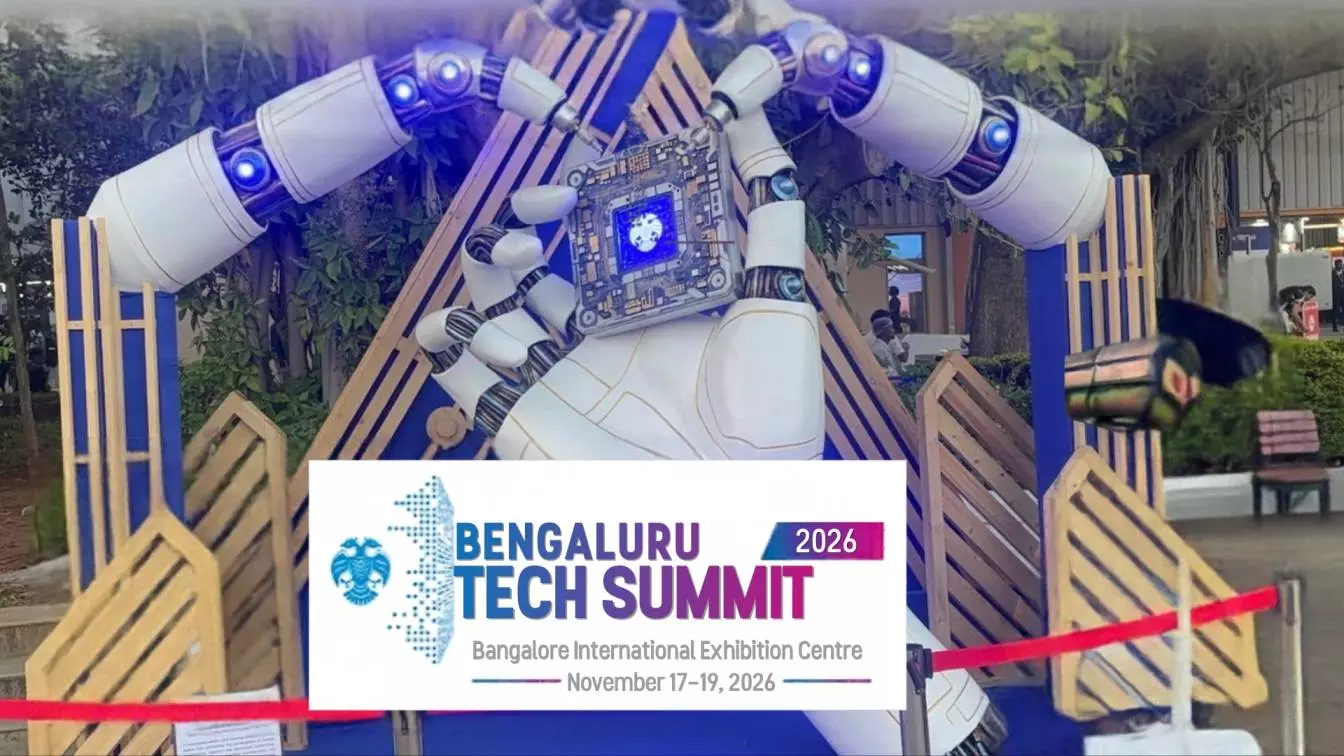
Robots, AI, innovations steal the show at Bengaluru Tech Summit 2026
From defence robots and lunar technology to smart farming and healthcare, event showcases innovations that could transform everyday life

The robotics pavilion emerged as one of the biggest crowd-pullers at the recently-held 29th edition of the Bengaluru Tech Summit.
Under the theme 'AI & Beyond', the event featured exhibitors, startups and innovators showcasing technologies spanning robotics, defence, space, agriculture, healthcare and everyday applications at the Bangalore International Exhibition Centre.
At the happening robotics pavilion, visitors gathered to watch machines walk, greet people and interact in real time. Beyond the demonstrations, innovators showcased how robots are being trained to perform risky, repetitive and precision-based tasks traditionally carried out by humans.
Reinforcement learning
One exhibitor explained how robots acquire new skills through reinforcement learning, comparing the process to humans training at a gym to achieve a fitness goal.
"Like how humans have a brain learning that skill, the same thing, it will save it," the exhibitor explained, describing how movements are translated into robotic instructions and stored in the machine.
The time required to train a robot depends on the complexity of the task. While simple pick-and-place movements could take a week to learn, more complicated movements and skills could require months of training. Once a skill is acquired, the robot can perform the task without constant human intervention.
Defence applications
The exhibition also featured M3, a robotic system developed in collaboration with the defence sector and equipped with an autonomous payload.
Another robot, Indus, was primarily designed for logistics, with the objective of replacing mules used by defence personnel in northern regions. Its potential applications also include inspection, patrolling and surveillance.
Moving beyond ground-based robotics, the exhibition showcased technologies designed for the skies and outer space, including surveillance drones and space technology models.
Technology on the moon
Among the space technology innovations was Orbit Beyond, which showcased its work on infrastructure for the Moon.
"We develop power nodes and AI data infrastructure for the Moon, so that people when going to stay on the Moon, they can use this infrastructure," a representative explained.
The technology is aimed at developing essential infrastructure that could support human activities on the lunar surface.
Farming innovations
The Agritech section focused on technologies designed to make agricultural operations easier and improve farming practices.
One exhibitor showcased its seaweed cultivation and processing operations, explaining how most of its farms are currently located in Indonesia, while a smaller share of cultivation takes place in India.
"90% of our farms are located in Indonesia," the representative said, explaining that the company operates a one-square-kilometre seaweed farm using its patented boards and other technologies.
The cultivated seaweed is processed to extract sap before being transported to India. The company has a production facility in Thoothukudi, Tamil Nadu, where the material undergoes hydrolysis and other processing techniques.
Healthcare solutions
Healthcare technology innovators presented products addressing everyday health concerns, including eye strain and dry eyes.
One exhibitor highlighted how increased laptop usage, particularly among younger people working in air-conditioned environments for extended periods, has contributed to eye-related discomfort.
Explaining the problem, the representative said that prolonged screen exposure can leave people with tired and strained eyes by the end of the day.
The showcased product aims to help alleviate symptoms associated with dry eyes, offering a technology-based solution to a common concern among people who spend long hours in front of screens.
Smarter everyday living
The startup section featured solutions aimed at improving everyday convenience. Among them was SleepyOne, a smart rest pod designed to provide affordable resting facilities in public spaces such as railway stations and airports.
The pod comes with several features, including a mattress, projector, star ceiling and two LED lights. A touchscreen interface allows users to control the lighting systems inside the unit.
The innovation aims to offer travellers and other users a dedicated space to rest in busy public locations.
Student innovations
University pavilions were another major attraction, with student teams presenting prototypes developed in their college laboratories.
One such project was a remotely controlled robot that replicates a person's physical movements using real-time image processing.
The technology allows a person to operate the robot from anywhere in the world using a device, with the machine replicating the movements performed by the operator.
Explaining its potential applications, a student said the technology could be particularly useful in situations involving dangerous environments, such as gas leakage repair operations.
"So I'll be in a clean room and I'll do the actions and this robot will go there," the student explained, highlighting how the technology could allow humans to perform tasks remotely without physically entering hazardous locations.
The system is designed to work without requiring heavy sensors. An operator simply stands in front of a camera and performs the required actions, which are then replicated by the robot.
Amid the serious technology demonstrations and startup pitches, interactive zones across the exhibition also kept visitors engaged, adding a lighter touch to the innovation-focused event.
From autonomous robots and lunar infrastructure to agricultural technology and healthcare solutions, the Bengaluru Tech Summit offered a glimpse into how emerging technologies are moving beyond experimentation and finding applications in the real world.
Watch the video here.