Bengaluru Metro Pink Line opens, but gaps remain: What first-day commuters say
Riders save time on Bannerghatta Road but want shorter intervals and feeder buses before Monday’s rush

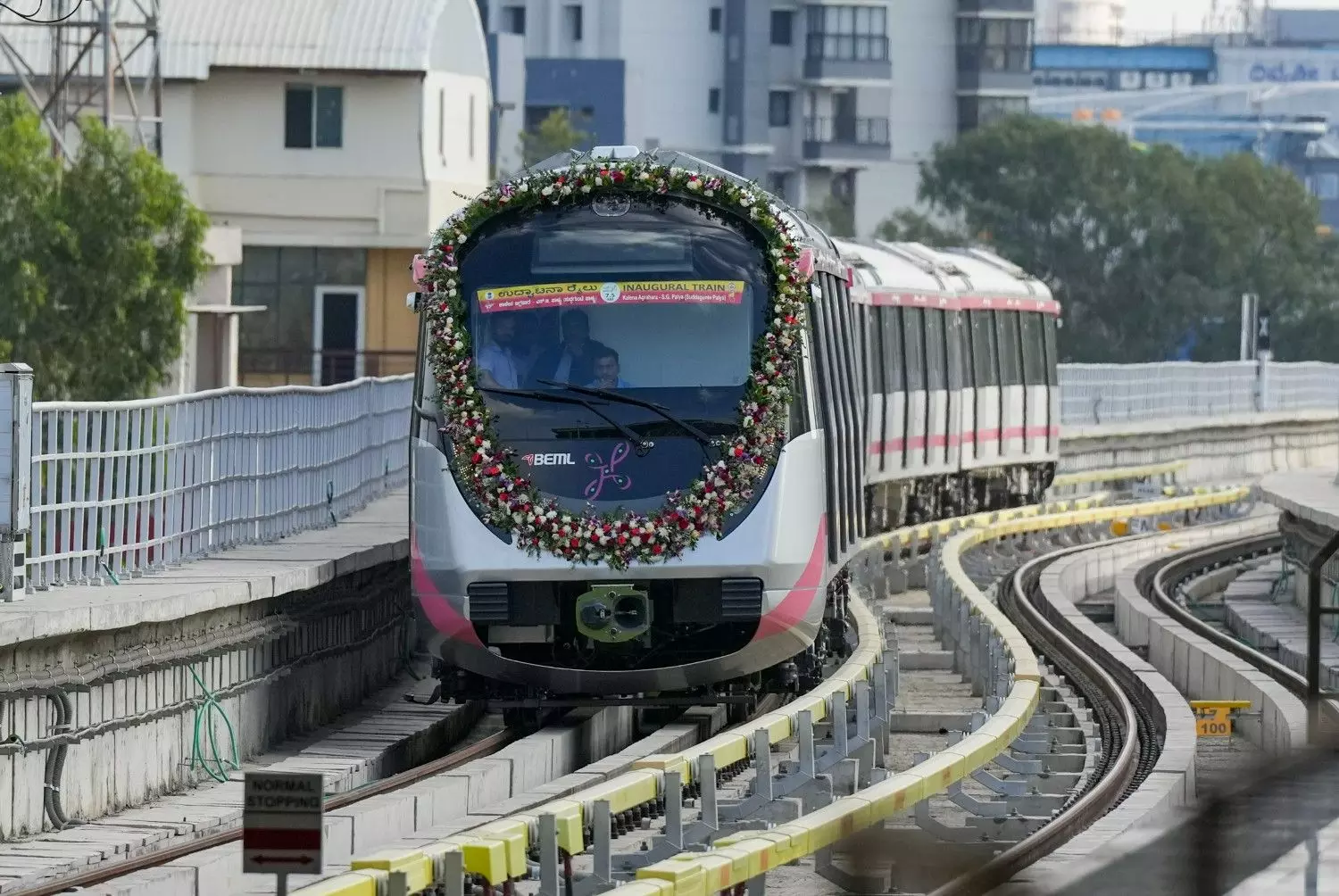
Bengaluru’s Pink Line opened to commuters on Saturday (November 14), a day after Prime Minister Narendra Modi flagged it off, but its first morning exposed gaps in connectivity, feeder buses and platform safety.
While the stretch eases traffic on Bannerghatta Road, a ground report by The Federal found that north and south Bengaluru remain disconnected, platforms lack basic safety bars and last-mile feeder buses are absent.
Sanctioned under Phase 2 in 2014, with civil work beginning in 2017-18 against an original completion target of 2023-24, the 21.26-km Pink Line was designed to link Kalena Agrahara in the south to Nagawara in the north.
6 stations operational
Nearly a decade later, only a 7.5 km elevated southern stub covering six stations (Kalena Agrahara, Hulimavu, IIMB (Bilekahalli-IIMB), NS Palya-JP Nagar 4th Phase, Jayadeva Hospital and SG Palya (Suddagunte Palya) (formerly Tavarekere)) has entered commercial service after receiving safety clearance on October 28. The first train on the Pink Line started at 6 am on Saturday.
Also read: Bengaluru-Madgaon (Goa) Vande Bharat Express: Stations, timings, ticket fares
The remaining 13.76 km underground corridor of 12 stations (Dairy Circle, Lakkasandra, Langford Town, National Military School, Mahatma Gandhi Road, Shivajinagar, Bangalore Cantonment Railway Station, Pottery Town, Tannery Road, Venkateshpura, Kadugondanahalli, Nagawara), the crucial link into central Bengaluru and northern tech parks, remains under trials until March-May 2027.
This rollout directly undercuts the importance of south Bengaluru, one of the city’s densest residential and commercial belts that relies on north-south mobility. Because the Pink Line halts abruptly at SG Palya, commuters travelling from south Bengaluru towards northern IT hubs in Nagawara, or heading onward to Kempegowda International Airport, are forced to switch midway to buses.
At the Jayadeva Hospital station, Bengaluru’s key multi-line junction linking RV Road, the Yellow Line, and the Pink Line, operational preparedness visibly lagged behind Day One footfall.
Conversely, thousands of daily commuters travelling from north Bengaluru to southern residential neighbourhoods, hospitals, and educational institutions face the same broken link, while at the southern tip, the lack of direct connectivity and feeder links to Electronic City leaves another major tech corridor stranded.
Major IT hubs remain out of reach
For thousands of software engineers, halting the line at SG Palya delivers only partial relief until the northern underground tunnel opens.
Also read: Congress vs Congress: Mekedatu row sparks spat between Shivakumar, Manickam Tagore
"Initially, the plan was to inaugurate by August 15, but it kept getting postponed. We used to check the newspaper every week for a new deadline," Giri Prasad, a software engineer at Manyata Tech Park, told The Federal. "Bannerghatta Road is notorious across the city for traffic jams, so having a definite travel time is a relief. I urge the authorities to complete the Nagawara stretch within the stipulated time so employees at Manyata Tech Park can ditch cars and buses for the metro."
Because the northern tunnel remains closed, professionals commuting towards Manyata Tech Park, which employs over one lakh workers, must still exit mid-way and switch back to road transport, limiting the corridor’s immediate ability to pull private cars off the road.
Missing feeder buses trap Electronic City commuters
At the southern end, a similar connectivity gap surfaces the moment passengers exit station gates. Muniraju, a commuter who shaved nearly 40 minutes off his morning trip from Bommasandra, pointed out that without dedicated feeder buses within a five-kilometre radius of stations, workers remain stuck in long traffic jams. "People still have to leave at 6 am because feeder buses to interior tech corridors are missing, and road bottlenecks easily consume two hours," he said.
When passengers must rely on infrequent buses or costly autos, feeder buses within a five-kilometre radius save significant time at road choke points.
Platform safety gaps at new stretch
At the Jayadeva Hospital station, Bengaluru’s key multi-line junction linking RV Road, the Yellow Line, and the Pink Line, operational preparedness visibly lagged behind Day One footfall. Platforms lacked safety barriers.
A platform on the Pink Line is decked up ahead of the inauguration on Friday (November 13) by Prime Minister Narendra Modi. PTI
"Even though it is the first day today, nearly 1,000 passengers have already turned up since morning," Sunil Kumar, platform in-charge at Jayadeva Station, told The Federal.
"An eight-minute frequency will be completely insufficient once weekday office rush begins, they must bring it down to five minutes."
When The Federal questioned him about the missing platform safety bars, he admitted authorities were taking a wait-and-watch approach: "Since operations just started today, we cannot predict the crowd movement yet. We will observe the footfall first and then decide what needs to be done."
However, safety bars were missing at all metro stations on the new pink stretch, and waiting to observe live passenger flow before installing safety barriers at a high-footfall interchange raises immediate safety concerns ahead of weekday peak crowds.
Train frequency and peak hour crowd equation
Even for commuters whose workplaces align with the operational stations, current train intervals risk buckling once weekend traffic gives way to Monday office peak hours.
"The Metro cuts a two-to-three-hour cab or bus commute down to an hour, which is great," said Ashwini, an IT worker. "However, an eight-minute frequency will be completely insufficient once weekday office rush begins, they must bring it down to five minutes."
Pink Line train at a platform on Saturday.
On established Namma Metro corridors, eight-minute waits during peak hours rapidly trigger platform crowding and coach congestion.
Everyday relief amid larger civic voids
For students and hospital visitors moving strictly along the Bannerghatta Road belt, the immediate benefits remain clear. "The fare matches the bus, and it saves crucial time during evening traffic jams," said Monish, a student. Metro supervisor Abhishek, who switched from taking the bus on Saturday, added, "Traffic used to be terrible, and this line will greatly help students and hospital visitors along the stretch."
Viewed against nearly a decade of barricaded roads, construction dust, cost escalations, and shifting deadlines, the new stretch offers commuters only half-hearted relief. Bengaluru’s residents are left celebrating a partial opening while waiting and questioning when the full line will finally deliver on its promise.