



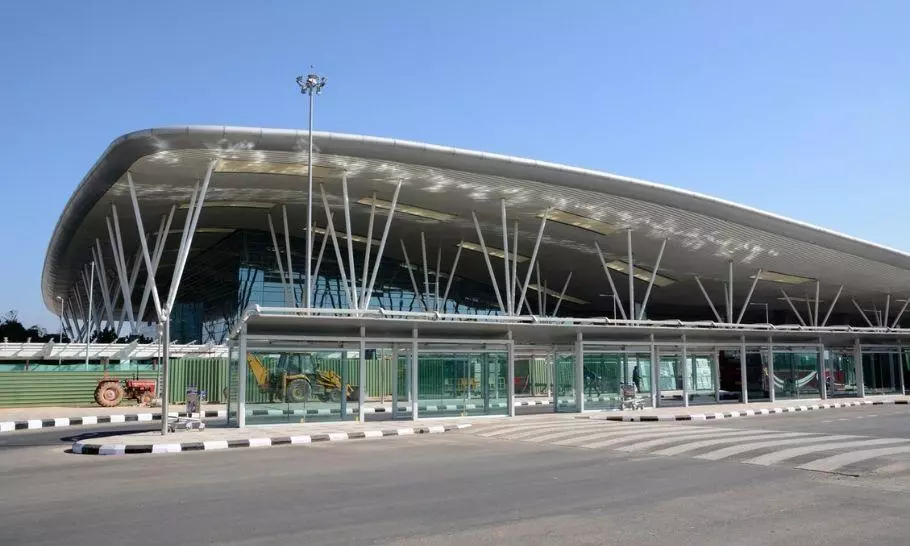
Bengaluru airport: User development fee slashed for passengers
UDF for departing domestic passengers has been fixed at Rs 300 per passenger, while it is Rs 997 for international travellers

Mumbai, Aug 21 (PTI) Regulator AERA on Friday steeply slashed the user development fee at the Bengaluru international airport to Rs 300 for domestic and Rs 997 for international passengers for the five-year control period till March 2031.
For the first time, the watchdog implemented the incremental ARR (Average Revenue Requirement) framework wherein the cost borne by the Bengaluru airport operator can be recovered from the passengers only after completing the high-value capex projects.
Previously, the User Development Fee (UDF) was recovered from the flyers before project completion.
UDF for departing domestic passengers has been fixed at Rs 300 per passenger, lower than the existing amount of Rs 550 and also lower than Rs 450 proposed by the airport operator BIAL, Airports Economic Regulatory Authority of India (AERA) said on Friday.
"Similarly, UDF for departing international passengers has been fixed at Rs 997 per passenger, as against Rs 1,215 proposed by the airport operator and the existing UDF Rs 1,500.
"Further, the landing charges have also been rationalised and determined at Rs 442 per MT (Metric Tonne) for domestic flights and Rs 652 per MT for international flights for the control period," it said in a release.
Domestic passengers account for around 84 per cent of the total passenger traffic at the Bengaluru airport.
While the fourth control period is from April 1, 2026 to March 31, 2031, the revised UDF amounts will be levied from September 1, 2026.
UDF will be Rs 125 and Rs 426 for the disembarking domestic and international passengers, respectively at the airport which is operated by the Bangalore International Airport Ltd (BIAL).
Regarding the incremental ARR, the regulator said the approach is intended to ensure that tariff recovery is more closely aligned with the actual availability and use of the airport's capex projects, and thus protect airport users from premature tariffs for assets that are not yet operational.
"This is also aimed at encouraging the airport operator for timely execution and commissioning of big capex projects at the airport and thus reduce the risk of over-recovery for passengers and airlines in case of delays, deferment, non-execution of such planned capex projects," it noted.
Under the incremental ARR framework, the cost of these identified high capex projects does not get loaded in the airport tariff from the 1st year of the 5-year control period but would instead be recovered through an incremental tariff from the date the respective assets are completed, commissioned and put to use for the airport users.
While the airport operator BIAL proposed a baseline ARR of Rs 41,398.93 crore (Rs 35,252.08 crore in present value terms) for the fourth control period, AERA considered a baseline ARR of Rs 14,604.31 crore (Rs 11,751.55 crore in present value terms).
"This translates into a baseline Yield per Passenger (YPP) of Rs 390.42 per passenger, which has been suitably apportioned between landing and parking charges, UDF and other airport charges," the release said.
For the airport, AERA adopted the incremental ARR approach for identified high-value projects, including the ECT, T2 Phase 2 Terminal and T2 Phase 2 Apron, coming only in the fourth year, 2029-30.
"Accordingly, incremental tariff recovery will commence only after the respective assets are completed, commissioned and put to use, thereby aligning tariff recovery with the actual availability of infrastructure to users.
"Thus, the UDF for BIAL for the 4th control period (2026-31) has been kept at a nominal Rs 300 per departing domestic passenger. Domestic passengers account for around 84 per cent of the total passenger traffic at Bengaluru airport. This will make air travel affordable to domestic passengers, while supporting the growth of domestic aviation," the release said.
In a statement, BIAL said the revised UDF rates, effective from September 1, will remain applicable until August 2029, following which the tariff will undergo modification based on the completion of key projects including Terminal 2 Phase 2 and associated airside/landside facilities.
"An important change under the new order is the introduction of UDF for both arriving and departing passengers. AERA has determined that the charge should be shared between arriving and departing passengers, consistent with the approach adopted across other newly launched and major airports in India," it added.
Elaborating, BIAL said the move does not translate into an overall increase in the base UDF.
"Despite undertaking a massive expansion project, the combined domestic UDF under the new structure will be Rs 425 compared with the existing Rs 550 charged to a departing domestic passenger, while the combined international UDF will be Rs 1,423 compared with the existing Rs 1,500 charged to a departing international passenger," the statement said. PTI