Uttar Pradesh politics has no shortage of issues, but the Shankaracharya Avimukteshwaranand episode has dominated headlines for some time now — and not just because the Opposition is pressurising the government over it.
What appears to be keeping the controversy alive, even after the Magh Mela has concluded, is the simmering anger against the manner in which the Shankaracharya's palanquin was stopped in Prayagraj, and the batuks (young disciples) had their shikhas (sacred tufts of hair) yanked.
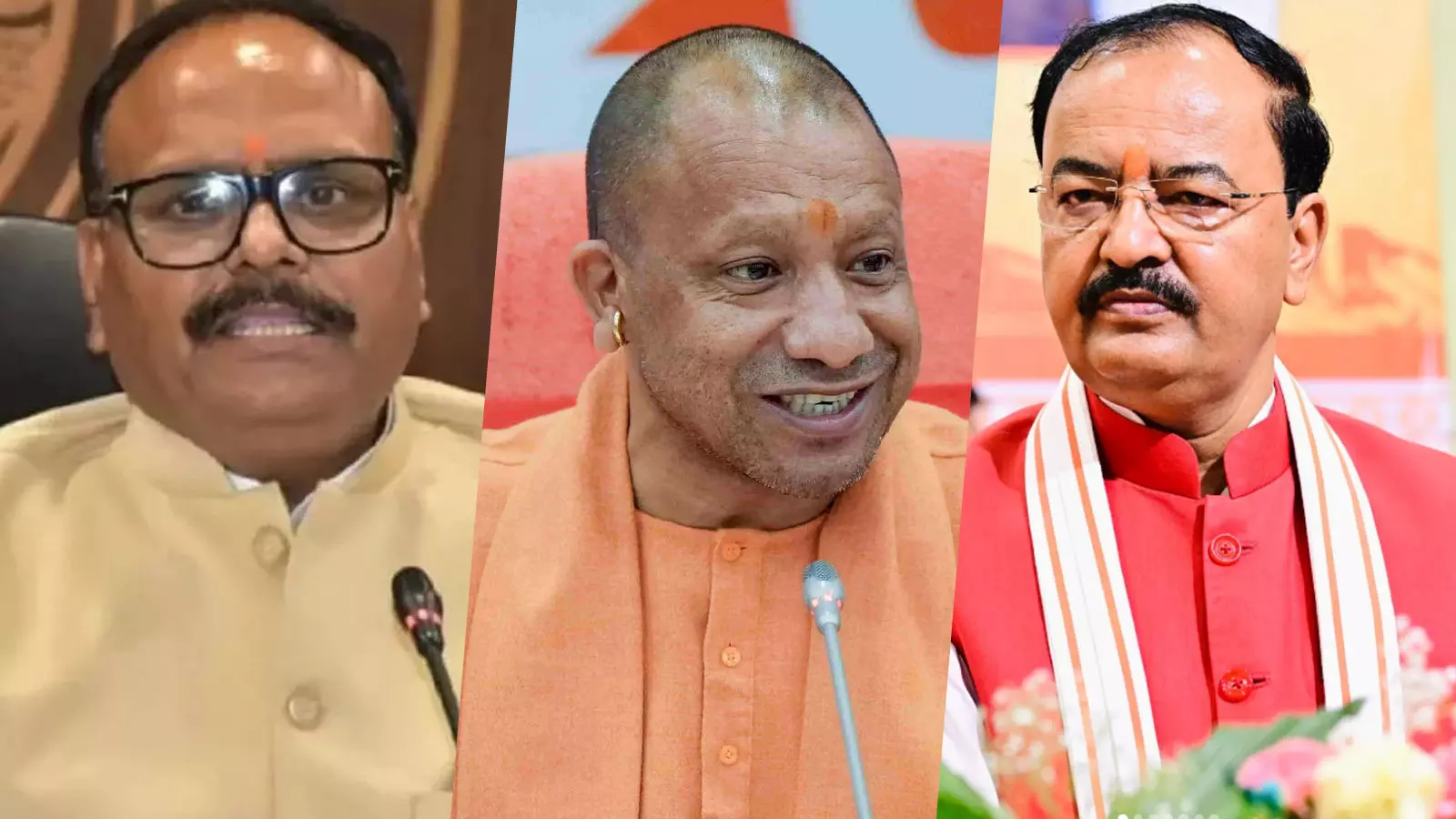
Notably, three of UP's most senior leaders — CM Yogi Adityanath, deputy CM Keshav Prasad Maurya, and deputy CM Brajesh Pathak — have struck significantly different notes on the matter. The question worth asking is why the government's number one, two, and three are taking different stances on the same issue.
Who said what?
Deputy CM Brajesh Pathak was unequivocal in his condemnation: "The disciples' shikhas should never have been pulled. If force was necessary, a lathi could have been used. Pulling the shikha is a mahapap (mortal sin) — the consequences will be felt."
The Shankaracharya had gone on a hunger strike over the episode and refused his ritual dip, and ultimately left for Kashi without performing it.
During the stand-off, deputy CM Keshav Prasad Maurya appealed to Avimukteshwaranand to take the dip and end the dispute, saying he would personally intervene if asked. When nothing moved on the ground, the Shankaracharya declared that Maurya was "spineless" and was waiting for nothing in particular.
CM Yogi Adityanath chose a different tack. He questioned whether anyone could simply call themselves a Shankaracharya, pointing to the Vidwat Parishad (council of scholars) that adjudicates such matters.
"Just as not everyone in UP can call themselves chief minister or a minister, there is a system, and everyone must respect it," he said. Avimukteshwaranand fired back: "How can a yogi be a king? The UP chief minister wants to be a Khalifa — a concept that has no place in Sanatan Dharma."
Old wounds, new eruptions
Political observers say the hostility has a long backstory, and the Shankaracharya episode is merely the immediate trigger.
When the BJP swept to power in UP in 2017 — ending two decades in the wilderness — it was Maurya who was state BJP president, widely credited with the organisational groundwork behind that victory. Yet, when it came to the chief minister's post, he lost out to Yogi, and relations between the two have run hot and cold ever since.
Ahead of the 2022 elections, Maurya made little secret of his frustrations. The central leadership intervened and smoothed things over, and the BJP won again — though with a reduced tally. The high command's faith in Yogi held, but the undercurrent of tension never really went away.
Why Pathak spoke up?
Senior journalist Sunita Aaron, who tracks UP politics closely, pointed out that Pathak has long harboured a quiet grievance — that while he heads the health ministry, he finds himself running into obstacles at every turn. If a deputy CM feels his work is being obstructed, the direction from which that obstruction is coming from not hard to guess, Aaron added.
With Brahmin community sentiment now coming to the fore, some may see the moment as an opportunity.
In politics, such manoeuvrings are hardly unusual. But for a party like the BJP — which markets itself as different in conduct, character, and leadership — having its three top state leaders speak in three different voices on the same issue sends a clear signal: all is not well.
(This article was originally published in The Federal Desh)