



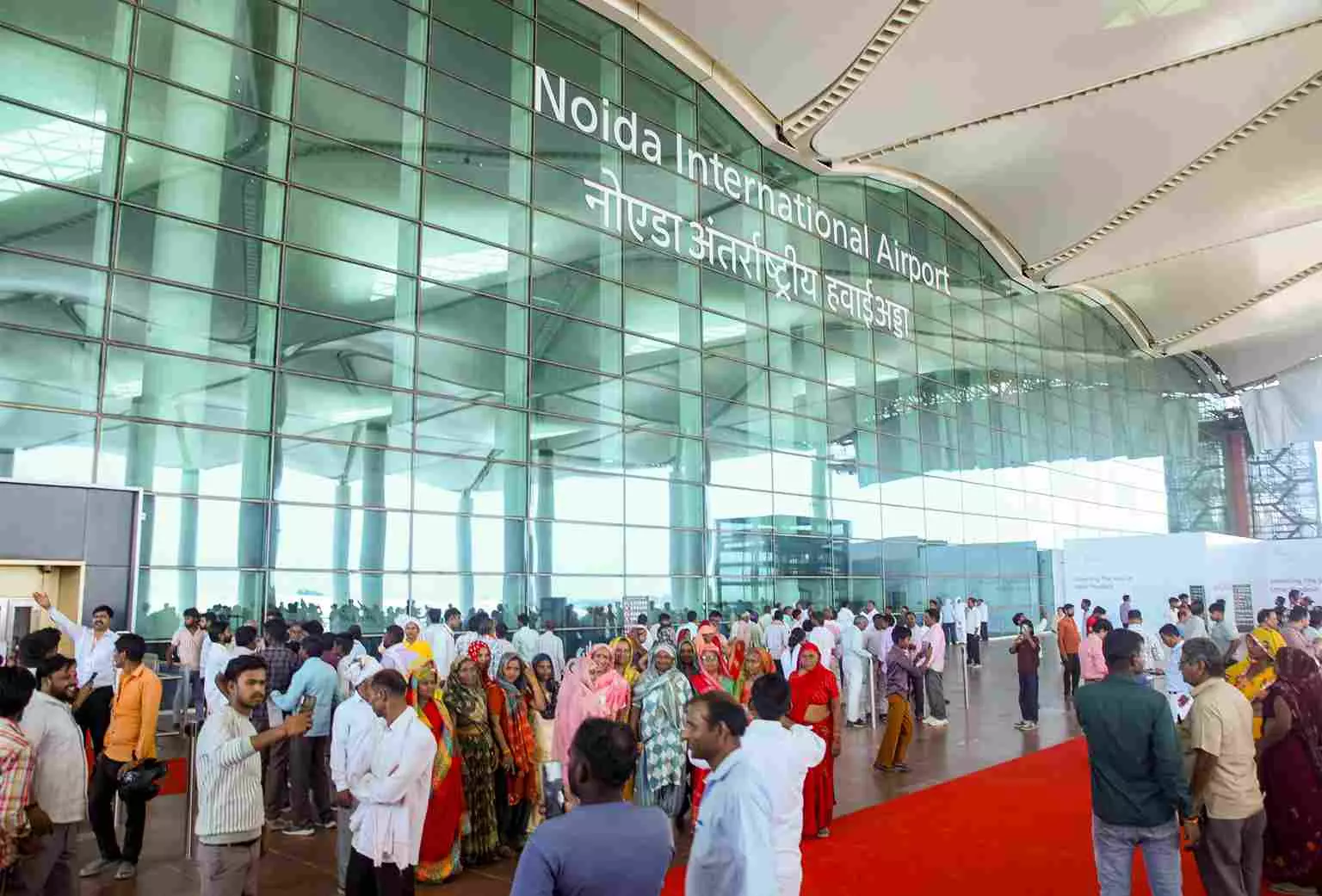
Noida airport launch: A look at key features, connectivity and expansion plans
PM Modi launches first phase of Jewar Airport; from smart travel tech to 225 million capacity, here’s how it will transform Delhi-NCR connectivity and economy

The Noida International Airport, also known as Jewar Airport, reached a significant milestone on Saturday (March 28) with Prime Minister Narendra Modi inaugurating its first phase.
Situated in Uttar Pradesh’s Gautam Buddh Nagar district near Delhi-NCR, the airport has been developed to enhance connectivity and reduce the burden on Delhi’s aviation network.
Describing the occasion as one of “immense importance” for Uttar Pradesh and the NCR, the prime minister said the project would boost commerce, improve regional connectivity, and help ease congestion at Delhi’s Indira Gandhi International Airport.
Also read | Noida's Valentine's Day deaths: Police probe man's WhatsApp note, caste angle
What sets Jewar Airport apart is not just its scale, but its focus on modern, passenger-friendly facilities designed to meet global standards. Here’s a detailed look at what the airport offers:
Scale, capacity and technical capabilities
Jewar Airport stands out for its scale and technical capabilities. Spread over 11,742.45 acres, it will feature an 87-acre multi-modal cargo hub and a dedicated maintenance, repair, and overhaul (MRO) facility, the first of its kind within an Indian airport. Once fully completed, it is expected to become the country’s largest airport, with a projected capacity of 225 million passengers annually.
The airport includes a 3,900-metre runway capable of handling wide-body aircraft such as the Boeing 777-300ER, along with advanced navigation systems like the Instrument Landing System (ILS) and modern airfield lighting. Detailed cargo infrastructure, including terminals, warehouses, and logistics zones, is also planned to support large-scale operations.
Tech-enabled travel experience from entry to boarding
Jewar Airport is designed to offer a smooth, technology-driven travel experience from entry to boarding. Passengers will be able to use self-check-in kiosks to avoid long queues, biometric-based boarding under DigiYatra, automated baggage drop counters, and paperless travel systems. These features are expected to significantly reduce waiting times and make the overall airport experience faster and more convenient.
Modern terminal built for comfort and efficiency
The terminal has been designed with a focus on comfort, efficiency, and modern aesthetics. It will feature spacious waiting lounges with comfortable seating, along with premium lounges for business and first-class passengers. Duty-free shopping zones with international brands, as well as a range of restaurants, cafés, and food courts, will enhance the travel experience. The architecture emphasises natural lighting and contemporary design to create a pleasant environment for passengers.
Strong road, rail and last-mile connectivity
One of Jewar Airport’s key strengths is its planned connectivity. The airport is directly accessible via the Yamuna Expressway and will be linked through proposed metro and rapid rail networks. In addition, taxi and app-based cab services will be readily available, along with large multi-level parking facilities. This integrated transport network is expected to make travel convenient for passengers from Delhi, Noida, Greater Noida, and surrounding areas.
Sustainable infrastructure with a green focus
Jewar Airport is being developed as one of India’s most environmentally sustainable airports. It incorporates renewable energy sources such as solar power, along with rainwater harvesting systems and efficient waste management and recycling processes. The buildings are designed to be energy-efficient, helping reduce the overall carbon footprint while maintaining high operational standards.
Cargo capabilities and plans for future growth
Beyond passenger services, the airport is set to become a major logistics and aviation hub. It will include dedicated cargo terminals to facilitate faster movement of goods and MRO (Maintenance, Repair, and Overhaul) services to support aircraft operations. Future phases will add multiple runways and expand capacity to handle increasing air traffic, positioning Jewar as a key infrastructure asset in the region.
Also read | Are governance failures and accountability lapses to blame for Noida techie’s death?
This is expected to boost trade, generate employment, and strengthen the region’s economy.
The Noida International Airport is more than just a new aviation facility; it reflects the future of air travel in India. With its emphasis on smart technology, passenger comfort, sustainability, and connectivity, it is poised to emerge as a major aviation hub in the years ahead.
As development continues, Jewar Airport is likely to transform not only travel in the Delhi-NCR region but also the broader economic landscape.