Akhilesh’s Rath Yatra in Raebareli: Why Congress matters in SP’s PDA scheme
Akhilesh Yadav’s PDA outreach begins with a show of strength in Raebareli, but Congress remains crucial to holding Dalit and Muslim support in 2027 polls

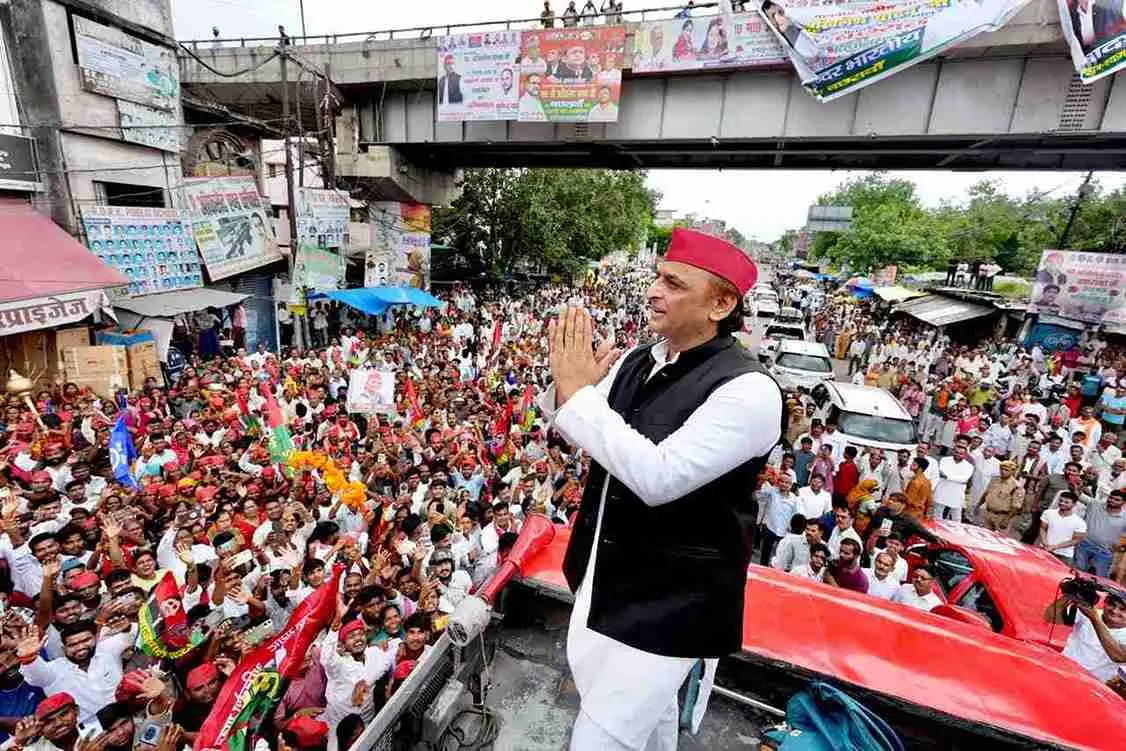
The stretch of the Lucknow-Prayagraj Expressway near the Bachhrawan toll plaza practically turned red on Thursday (September 24), as Samajwadi Party supporters lined the road under an overcast sky to welcome party supremo Akhilesh Yadav’s Rath Yatra.
As Akhilesh climbed atop the specially designed bus to greet supporters, the crowd burst into loud cheers in support of him and his late father, Mulayam Singh Yadav. Party workers even showered flowers on him from a bulldozer-mounted crane. The Yatra culminated with Yadav meeting Harchandpur MLA Rahul Lodhi.
SP’s PDA formula
The grand spectacle was orchestrated to formally, and loudly, announce the party’s core electoral formula of Pichhda, Dalit and Alpsankhyak (PDA) at the centre of its early mobilisation for the 2027 polls.
Also read: Motormouths, mixed messages and a fragile alliance: Congress-SP’s UP challenge
The SP says that the Yatra had been preponed from its initial schedule in October in the wake of the September 17 clashes at Feroze Gandhi Degree College in Raebareli city between members of the RSS-linked ABVP and the SP-affiliated Chhatra Sabha.
“The Yatra’s sole objective is to reassure the marginalised and oppressed communities across caste and religious lines that the Akhilesh Yadav-led Samajwadi Party stands by their side like a rock,” SP spokesperson Abhishek Bajpai told The Federal.
“Moreover, Akhilesh-ji’s visit aims to boost the morale of the Chhatra Sabha leaders who were manhandled and did not receive fair representation from the administration,” he added.
Why Raebareli?
Meanwhile, the timing and the location to kickstart the PDA outreach ahead of the 2027 elections, are hard to miss.
Raebareli is not just another district on the SP’s political map. It is a Congress stronghold, and Rahul Gandhi bagged the Lok Sabha constituency in 2024.
Since then, both the parties have publicly reiterated that they wish to keep the alliance intact for the 2027 UP assembly elections too, even as the two parties are yet to work out the details of seat-sharing.
Whose Raebareli is it anyway?
The SP currently has three MLAs among the five Assembly segments under the Raebareli Lok Sabha constituency—Bachhrawan, Harchandpur and Sareni. The remaining two, Raebareli and Unchahar, are represented by BJP MLAs.
That gives the SP a compelling argument during the seat-sharing negotiations with Congress that are slated to be held in coming week.
Also read: In Akhilesh starting PDA yatra from Rahul’s Raebareli, a message to Congress?
The Congress, meanwhile, has its own political claim to the region because of the Gandhi family’s longstanding association with Raebareli.
So, while SP leaders have described the Raebareli rally as a local mobilization drill, political observers have viewed it as a possible “show of strength” to, perhaps, claim a vantage point when the negotiations commence.
“Seat sharing has always been a thorny issue for the both parties. So, it’s natural to draw attention and interpretations. Both the parties want to claim more seats. One cannot say with absolute certainty that this is a pressure tactic or not but it’s surely going to invite debate and discussions since this is going to be high-stakes elections for both the parties,” pointed out a senior political observer and analyst JP Shukla.
Will PDA formula work again?
The PDA electoral formula, SP chief Akhilesh Yadav proudly boasts, ushered the INDIA bloc to bag 43 of the 80 seats in 2024. While 37 of those seats went to SP, Congress managed to wrest six.
The alliance wants the same formula to stop the sitting Chief Minister Yogi Adityanath-led Bhartiya Janta Party to return to power for the third consecutive time.
Assembly elections, however, are a different ball game altogether. Psephologists and veteran journalists who have followed UP elections over several decades argue that the D in the PDA, which stands for Dalit, cannot be taken for granted.
Dalits versus Yadavs
A senior journalist and political commentator Anand Vardhan argues that traditionally Dalit community does not gel well with the Yadav community and that these longstanding caste equations become lot more predominant during assembly polls than Lok Sabha elections.
“Dalits would almost never go with Yadav. That has always been the case. They would much rather go with Thakurs and Brahmins and vote for the BJP henceforth. That’s why the decline of the BSP and the political vacuum thus created benefitted BJP more. And whatever Dalits votes did go to SP were because of its alliance with Congress,” Vardhan argues.
Historically, the Dalit voters in the Hindi heartland have kept a safe distance from the SP’s Yadav base. Their political imagination and preferences have been instead shaped by the decades-long BSP’s mobilisation under Kanshi Ram and Mayawati. However, with the BSP’s decline and the resulting political vacuum in the subaltern space, the Dalit vote has not remained monolithic.
Why Congress matters
The 2024 Lokniti-CSDS data offers a glimpse of that shift. The INDIA bloc secured 56 per cent of non-Jatav Dalit votes in Uttar Pradesh, compared with 29 per cent for the NDA. Among Jatavs, however, the picture was very different: The BSP retained 44 per cent, while the INDIA bloc received 25 per cent and the NDA 24 per cent.
The data reflects that the decline of the BSP opened space for the INDIA bloc, but that did not amount to a wholesale transfer of the Dalit electorate. “And this is where Congress comes into the picture and becomes more than just a seat-sharing partner,” Vardhan reasoned.
The ‘alpasankhyak’ factor
Lending weight to that argument, another senior journalist and political commentator Anando Bhakto argued that after Mayawati’s loss of prominence in UP politics, Dalits are looking for a safe home.
“Akhilesh Yadav has to understand that given his past regime’s reputation of lawlessness, and his core Yadav supporters’ arrogant social interactions with Dalits, he has no shot on that vote unless the Congress is a substantial partner in his alliance and inspires faith among Dalits,” he argued.
Also read: How BJP plans to weaponise UCC to gain edge in poll-bound UP, break Oppn unity
Political scientists further contest that besides securing Dalit votes, the SP also needs to focus on consolidating Muslim votes, which could split and transfer to smaller but consequential players like Asaduddin Owaisi.
“Besides Dalits, the Muslim vote should not be taken for granted either,” he said.
Need for coalition
The harder task, then, for Akhilesh will be to turn a successful electoral coalition into a durable political one.
A good seat-sharing arrangement could thus, experts suggest, matter more than the division of constituencies based on show of strength. It could allow the SP to retain its Yadav-Muslim core, preserve its Dalit gains and, through Congress, seek openings among sections of Brahmin voters.
“The key to shattering the BJP’s superior social coalition lies in defecting a section of the Brahmins, and in making inroads among Dalit voters. The ‘Congress bulwark’ is also required to tap into Brahmins, who are otherwise not very upbeat about handing Yogi Adityanath a third term,” Bhakto noted.