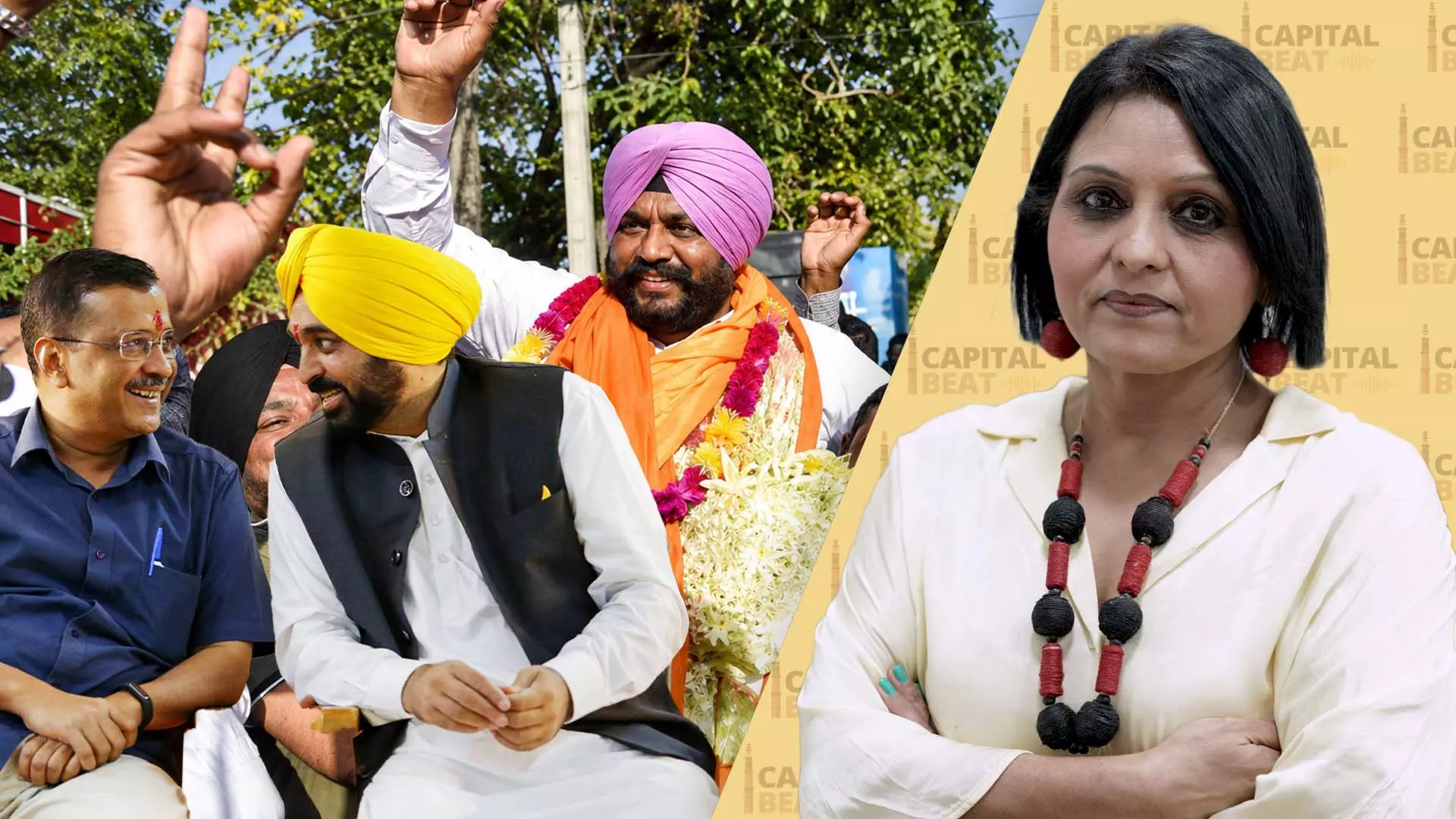
What do Punjab’s civic election results mean for AAP’s 2027 prospects? | Capital Beat
While AAP dominated Punjab's local body elections, questions remain over governance, Opposition strength and whether local results can predict 2027

The Aam Aadmi Party’s emphatic performance in Punjab’s civic polls has reignited debate over its political future, but experts remain divided on whether the results signal a genuine revival ahead of the 2027 Assembly elections. While AAP won 958 of the 1,977 wards contested across the state, panellists cautioned against reading the outcome as a definitive indicator of what lies ahead.
In this episode of Capital Beat, The Federal spoke to Prof Jagrup Singh Sekhon, political analyst; Jagdeep Singh Sindhu, senior journalist and political commentator; and TK Rajalakshmi, Senior Deputy Editor of Frontline, to assess whether the civic poll results reflect a resurgence for AAP or merely provide temporary relief to a party facing significant challenges.
Punjab Chief Minister Bhagwant Mann’s party secured nearly half the wards in the elections, while Congress finished a distant second with 397 seats. The Shiromani Akali Dal won 192 seats and the BJP secured 172. Independents also made a notable impact, winning 251 wards.
Not a barometer
Sekhon argued that local body elections should not be treated as a reliable predictor of Assembly election outcomes.
He pointed out that AAP had performed poorly in several major municipal corporation elections held earlier, particularly in cities such as Amritsar, Jalandhar and Ludhiana. According to him, the latest civic polls involved smaller municipal bodies and therefore reflected a different political dynamic.
Also read | Punjab civic polls: AAP wins over 690 wards, counting of votes underway
He noted that ruling parties often enjoy structural advantages in grassroots elections and said similar trends had been witnessed in Punjab in the past. Congress, for instance, dominated local body elections in 2021 but suffered a crushing defeat in the subsequent Assembly elections.
For Sekhon, the result should be viewed more as a morale booster than a decisive political endorsement.
He argued that Punjab continues to face serious concerns relating to law and order, economic distress, unemployment and agrarian issues. These challenges, he said, remain central to voter sentiment and could shape the 2027 contest more than civic poll outcomes.
Warning signs
Despite AAP’s victory, Sekhon described the result as a “major challenge” rather than a cause for celebration.
He pointed to reported tensions between the party’s national and state leadership and suggested that the party must undertake serious introspection before the next Assembly election.
According to him, AAP’s inability to cross the 1,000-seat mark despite being in power should be viewed carefully, particularly when compared to previous ruling parties that performed even more strongly in local polls before being voted out at the state level.
“The challenge is very much there,” he said, adding that no political party can assume continuity in power based solely on local body election victories.
Sekhon maintained that while AAP can use the result to project confidence, it would be premature to conclude that the party has secured a strong position for 2027.
Questions over fairness
Sindhu also rejected the notion that the civic poll results could serve as a yardstick for the next Assembly election.
He argued that local elections are fundamentally different because they revolve around ward-level governance and local issues rather than broader state-wide political considerations.
Sindhu said the outcome may offer some consolation to AAP after recent political setbacks, including defections and internal disagreements. However, he highlighted allegations made by opposition parties regarding the conduct of the elections.
According to Sindhu, Congress and other opposition parties accused the state government of using administrative machinery to influence the electoral process. He referred to claims involving rejected nominations, obstacles to filing papers and allegations of police intervention.
He also noted that around 80 AAP candidates were elected unopposed, a figure that opposition parties have cited while questioning the fairness of the electoral process.
“These are controlled results, not free and fair results,” Sindhu claimed, while stressing that such concerns must be considered before drawing wider political conclusions.
AAP’s credibility test
Sindhu further argued that the government’s response to criticism reflected insecurity rather than confidence.
He referred to reports involving a journalist who allegedly faced pressure after publishing a report about possible ticket denials to AAP legislators ahead of the next election. According to him, a government confident about its future electoral prospects would not react in such a manner.
Also read | Punjab Assembly passes trust vote; AAP puts up united front after RS MP defections
Sindhu also questioned AAP’s record on key promises made before the 2022 Assembly election. He cited the delayed implementation of financial assistance for women, concerns over unresolved Sikh issues and the party’s inability to tackle what it had earlier described as entrenched mafias.
For Sindhu, the civic poll results do not erase these governance questions, which could become critical in the run-up to 2027.
Congress factor
While critical of AAP, Sindhu acknowledged that Congress remains a significant political force in Punjab.
He noted that the party’s victory in seven of Punjab’s 13 Lok Sabha seats in 2024 demonstrated its continued relevance.
Although Congress continues to struggle with factionalism, he argued that the party retains substantial support across the state.
Sindhu also urged caution in interpreting civic poll data because many Assembly constituencies are predominantly rural, whereas these elections largely reflected urban and semi-urban voting patterns.
As a result, he said, entirely different political dynamics could emerge when Punjab votes in the Assembly election.
Can Congress capitalise?
Sekhon similarly viewed Congress as the principal challenger to AAP. He argued that BJP has struggled to gain meaningful ground in Punjab despite sustained efforts since its split with the Shiromani Akali Dal.
According to him, Punjab’s political culture has not aligned with the BJP’s approach, limiting its expansion in the state.
Sekhon said Congress’s biggest challenge remains its internal divisions rather than a lack of public support. He claimed that if Congress can unite its leadership and campaign effectively, it could emerge as a serious contender for power in 2027.
He also suggested that Rahul Gandhi’s reported interest in taking a more active role in Punjab politics could strengthen the party’s prospects.
At the same time, he described the Shiromani Akali Dal as a party facing a prolonged structural crisis and questioned its ability to regain political relevance on its own.
Damage control
Rajalakshmi offered a more balanced assessment of AAP’s performance.
While acknowledging Congress’s continued strength, she argued that the civic poll results indicate that anti-incumbency against AAP is not as severe as many observers had expected.
She pointed to government initiatives such as anti-drug campaigns and welfare measures, including expanded health insurance coverage, as examples of efforts that may have helped the party retain support.
According to Rajalakshmi, AAP’s dominance in urban local bodies suggests that it continues to enjoy significant backing in small towns and urban centres.
Had anti-incumbency been overwhelming, she argued, Congress would likely have emerged as the clear winner.
Instead, the results indicate that AAP has managed a degree of political damage control despite facing criticism over governance and internal turmoil.
Road to 2027
The panel broadly agreed that Punjab’s civic poll outcome has given AAP an important psychological boost. However, none of the speakers viewed the result as a definitive predictor of the 2027 Assembly election.
Also read | BJP has killed democracy by manipulating elections, Punjab will halt its Vijay Rath: Kejriwal
For Sekhon, the verdict is a warning as much as a victory. For Sindhu, it raises questions about governance and electoral fairness. For Rajalakshmi, it demonstrates that AAP remains a formidable force despite predictions of decline.
As Punjab’s political parties begin positioning themselves for the next Assembly battle, the civic polls have provided fresh momentum to AAP — but whether that momentum translates into electoral success remains an open question.
The content above has been transcribed from video using a fine-tuned AI model. To ensure accuracy, quality, and editorial integrity, we employ a Human-In-The-Loop (HITL) process. While AI assists in creating the initial draft, our experienced editorial team carefully reviews, edits, and refines the content before publication. At The Federal, we combine the efficiency of AI with the expertise of human editors to deliver reliable and insightful journalism.