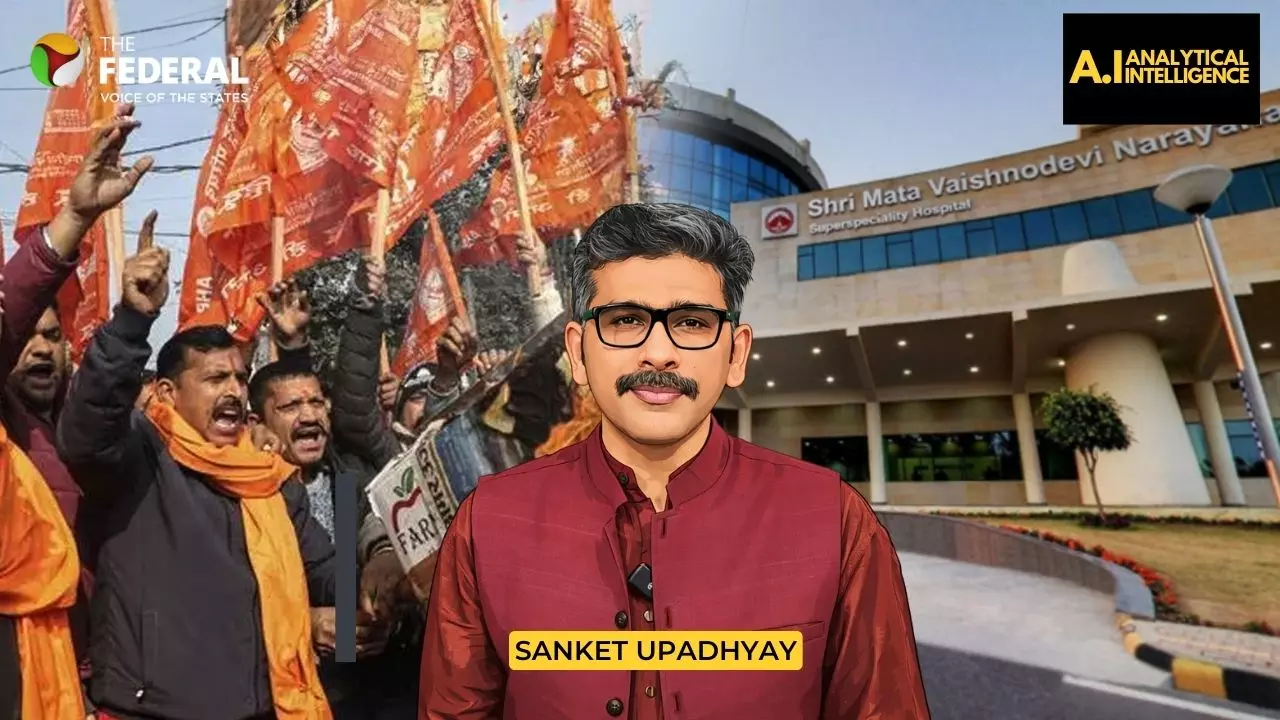
Jammu and Kashmir medical institute shut amid right-wing protest: Being Muslim a crime? AI With Sanket
Sri Mata Vaishno Devi Institute of Medical Excellence's MBBS approval gets withdrawn after protests over student composition. Was it pressure?

Ranbir Singh Pathania, a Bharatiya Janata Party (BJP) MLA in Jammu and Kashmir, and Imran Nabi Dar, spokesperson of the Jammu and Kashmir National Conference, recently debated the shutdown of admissions and classes at Sri Mata Vaishno Devi Institute of Medical Excellence (SMVDIME) after a controversy over the first MBBS batch’s composition and the National Medical Commission’s (NMC) decision to revoke recognition, leaving students in limbo.
The controversy
The programme laid out a timeline around the SVMDIME and the start of a new MBBS programme. It stated that an application was submitted in December 2024 under a public notice, and that the NMC approved 50 seats in September 2025 for NEET-qualified students.
The episode then flagged the composition of the first intake — of the 50 seats, 42 selected through NEET were said to be Muslims. The broadcast linked this to protests by right-wing organisations, naming the BJP, the RSS and affiliate organisations, and framed the protests around why Muslim students were admitted, despite them clearing NEET.
It then described regulatory action that followed: a “surprise visit” by an NMC team on January 2, and cancellation of recognition on January 6, reversing the approval granted in September 2025.
The protest claims
The show summarised the protests as revolving around the first batch distribution—42 Muslim students, seven Hindus and one Sikh —and said the allegation raised was discrimination in seat allocation, claiming Hindu students were overlooked.
A second claim cited on the programme was funding: the college was described as being funded by "chanda" (offerings) from devotees at the Vaishno Devi shrine, and the argument presented was that Hindu students should be prioritised on that basis.
The programme also stated that BJP leaders met Lieutenant-Governor Manoj Sinha, demanding admissions only for Hindus, and posed the broader question of whether NEET-qualified students were being viewed through the prism of religion.
What NMC cited
During the debate, it was emphasised that the NMC’s stated reasons were not framed as religion-linked. It said the regulator cited failure to meet “essential minimum standards” under 2023 regulations.
Specific shortfalls were read out: teaching faculty strength allegedly fell short by 39 per cent, tutors and senior resident doctors were 65 per cent short, the OPD (outpatient department) had 182 patients, the library had 744 books, and there were two functional operation theatres. The episode also said classes were halted mid-session and orders were issued to vacate hostels.
The programme also relayed the students’ position. They said selection was purely on merit, there was no religious tension on campus, and even if transfers to other colleges happen, delays to careers would be inevitable.
Pathania’s framing
Pathania, who represents Udhampur East in the Jammu and Kashmir Assembly, argued the controversy was being misread, and rooted his view in the shrine board’s purpose and use of funds. He referred to the Shri Mata Vaishno Devi Shrine Board being established through legislation in 1986–87, describing its intent as better management and the use of shrine funds for the welfare of pilgrims and worshippers.
He also brought in grievances he said were raised earlier—land acquisition, loss of employment, and the displacement of traditional pujari roles he referred to as “baridars”—and said there should have been “a window” for those affected.
On the admissions question, Pathania rejected the claim that the BJP demanded exclusion of Muslims, and said the party’s point was about shrine donations, state control, and what he described as broader questions around how religious institutions are administered.
He also advanced an argument about selection and quotas, alleging a “financial fraud” and pointing to a marked gap he claimed existed between Jammu and Kashmir selections and all-India selections. He cited fee comparisons for “payment seats” to argue that an elite “band” benefitted.
Dar’s counter
Dar disputed Pathania’s denial and alleged that BJP leaders were central to raising the “42 Muslim students” issue. He claimed that Pathania and Sunil Sharma, the Leader of Opposition in J&K Assembly, who is also from the BJP, submitted a memorandum to the lieutenant-governor raising the question of 42 Muslim students in what Dar called a “Hindu institution.”
Dar also said a BJP delegation met Union Health Minister J P Nadda and raised the same issue, and argued the campaign was designed to exclude students. He claimed protests involved RSS-linked organisations, including Bajrang Dal, and asserted that most people in Jammu were not aligned with the protests.
He questioned the NMC’s reversal, pointing to the short time between approval and cancellation, and argued that if the same parameters were applied widely, many other colleges would face similar action. He suggested the regulator’s decision came under pressure from protests, and framed it as part of a broader pattern of institutions buckling under ideological pressure.
The core clash
The exchange repeatedly returned to one central contest: whether the college’s shutdown was purely about regulatory standards, or whether the standards explanation masked pressure linked to the batch’s religious composition.
The programme pressed on rules, not “wish,” asking whether the institution had any legal basis to restrict admissions by religion, and whether NEET-qualified students should be seen first as students from Jammu and Kashmir rather than as religious categories.
Pathania maintained that the de-recognition was an issue between the NMC and the college, emphasised “quality,” and said the shrine board’s university already had students from all religions in multiple courses. Dar maintained the trigger was the composition of the first batch, and argued the timing of political representations and regulatory action raised questions that needed answers.
The programme ended by underscoring the optics: at a time when regions compete for more medical colleges and better health infrastructure, a situation in which a medical college’s recognition was cancelled—and celebrations were reported—was presented as a damaging message. It concluded that clearer answers from government organisations would be needed to “clear the air”, and warned of consequences for education if the situation continued.
The content above has been transcribed from video using a fine-tuned AI model. To ensure accuracy, quality, and editorial integrity, we employ a Human-In-The-Loop (HITL) process. While AI assists in creating the initial draft, our experienced editorial team carefully reviews, edits, and refines the content before publication. At The Federal, we combine the efficiency of AI with the expertise of human editors to deliver reliable and insightful journalism.