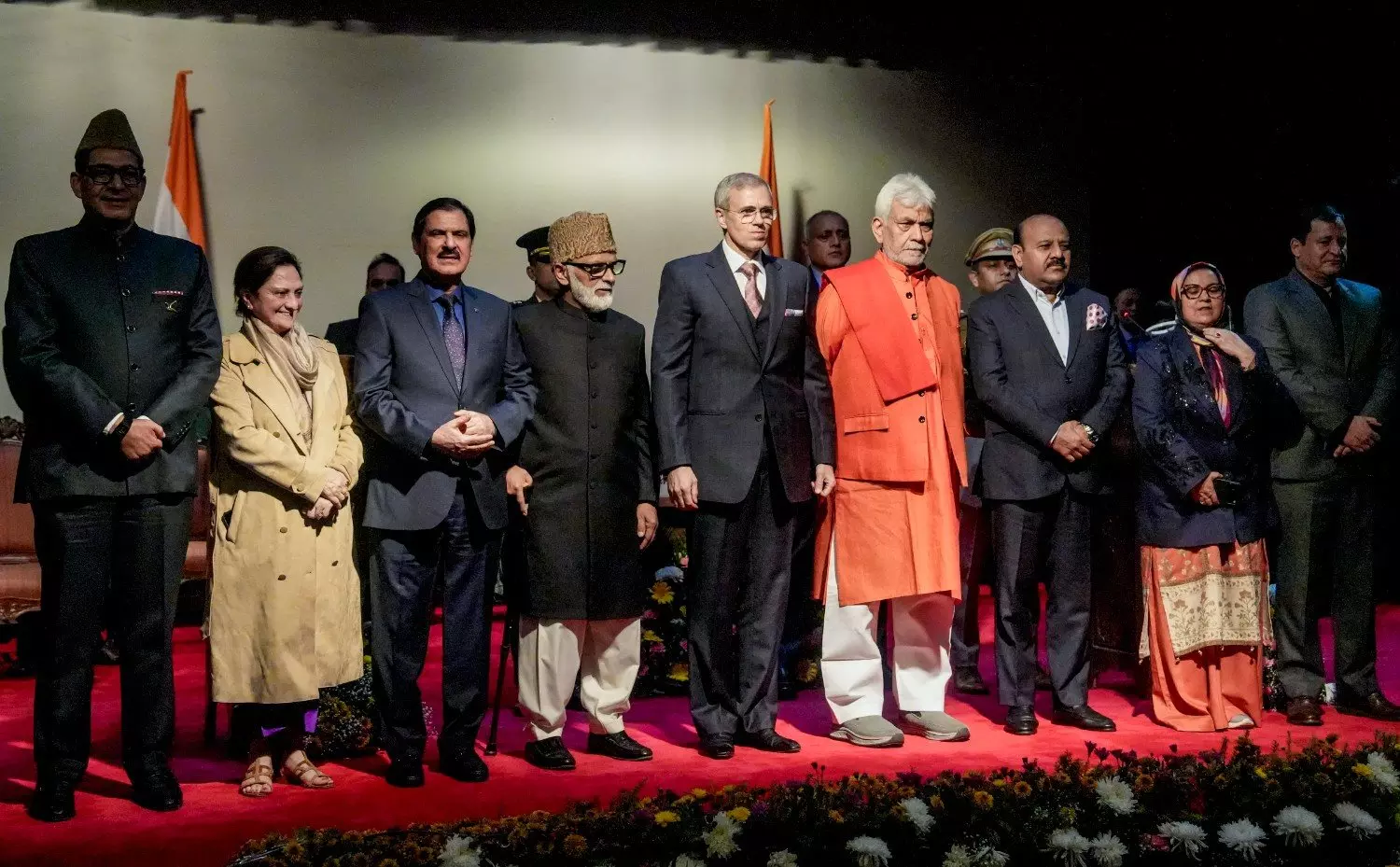
Jammu and Kashmir Lieutenant Governor Manoj Sinha, CM Omar Abdullah, and others in a group picture during the swearing-in ceremony of new cabinet ministers of Union Territory, in Srinagar, Tuesday, October 27. PTI
Omar’s reshuffle triggers dissent in NC; anger boils over in Jammu
Four new ministers inducted and one dropped, but the exercise has stirred anger among NC legislators, independents, while Congress stays out of the Cabinet

Two years into his term as Jammu and Kashmir Chief Minister, Omar Abdullah revamped his ministerial team on Tuesday (October 27), inducting four new ministers, dropping an incumbent and filling all vacant spots in his Cabinet. Yet, if the long-awaited exercise was meant to be a glide path in Abdullah’s quest to soothe frayed nerves within his National Conference (NC) and consolidate his position, both politically and administratively, it was not.
All Cabinet reshuffles ultimately boil down to balancing regional, caste and community equations, effecting a political course correction and buttressing the image of the person at the helm of government. The reshuffle achieves none of this for Abdullah. Instead, it appears like a poorly executed trapeze act that has left the chief minister more vulnerable than before to crashing into a wave of challenges.
Among the new inductees are National Conference veterans Ali Mohammad Sagar, Shameem Firdous and Mir Saifullah and second-term Pahalgam legislator Altaf Ahmad Wani. Abdullah has also retained Surinder Choudhary as deputy chief minister as well as Javed Ahmed Rana, Sakina Itoo and Javid Ahmed Dar in his Cabinet.
Dissent over exclusions, including Satish Sharma
In J&K’s power corridors, however, it is the exclusions from Abdullah’s Cabinet that have triggered agitated discussions and palpable dissent.
Also read: Farooq Abdullah’s Pakistan remarks trigger protests in Jammu, BJP demands apology
By dropping Satish Sharma, the independent first-term legislator from Jammu’s Chhamb from his ministerial team and filling up all vacant berths with lawmakers from the Kashmir Valley, Abdullah has cobbled up a council of ministers that, arguably for the first time in J&K’s history, is devoid of any representation from the wider Jammu region (except Pir Panjal; represented by Choudhary and Rana) that constitutes a bulk of the Muslim-majority Union Territory’s nearly 30 per cent Hindu electorate.
The omission is a political gamble Abdullah may regret making, says Jammu-based journalist Tarun Upadhyay. “It isn’t just about dropping one Satish Sharma but about the message that Abdullah has sent to the entire Jammu region beyond Pir Panjal – that your representation and voice in the government is dispensable,” he says.
“The Jammu region has, for decades, complained about step-motherly treatment from successive governments and the root cause of that resentment has been concentration of power with a political class, be it from the NC or the PDP, which refuses to look beyond Kashmir. However, no past chief minister or government, including Abdullah himself when he first served as CM between 2009 and 2015, has skewed regional balance in the Cabinet so brazenly towards the Valley… the BJP will go to town over this giving it a communal colour and highlighting how there is only one Hindu in the nine-member Cabinet,” Upadhyay adds.
'Omar saheb has done his best'
NC leaders close to Abdullah said the regional imbalance visible in the reshuffle reflected how J&K voted in the 2024 Assembly polls. In the J&K Assembly, reconstituted as a 90-member House following the carving out of Ladakh from the erstwhile state in 2019 and an extensive delimitation exercise, Muslim-majority Kashmir has 47 seats while the Hindu-dominated Jammu region has 43 seats.
Also read: J&K Congress stays out of Omar Abdullah Cabinet, demands full statehood
In the 2024 polls, the BJP had won 29 seats across the Jammu’s regions Samba, Kathua, Udhampur, Reasi, Kishtwar, Doda, Jammu and Rajouri districts. The NC had bagged 42 seats, of which 35 were in the Kashmir Valley while the rest came from the Jammu region’s Poonch, Rajouri and Ramban districts of Pir Panjal and the Chenab Valley.
“There is nothing deliberate about this. Everyone knows that the BJP won all Assembly seats across Jammu, Reasi, Udhampur, Kathua and Samba, so how do we include an MLA from these districts in the Cabinet? Given the limitations imposed on us by the mandate and the fact that after the reconstitution of J&K as a Union Territory we can only have a nine-member Cabinet, including the CM, Omar saheb has done his best to give fair representation in all aspects,” said a Rajya Sabha MP from the NC.
The NC leader added, “You can’t say higher representation for Kashmir has come at the cost of Jammu because even across Kashmir, there is geographical, social and cultural diversity; if you exclude the CM, there are now two ministers each from north Kashmir, Central Kashmir, South Kashmir and Jammu region; out of these, two ministers are women and we also have representation of the tribal (Gujjar) community.”
Sunil Sharma, Leader of Opposition in the J&K Assembly and the BJP’s MLA from the Padder-Nagseni seat in the Jammu region’s Kishtwar district disagrees.
“Yes, the BJP swept the Jammu region but the NC should think why that happened; it is because of the step-motherly treatment that parties like the NC, PDP and Congress gave to people of Jammu but having said that, it is not true that the NC could not have accommodated more ministers from the Jammu region; Satish Sharma represented the Jammu district in the Cabinet so what was the need to drop him; independent MLAs from the Jammu region like Pyarelal Sharma and Rameshwar Singh have also been supporting the government, why could one them not be made a minister, if Abdullah didn’t want independents he could have included NC’s own MLA from Ramban (Arjun Singh),” said Sharma, adding that “looking at the new Cabinet, it feels as if for the chief minister J&K starts from Kashmir and ends in Pir Panjal”.
Mehdi Vs Abdullah
While the unease across Jammu over its diminished representation and the BJP’s criticism were to be expected, Abdullah has also ruffled feathers within his National Conference and, perhaps more importantly, of others supporting his government, including six MLAs of the Congress party and as many independents.
NC insiders feel the decision to induct all new ministers from the Valley may have been prompted by Abdullah’s fear of losing his grip on the party’s traditional base in the region due to a widely held perception that he had done precious little since becoming chief minister to aggressively lobby with Prime Minister Narendra Modi’s government for restoring J&K’s statehood and the constitutional guarantees and protections that were stripped away when Article 370 was abrogated. The view that Abdullah, instead, normalised the post-abrogation reality of Kashmir has also caused fissures within the ruling party, admit NC leaders.
The NC’s Srinagar MP Aga Syed Ruhullah Mehdi, a prominent Shia leader from Budgam, has been on the warpath against Abdullah for months, accusing him periodically of surrendering Kashmir’s interests to Delhi. Mehdi has also announced his decision to quit the party and his seat in Lok Sabha on November 3. NC leaders believe Mehdi would incite others in the party to follow in his footsteps while also mobilising public mood in the Valley against Abdullah for “betraying the trust, aspirations and sentiments with which Kashmiris voted the NC to power”.
In this backdrop, Abdullah’s urge to stack his Cabinet with NC veterans and loyalists from the Valley may seem understandable; perhaps even justified. That the reshuffle has, instead, triggered further dissent within the NC should, thus, come as a cause for alarm to the beleaguered chief minister.
NC leaders express resentment in public
Since the reshuffle, several NC lawmakers, including former Assembly Speaker and sixth-term Eidgah MLA Mubarak Gul, Gurez MLA Nazeer Ahmed Khan and Anantnag West MLA Majeed Larmi, have gone public expressing their resentment at being left out. Gul, the senior-most among them, was promptly appointed party general secretary by NC chief Farooq Abdullah in a clear damage-control move.
A multiple-term NC legislator who was hopeful of getting a ministerial berth but failed to make the cut told The Federal, “When years of loyalty to the party go unrecognised, one is bound to be unhappy… it is humiliating to go back to your constituency and face voters who voted for you thinking you will be made a minister because of your seniority; what do I tell them now; there is a limit to everyone’s patience.”
Jammu-based political commentator Anil Anand says the reshuffle has “far from being a balancing act, exposed Abdullah’s nervousness and vulnerabilities... he has managed to draw the ire of everyone – the independents who are supporting his government are unhappy because they think their support is being taken for granted, senior NC leaders who were left out are angry, the Congress, which contested the polls as an NC ally hasn’t had an easy relationship with Abdullah for two years and has again decided to stay out of the cabinet, and the BJP is raising a stink over the lack of representation for Jammu and of Hindus”.