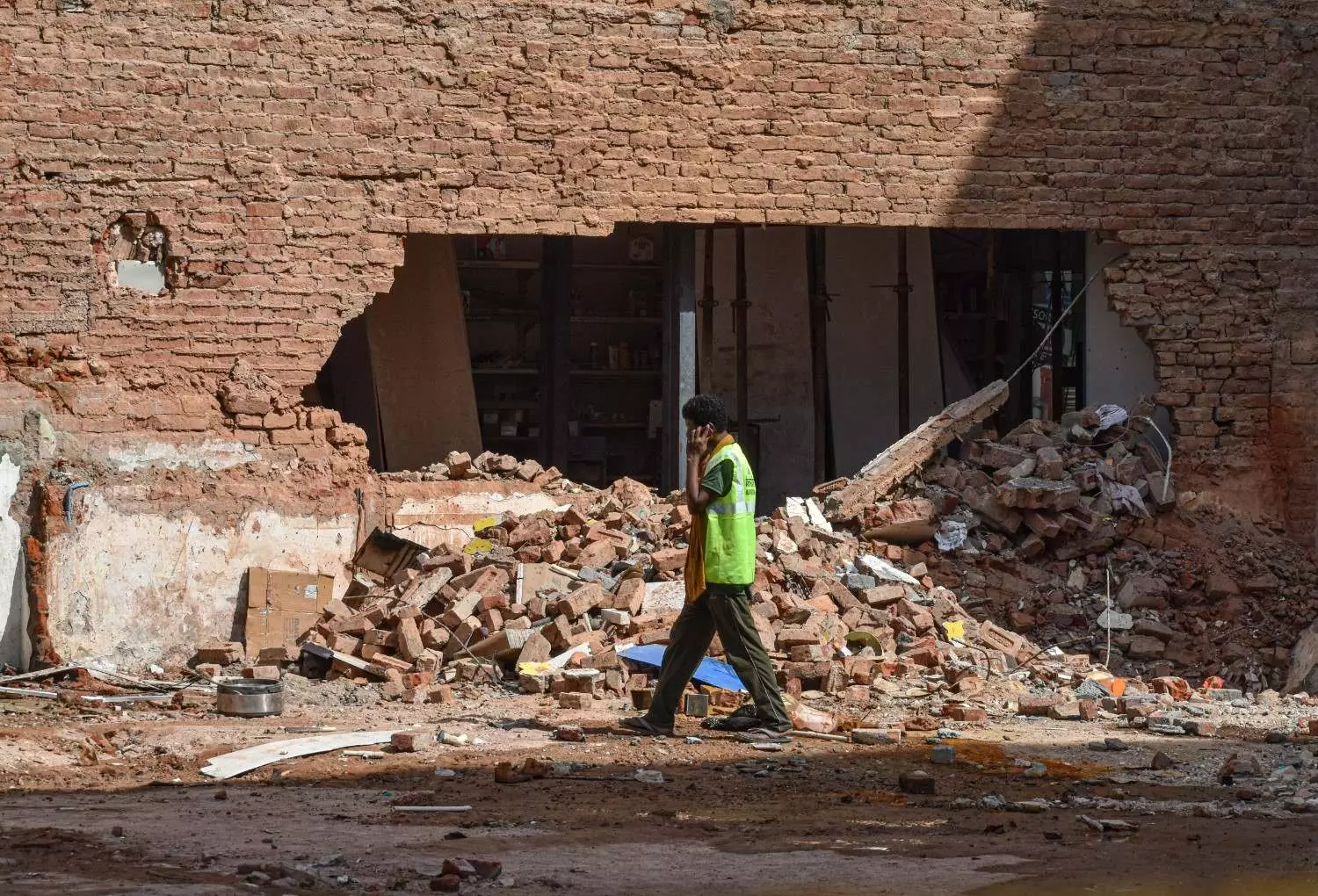
A Municipal Corporation of Delhi (MCD) official arrives to dismantle an unsafe adjacent structure following the multi-storey building collapse tragedy at Satya Niketan, in New Delhi, Wednesday, September 9. PTI
Satya Niketan tragedy: 'Govt, universities must invest in affordable student accommodation'
Experts say how Delhi University's hostel shortage, unregulated PG housing, and government inaction have left students, especially women, vulnerable

The collapse of a five-storey PG building in Delhi’s Satya Niketan that claimed seven lives has brought renewed focus on the shortage of safe and affordable accommodation for students in the national capital, with experts questioning the dependence of thousands of students on private paying guest (PG) facilities.
Speaking on The Federal’s Capital Beat show, political analyst Dr Akash Deep Muni said the shortage of hostel accommodation at Delhi University was a key factor behind the dependence on private housing. He pointed to the large number of students enrolled at the university in comparison with its limited hostel capacity.
Muni said governments and universities needed to invest in affordable student accommodation instead of leaving students dependent on private PG operators.
Safety issues for women
Senior journalist TK Rajalakshmi said the problem had a wider structural dimension. Students arriving in Delhi from smaller towns and cities often depended on hostels as private accommodation was unaffordable for many families, she said.
Also read: ‘Not accident, murder’: What DU students protesting at PG collapse site want | Ground report
For women students in particular, access to safe and affordable accommodation was an important part of being able to pursue higher education, she said.
Referring to provisions in the Delhi University Act, 1922, relating to students residing in colleges, halls or under prescribed conditions, Rajalakshmi questioned what the education system could guarantee if adequate hostel infrastructure was unavailable.
A significant proportion of Delhi University students come from outside the national capital, making accommodation an essential component of access to higher education rather than a peripheral concern, she said.
Rajalakshmi said the issue could not be reduced to illegal construction alone. It also raised questions about whether governments and universities were providing the infrastructure needed for students to live and study safely.
Call for greater investment
Muni called for increased public spending on education and referred to the National Education Policy's (NEP) stated objective of raising public expenditure on education to 6 per cent of GDP. Greater investment, he said, could help universities expand hostel facilities.
Also read: Satya Niketan building collapse: PG operator, contractor held; CM announces aid
He also called for a broader technical response to Delhi's infrastructure vulnerabilities. Institutions such as the IITs, along with professors and scientists, could be involved in assessing ageing and vulnerable buildings in the city, he suggested.
Rajalakshmi said a proposed regulatory framework for PG accommodation could address the lack of formal oversight, but cautioned that regulation alone would not resolve the shortage of affordable housing.
The problem, she noted, extended beyond students to working people migrating to Delhi, many of whom also struggled to find accommodation that was affordable and fit to live in.
Rajat Yadav, National General Secretary of Yuva Halla Bol, expressed scepticism about whether the latest tragedy would lead to sustained action. Governments, he said, often responded to such incidents with inquiries and administrative measures until public attention shifted to other issues.
He cited the shortage of dedicated hostels for women students as an example of what he described as misplaced priorities. Students, he said, should not be left to navigate an expensive and potentially unsafe private housing market on their own.
Questions over regulatory response
Rajalakshmi described the government's response as largely reactive, arguing that authorities had been aware of the shortage of safe accommodation and the existence of questionable structures well before the Satya Niketan incident.
While an inquiry and regulatory measures could follow the collapse, she said the larger issue was whether governments would take responsibility for creating adequate hostel infrastructure.
Muni reiterated the need for greater investment in education and student accommodation, along with stronger technical oversight of buildings in Delhi.
Rajalakshmi argued that education could not be treated as a right without providing the infrastructure that enabled students to access it. Safe and affordable accommodation, she said, was an important part of that enabling infrastructure.