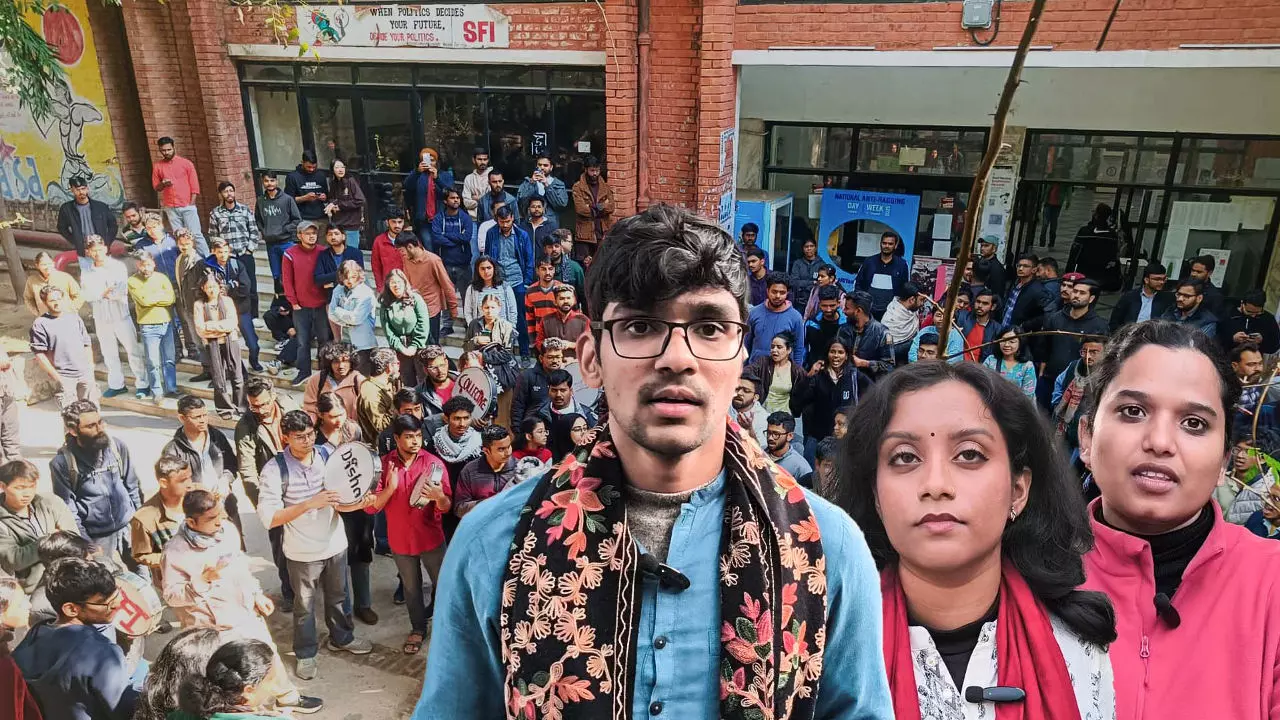
JNU move to rusticate top student leaders over last year’s protest sparks row
The university barred four office-bearers from campus for two semesters following charges of vandalism during a 2025 protest, while eight other students were fined

The JNU administration’s February 2 decision to rusticate the four main office-bearers of the JNUSU has sparked a controversy, with the student leaders facing disciplinary action for their involvement in a protest last year.
In an unprecedented move, the university had rusticated all four office-bearers – JNUSU president, vice president, secretary and joint secretary – of the Jawaharlal Nehru University Students’ Union (JNUSU) for two semesters, declaring them out of bounds of the campus. Former JNUSU president Nitish Kumar was also given the same punishment.
According to the university administration, the students were found guilty of vandalism during a protest held last year.
Union under fire
The JNUSU said that eight other students were also penalised in connection with the protest.
“These students have been fined Rs 19,000 each, allegedly for clapping and participating in the protest,” the students’ union stated.
The union questioned the severity of the punishment, calling it disproportionate to the alleged actions during the demonstration.
Camera dispute
The issue dates back to August last year, when the JNU administration decided to install facial recognition cameras inside the university’s central library.
According to the JNUSU, the administration had repeatedly given verbal assurances that the surveillance measures would not be implemented.
The assurances were allegedly given after the previous students’ union staged a prolonged sit-in outside the library opposing the move.
Election timing
However, the JNUSU alleged that the cameras were installed surreptitiously in November 2025.
The installation, according to the union, took place in the middle of the JNUSU elections.
The students’ body said the move amounted to a breach of trust, as the administration had repeatedly assured that facial recognition cameras would not be installed.
The content above has been transcribed from video using a fine-tuned AI model. To ensure accuracy, quality, and editorial integrity, we employ a Human-In-The-Loop (HITL) process. While AI assists in creating the initial draft, our experienced editorial team carefully reviews, edits, and refines the content before publication. At The Federal, we combine the efficiency of AI with the expertise of human editors to deliver reliable and insightful journalism.