JNU protests escalate as Opposition targets vice-chancellor
Teachers, students and Opposition leaders demand VC’s resignation after controversial remarks and student arrests. Will the row deepen further?

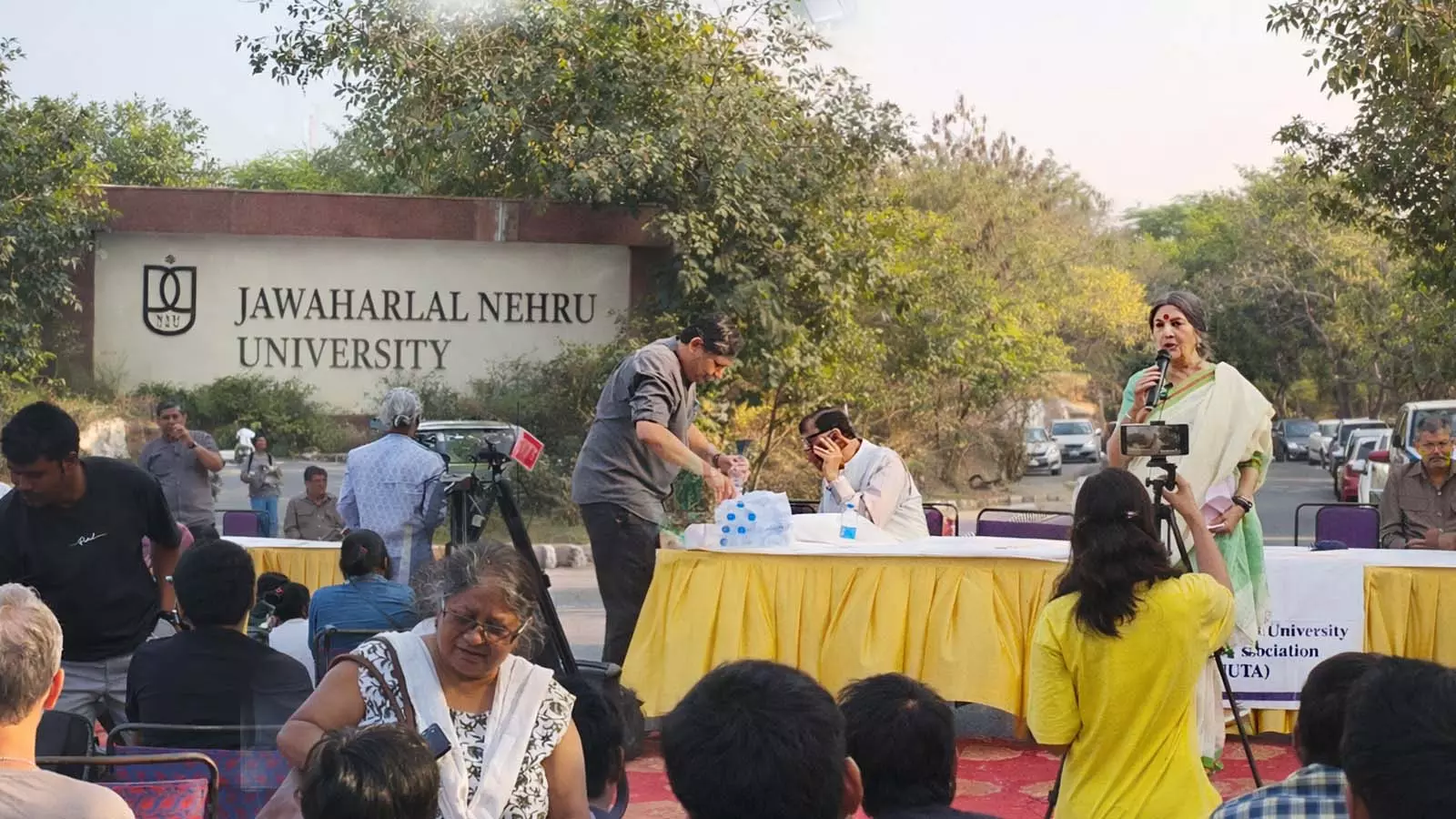
Protests erupted at Jawaharlal Nehru University (JNU) on Monday (March 2), with teachers, students and Opposition leaders accusing the administration of undermining the campus’s inclusive ethos.
The demonstrations were triggered by controversial remarks made by Vice-Chancellor Santishree Dhulipudi Pandit and were further fuelled by the arrest and subsequent release of 14 students.
The protests saw sharp political reactions, with leaders alleging interference in central universities and accusing the BJP-led Union government of shielding the vice-chancellor.
The controversy has now grown beyond the campus, turning into a wider political flashpoint.
Triggering remarks
The immediate spark for the protests was vice-chancellor Pandit’s remarks in a podcast, which drew sharp criticism from students and faculty.
Also read: JNU protest march: Student leaders among 14 protesters released from jail
Tensions escalated after 14 students were arrested during earlier demonstrations and later released by a Delhi court. The arrests intensified anger on campus and prompted calls for accountability.
Opposition leaders alleged that the developments reflected broader interference in central universities.
Political response
CPI(M) leader Brinda Karat invoked Dr BR Ambedkar’s Annihilation of Caste while criticising the vice-chancellor. She argued that recent developments threatened affirmative action and the rights of marginalised communities.
Congress MP Mukul Wasnik described the issue as symptomatic of “constitutional backsliding” in higher education institutions.
CPI-ML (Liberation) general secretary Dipankar Bhattacharya linked the controversy to debates on reservation and regulatory changes, placing the row within a larger ideological context.
Legal route
Protesters demanded the vice-chancellor’s resignation and called for the reversal of disciplinary action against student leaders.
Also read: JNUSU protest march: Police, students injured in clash, over 50 detained
Mukul Wasnik said legal action under the SC/ST Act was being considered, signalling that the confrontation could move beyond protests into the legal arena.
With teachers, students and opposition leaders united, the JNU row has evolved into a broader political controversy that may continue to reverberate beyond the campus.
(The content above has been transcribed from video using a fine-tuned AI model. To ensure accuracy, quality, and editorial integrity, we employ a Human-In-The-Loop (HITL) process. While AI assists in creating the initial draft, our experienced editorial team carefully reviews, edits, and refines the content before publication. At The Federal, we combine the efficiency of AI with the expertise of human editors to deliver reliable and insightful journalism.)