Is Delhi University’s protest ban an abdication of duty? Apoorvanand questions move
Delhi University professor says the month-long restriction silences student dissent, raises concerns over academic freedom, and reflects a political approach to campus protests

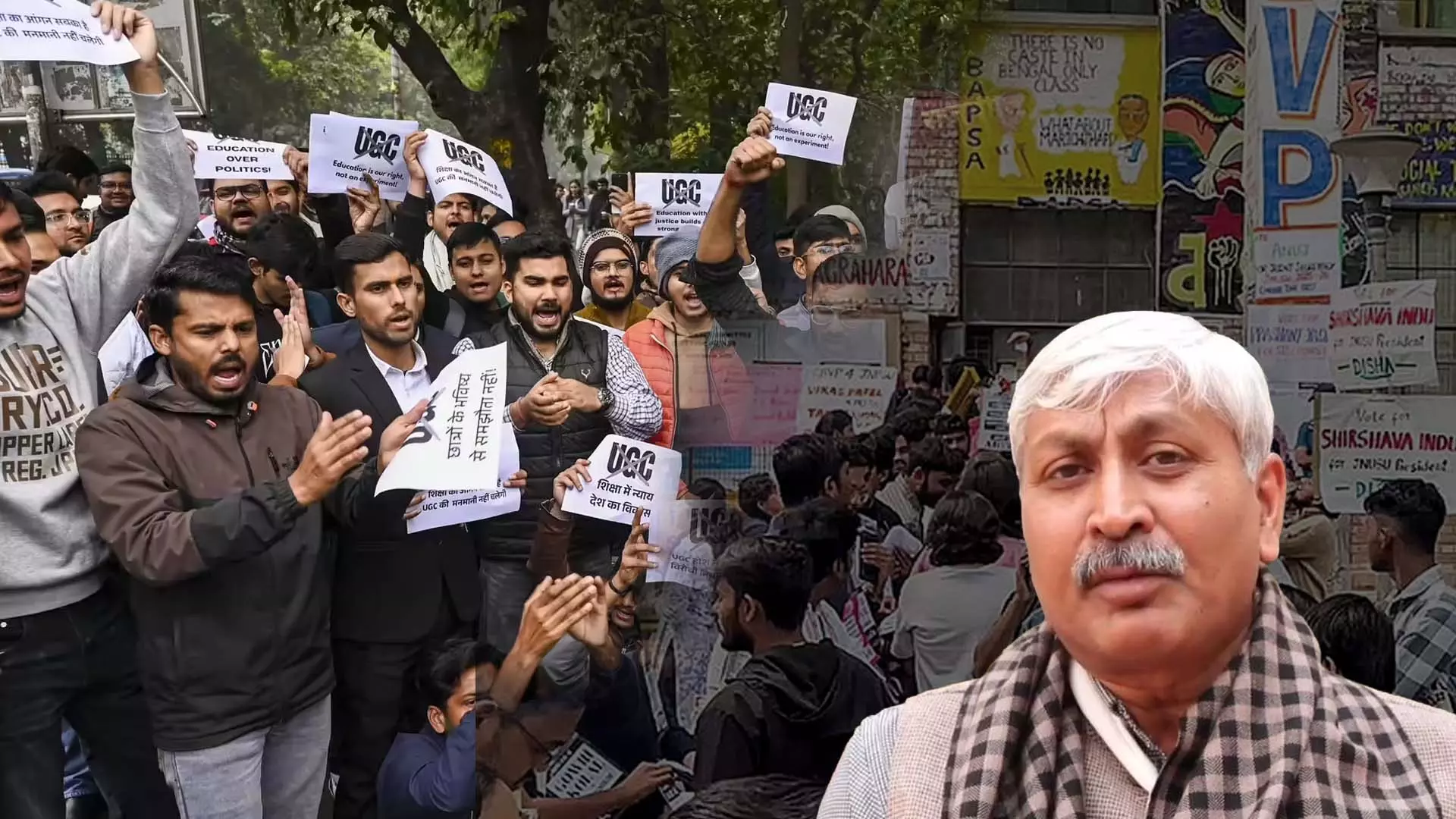
“This is a very political decision,” says Delhi University professor Apoorvanand, calling the month-long ban on protests an “abdication of duty” by the administration. He argues that instead of acting against those who allegedly disrupted a peaceful demonstration, the university has chosen to silence protests altogether.
The ban, imposed from February 17 following campus clashes linked to a protest over UGC equity regulations, has sparked sharp debate on academic freedom and student politics. The Federal spoke to Delhi University professor Apoorvanand about the implications of the decision and what it means for campus democracy.
How do you view the Delhi University administration’s decision to impose a blanket ban on protests?
I think it is very disappointing to see the Delhi University administration, in a way, abdicating its duty and resorting to such an act — banning protests of all kinds for a month.
As you said, this decision was taken after a scuffle between two groups at a protest called by a joint forum. It was not just the All India Students’ Association; it was a joint forum agitating for the implementation of guidelines suggested by the UGC to end discrimination on campuses.
During the protest, as reports suggest, some YouTubers entered and tried to create a ruckus, which led to a larger scuffle. One YouTuber — as seen in the video — hit one of the activists. The activists then tried to hand her over to the police, but the police allowed her to go free.
Subsequently, the activists went to the police station to lodge an FIR. There, they found a mob waiting for them. It was very dangerous because the mob was raising slogans like ‘Goli Maro’, which is now a favourite slogan of BJP affiliates. They were literally mobbed.
Thanks to the Delhi Police, they were saved. But they had to remain holed up in the police station till midnight. This was because of a mob that calls itself nationalist and upper caste. They were raising slogans like ‘Brahmanvad Zindabad’.
So one can clearly see which elements are trying to indulge in violence. It is not the protesters. The protesters were asking the authorities to implement the UGC guidelines and were agitating in their favour.
There was no violence from that side. Some elements entered and tried to disrupt the protest. What authorities are supposed to do is stop the disruptive elements — not tell the protesters that they cannot protest because some people might come and disrupt.
This is not performing your role as a law and order authority or as a university administration. It is abdication of duty. I think this decision is wrong and very disappointing.
Is this an unprecedented move in Delhi University’s recent history?
What the university has done before is to outlaw protests by "anti-government organisations" — organisations that are critical of the present government. Those protests have been banned.
Protesters have been penalised, suspended, expelled. Their PhD degrees have been withheld. Different kinds of punitive measures have been taken against those who protest against the government.
But no action has been taken against those who perpetrate violence at these protests. ABVP members have not been penalised at all. We have seen repeated incidents of violence from that side, but I have not read any report saying the university initiated penal action against them.
People affiliated with the present government are allowed not only to do what they want but also to disrupt the programmes and protests of other organisations. The university just stands by and watches.
This is the first time a blanket ban like this has been imposed. Why? Because this is a very sensitive issue. Here you will see Dalits and students belonging to Other Backward Classes coming together to protest. Socially, this becomes very costly for the BJP.
What they want is not to allow these communities to come out and be seen protesting against the government. That is why this decision has been taken — to disallow any protest.
For the first two or three days, we saw protests by the general category — mostly upper-caste students — against the regulations. Then the Supreme Court intervened and stayed implementation of those regulations.
Now students belonging to Dalit and Other Backward communities are on the streets protesting against the stay. This is what the university wants to stop. It is a very political decision.
You mentioned JNU. Do you see a difference in how student activism is handled there compared to Delhi University?
There is a difference in the nature of student politics in JNU and Delhi University. In Delhi University, money and muscle power largely decide the nature of student politics. In JNU, it is very different.
In JNU, for the last 10 years, they have been trying to make life difficult for student organisations identified with the Left. You saw it happening in 2016. It has now been 10 years since 2016, when Umar Khalid, Kanhaiya Kumar, Rama Naga and Anirban Bhattacharya were arrested and jailed.
That was the beginning of the attack on student activism in JNU. Even after 11 years of BJP rule, they have not been able to make a significant dent in JNU’s student politics.
But if you closely observe what is happening there, most of the campus is now out of bounds for student organisations. Post-dinner meetings in hostel messes have stopped. Student activities have shrunk.
I am told that outside Sabarmati Hostel there is a lawn where meetings are allowed. But even there, if you try to organise a meeting, security guards create trouble.
Life for student activism in JNU has become very difficult after 2016 and is growing increasingly so. Recently, you saw restrictions on JNUSU functionaries. That is how they are trying to disable student activism in JNU.
In Delhi University, it is different. Left activism does not have much popular support but still exists. Here, ABVP and NSUI are the main contenders, and this has been the case for decades.
Now the university authorities are trying not to allow any other voice to be heard on campus — any voice other than that of the BJP. We are made to understand that the ABVP or BJP are not doing politics; they are doing nationalism, while other student organisations are doing politics.
They don’t want politics, they say. They want nationalism — which ABVP does, which BJP does. So it is not politics. But what the All India Students’ Association or SFI does is called politics, and they don’t want politics. That is the attitude.
How do you see this situation playing out now? Will there be more protests despite the ban?
I cannot make any prediction. But I think students can see through these orders.
The vice-chancellor recently issued a statement expressing concern about violence. But two days before this entire episode, during a meeting at the Arts Faculty gate, some people threw a bucket full of water that barely missed Prof S Irfan Habib. His clothes were soaked. Then stones were thrown.
University security personnel were present. But the vice-chancellor did not express any concern then. That tells you something. Students can see through this.
If there is anger, if there is frustration, if there is criticism of the government, it will be expressed in some form. If you try to suppress it, it will not be suppressed.
The most honest thing the university authorities can do is maintain peace on campus. It is not the protesters who are creating a ruckus or violence; rather, it is the protesters who are under attack.
Who are attacking? They can be identified. University security personnel are there. CCTV cameras are there. You cannot equate the two. You cannot say both are similar and treat them equally. One side is protesting and exercising its right to free expression, while the other is trying to incite violence. You have to differentiate between the two.
The content above has been transcribed from video using a fine-tuned AI model. To ensure accuracy, quality, and editorial integrity, we employ a Human-In-The-Loop (HITL) process. While AI assists in creating the initial draft, our experienced editorial team carefully reviews, edits, and refines the content before publication. At The Federal, we combine the efficiency of AI with the expertise of human editors to deliver reliable and insightful journalism.