


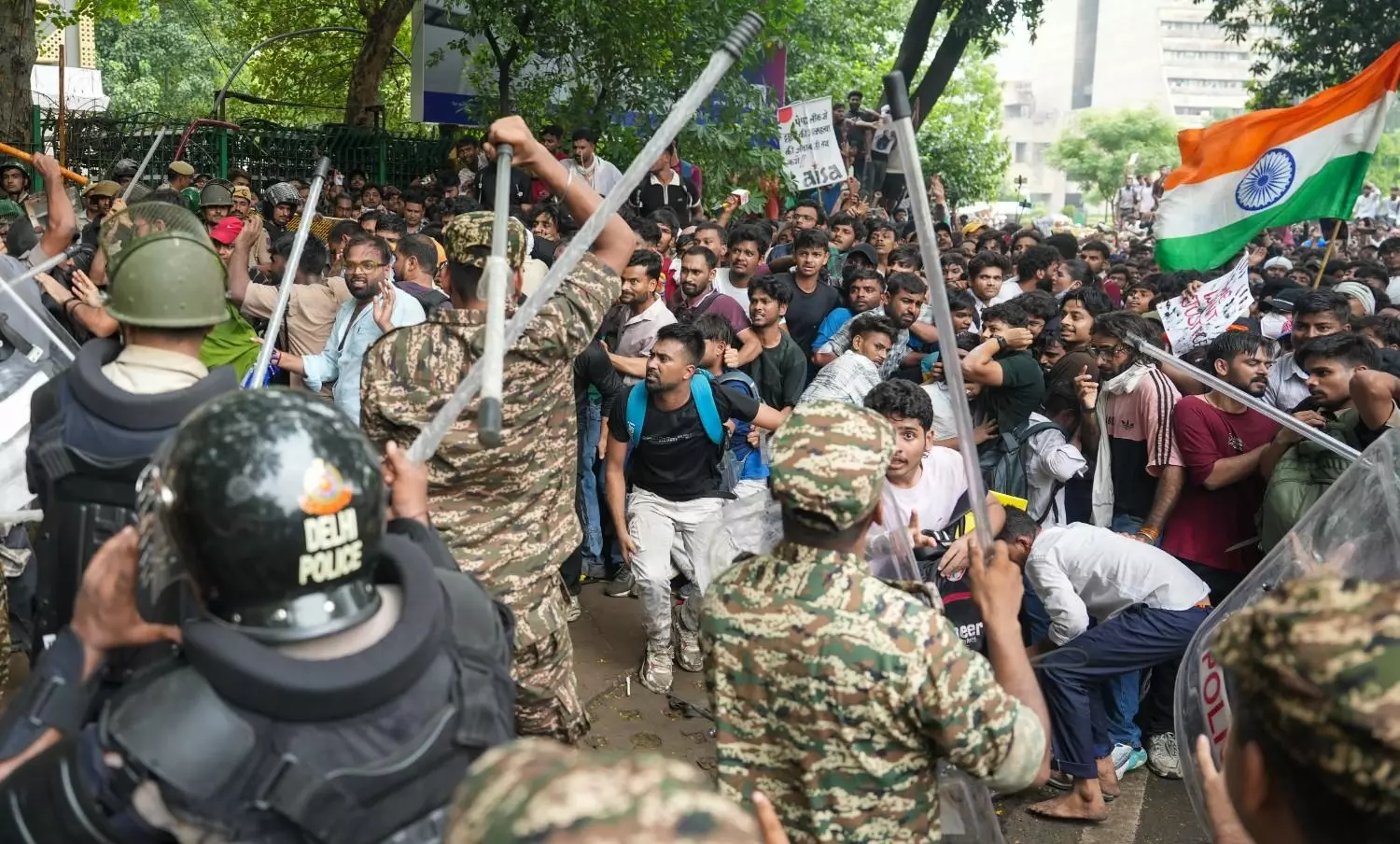
‘Refuse the villain role’: Delhi cops get guidelines to handle Gen Z protesters
After Jantar Mantar clashes, officers have reportedly been told how to behave when every confrontation can become viral content

Following the face-off between its personnel and protesters during the recent Jantar Mantar clashes, the Delhi Police has issued a new Standard Operating Procedure (SOP) asking officers to remain calm, avoid showing anger and not get into verbal arguments with protesters.
A major part of the guidelines deals with how personnel should behave in front of cameras, especially while dealing with tech-savvy Gen Z protesters. “Your angry face is their content. They are not fighting you. They are making a film in which they want you to play the villain. Refuse that role,” the new guidelines state.
The SOP, which lays down a set of ‘Do’s and Don’ts’, comes after a series of high-profile and heavily documented clashes between police and protesters at Jantar Mantar, The Indian Express reported.
Also read: No excessive force against protesters; July 20 march was illegal: Delhi Police tell SC
Issued to all 15 districts, the guidelines explain how police should deal with protesters who often record such confrontations on their mobile phones and share them on social media.
‘Your angry face is their content’
The guidelines reportedly ask police personnel not to get into shouting matches or answer highly emotional or personal questions. They have been told to maintain a neutral expression, look straight ahead and remain calm even when protesters put mobile phones in their faces.
The Jantar Mantar protest saw several protesters confront police personnel with questions, particularly after the July 20 attempt to march towards Parliament that led to clashes. Security forces used lathis and tear gas and, in at least one instance, a pellet gun to disperse the crowd. Authorities have denied using excessive force.
The SOP asks personnel to remain silent even when provoked. Protesters may cry loudly, fall at the feet of personnel or ask questions aimed at provoking sympathy or anger, including references to their family background or salaries.
In such situations, officers have reportedly been advised not to debate, argue or show agreement. If necessary, they should use only a brief response: “Please cooperate, we are doing our duty.” They have then been asked to maintain silence.
Also read: CJP protest: Families of injured Delhi cops seek Parliament discussion
Personnel have also been warned against pushing away phones, snatching objects, throwing things, shouting in anger or reacting to humour, mockery, songs, dances, mock salutes or placards directed at them.
'Don’t give the camera a reaction'
The SOP specifically warns officers against reacting to seemingly harmless gestures that could turn into social media content, says the report. Protesters may offer flowers, sweets, water bottles or tea, knowing that an angry rejection or overreaction could generate online traction.
The guidelines also lay down strict gender protocols. Male personnel have been asked to avoid touching female protesters, with women personnel expected to handle such situations.
‘A calm face and a helping hand’
The advisory also tells personnel how they should respond when protesters need help. Officers have been asked to assist sick or injured protesters and help children who get separated from their parents.
“If a protester faints, falls or is injured, they should be the first to step forward, lift the person carefully, call an ambulance and clear the path,” the SOP reportedly says. Such assistance should be provided naturally and not as a performance for cameras, while recognising that it is likely to be recorded.
Also read: ‘Delhi cops should have used water cannons; pellet guns meant for rare cases’
The SOP also tells officers how to speak to protesters. They have been encouraged to use phrases such as “Uncle, come this way”, “Aunty, please go to this side” and “Sir, please cooperate”. When asking a crowd to move, they have been advised to use their hands in appeal rather than raising a lathi.
“Respectful language from uniformed personnel can help calm a crowd,” the source said. The advisory sums up the approach in a simple message: “Let them (the protesters’ cameras) see only two things — your calm face and a helping hand.”
Restrictions on protests at Jantar Mantar
The Delhi Police has tightened its operational protocols for assemblies at Jantar Mantar. Section 163 of the BNSS, which replaced Section 144 of the CrPC, remains in force across the New Delhi district, restricting unauthorised marches, demonstrations and gatherings of five or more people.
The police has clarified that there is no general permission for sudden or large-scale agitations at Jantar Mantar. Unauthorised gatherings will face immediate detention.
Also read: SC to hear plea against Delhi Police’s use of ‘facial recognition’ at CJP protest
Demonstrations are instead being directed to Ramlila Ground, where participation is capped and strict time limits apply. In some cases, the permitted strength can be restricted to 500 participants.
The department has further warned that legal action will be taken against those who fabricate, circulate or promote misleading social media posts to mobilise crowds at restricted locations.