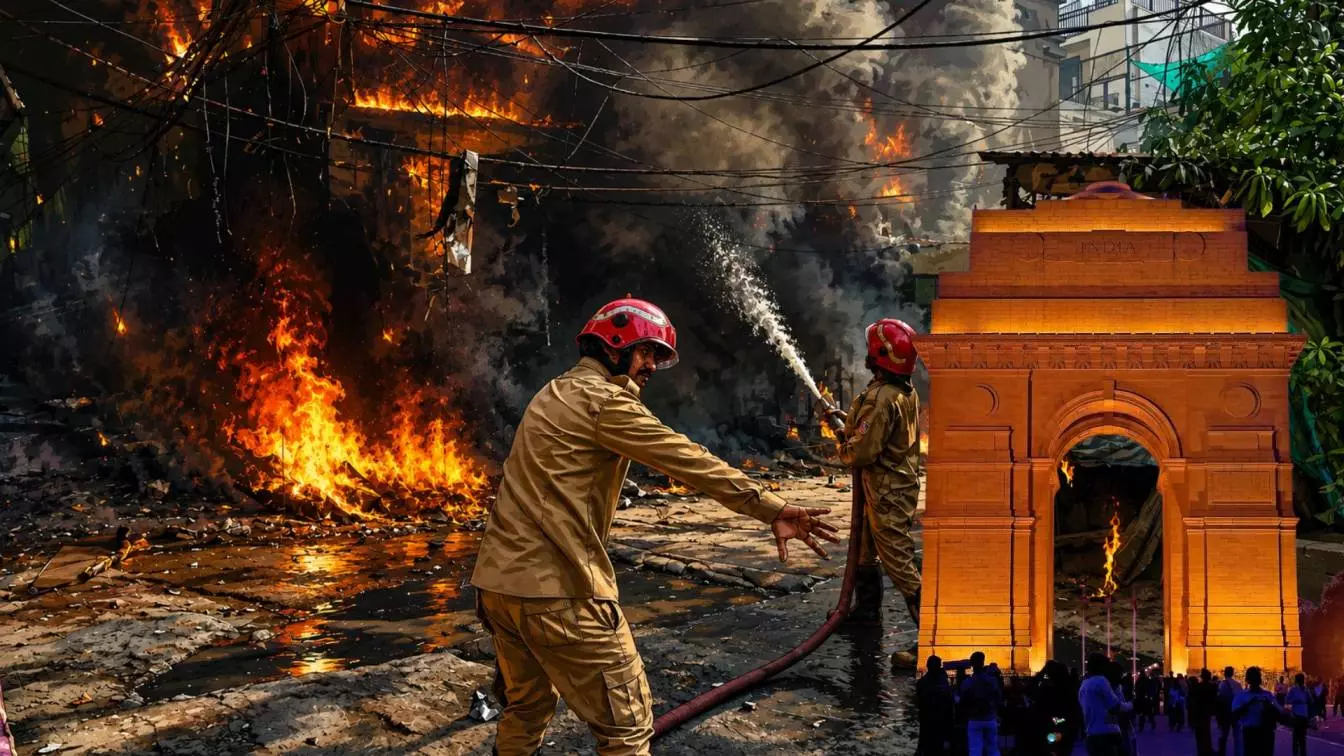
Why Delhi has become a firefighter's nightmare this summer
Over 7,800 emergency calls, rising electrical faults and unsafe buildings have exposed Delhi’s growing fire risk. What must change first?

Delhi is witnessing an alarming rise in fire incidents, with recent tragedies highlighting deeper structural problems that have been building for years. The latest incident in Govindpuri, where three members of a family lost their lives, has once again brought attention to a crisis that extends far beyond isolated accidents.
According to available data, the Delhi Fire Services received more than 7,800 emergency calls in the first few months of this year. That represents a 20 per cent increase compared to last year and a 73 per cent rise over the previous few months. Incidents reported from areas such as Malviya Nagar, Vivek Vihar, Palam, Greater Kailash and Govindpuri indicate a troubling pattern.
Heat impact
One of the biggest contributors to the spike in fire incidents has been the intense summer heat experienced by the national capital.
This year, temperatures reportedly ranged between 42 and 46 degrees Celsius, putting unprecedented pressure on Delhi's electrical infrastructure. As millions of residents and businesses relied heavily on air conditioners to cope with the heat, electricity demand surged across the city.
Also read: Delhi building fire: 'Save us' cries, residents used sarees to escape through windows
The increased load has led to overheating transformers, damaged wiring and a rise in short circuits. According to available estimates, between 60 and 80 per cent of Delhi's fire incidents this year have been linked to electrical faults.
Electrical strain
Experts point to electrical overload as a major factor behind many recent fires. Much of Delhi's infrastructure was not designed to handle the current scale of electricity consumption.
Modern air conditioning systems have introduced an additional challenge. While newer refrigerant gases are more environmentally friendly, they are also mildly flammable. Under prolonged heat stress, overheating compressors can potentially become fire hazards inside homes and commercial establishments.
This combination of extreme temperatures and ageing electrical infrastructure has created conditions where fires can ignite more easily than before.
Building risks
While electrical faults may explain how many fires begin, they do not fully explain why so many incidents turn deadly.
Also read: Delhi fire: How locals risked lives to smash windows, saved leaping people with mattresses
A large number of older residential and commercial buildings across Delhi feature only a single narrow staircase. In the event of a fire, smoke can quickly fill these stairwells, cutting off escape routes for people trapped on upper floors.
Many buildings also have permanently installed iron grills on windows for security purposes. While intended to prevent crime, these grills often eliminate alternative escape routes and complicate rescue operations conducted from outside the building.
Safety gaps
Another significant concern lies in existing regulations.
Under current rules, residential buildings below 15 metres in height and commercial buildings under 9 metres are exempt from obtaining a mandatory Fire No Objection Certificate (NOC). Without such requirements, many structures are not legally obligated to maintain fire alarms, extinguishers or other critical safety systems.
A substantial number of buildings affected by fire incidents reportedly fall within these exempt categories. As a result, basic fire preparedness measures are often absent.
The regulatory framework, critics argue, leaves large sections of the city vulnerable to preventable disasters.
Access issues
Emergency response efforts face challenges of their own.
Several of Delhi's older neighbourhoods, including Chandni Chowk, Malviya Nagar, Tughlakabad Extension and numerous urban villages, contain narrow lanes that large fire tenders cannot easily enter.
Also read: Activists slam Delhi hotel fire: 'System created to profit from tragedies' | AI With Sanket
When fires break out in these areas, firefighters are often forced to leave vehicles at a distance and carry equipment manually through congested streets. The resulting delays can prove critical during emergencies.
The problem is compounded by inadequate access to water in certain localities, where nearby hydrants are unavailable or difficult to reach. Fire crews may lose valuable time sourcing water before firefighting operations can begin.
Urban mismatch
Delhi's rapid urban transformation has added another layer to the problem.
Areas such as Mukherjee Nagar, Laxmi Nagar and several urban villages were originally planned as residential neighbourhoods. Over time, many have evolved into hubs for coaching centres, paying guest accommodations, warehouses and small-scale commercial operations.
These new activities generate significantly higher electrical loads and attract far larger populations than the original infrastructure was designed to support.
Yet many of these buildings continue to operate without corresponding upgrades to safety systems, creating a mismatch between usage and capacity.
Preventable deaths
Fire-related fatalities are often associated with flames, but experts suggest that the reality is more complex.
Many victims die from smoke inhalation, blocked exits, delayed warnings and difficulties in evacuation rather than from burns alone.
In numerous cases, the fires themselves may not have been unsurvivable. Instead, the absence of safety measures, poor building design and delayed emergency access combined to create fatal outcomes.
Also read: Delhi hotel fire: Cook arrested for ‘negligence’ as probe reveals safety lapses
This distinction is important because it suggests that many deaths could potentially be prevented through better planning and enforcement.
Government response
Authorities have initiated several measures to address the growing problem.
The Delhi government, working with the Bureau of Energy Efficiency, is implementing a policy that restricts air-conditioner temperature settings to a range of 20 to 28 degrees Celsius. The objective is to reduce electricity demand and ease pressure on the power grid during peak summer months.
At the same time, enforcement drives under the Disaster Management Act are targeting buildings with serious fire safety violations.
While these initiatives represent a step forward, many observers believe they address only part of a much larger challenge involving ageing infrastructure, urban planning issues and regulatory loopholes.
The larger question
More than 7,800 emergency calls since January tell a story that extends beyond statistics. Behind every incident is a family, a neighbourhood and a community affected by crisis.
The causes of Delhi's fire problem are increasingly well understood: extreme heat, overloaded electrical systems, inadequate building safety measures, narrow access routes and unchecked urban expansion.
As temperatures continue to rise and the city's infrastructure faces mounting pressure, experts warn that addressing these vulnerabilities can no longer be postponed.
The causes are known. The solutions are largely understood. The question is whether the urgency to implement them will arrive before the next major tragedy.
The content above has been transcribed from video using a fine-tuned AI model. To ensure accuracy, quality, and editorial integrity, we employ a Human-In-The-Loop (HITL) process. While AI assists in creating the initial draft, our experienced editorial team carefully reviews, edits, and refines the content before publication. At The Federal, we combine the efficiency of AI with the expertise of human editors to deliver reliable and insightful journalism.