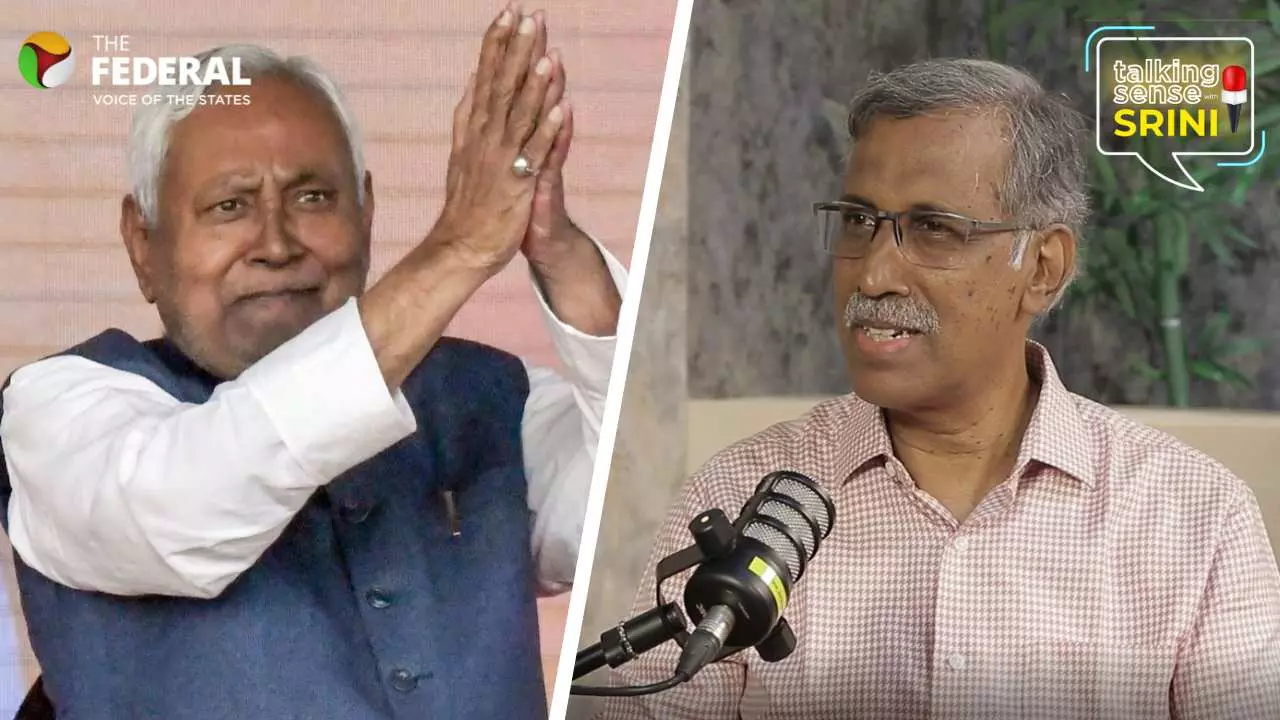
Nitish 10.0: Chief minister or compromise minister? | Talking Sense With Srini
Despite the JDU’s strong tally, the BJP’s dominance, fiscal strain and shifting power equations leave the veteran leader navigating his most constrained term in office

Nitish Kumar was sworn in as Bihar’s chief minister for a record tenth time, but the political reality he faces is far more constrained than during his earlier stints. Despite his JDU securing 85 seats, the BJP’s 89-seat tally has placed it firmly in the driver’s seat of the coalition government.
“This time it’s no longer the tail wagging the head — the head has taken charge,” said S Srinivasan, Editor-in-Chief of The Federal on Talking Sense With Srini. He added that Nitish “has to live with” the BJP’s growing influence, pointing to the cabinet formation in which the BJP held firm on securing the Speaker’s post and retained two deputy chief minister positions.
From reform to regression
Nitish, once known as Sushasan Babu, rose to prominence after 2005 on the back of governance reforms that improved law and order, upgraded roads, boosted school enrollment and expanded welfare for women. “His first decade was his golden period,” Srinivasan said. “He brought women to centre stage, reduced domestic violence through prohibition and improved law and order after the so-called ‘jungle raj’ of the 1990s.”Also read | Nitish returns to power leaning on Modi, the very man he once opposed
But Srinivasan described Nitish’s performance over two decades as “50–50,” noting that the second half of his tenure saw stagnation and rising allegations of corruption — not against him personally, but among those around him, including BJP allies. “Many things he personally wouldn’t have encouraged began happening, and he had to look the other way,” he said.
Fiscal strain looms large
Fiscal pressures threaten to define Kumar’s next term. Pre-poll promises — estimated at about ₹7 trillion — come at a time when the state’s fiscal deficit has already breached FRBM limits. A major immediate burden is the next tranche of the Mukhyamantri Mahila Rojgar Yojana, which could require up to ₹190,000 per beneficiary within months. “Maharashtra wasn’t able to handle a similar payout,” Srinivasan said, warning that Bihar may face similar strains.
Srinivasan argued that Nitish’s political vulnerability is now sharper than ever. With the BJP holding numerical and political leverage, the JDU has little room to manoeuvre. “He is no longer the kingmaker,” he said. “Even if the BJP behaves professionally, its sheer dominance can be overbearing for a smaller partner like the JDU.”
Old hand, new constraints
Asked whether this could mark the final phase of Nitish’s political career, Srinivasan was cautious. “In politics, you can never write off anyone,” he said, though he noted concerns over his health and whether he retains the energy for another reinvention.
Also read | Intense lobbying for Bihar cabinet berths; both JD(U), BJP want Speaker's post
For now, one of the India’s longest-serving chief ministers returns to power, but with fewer levers than ever before — and a far more complex political terrain to navigate.