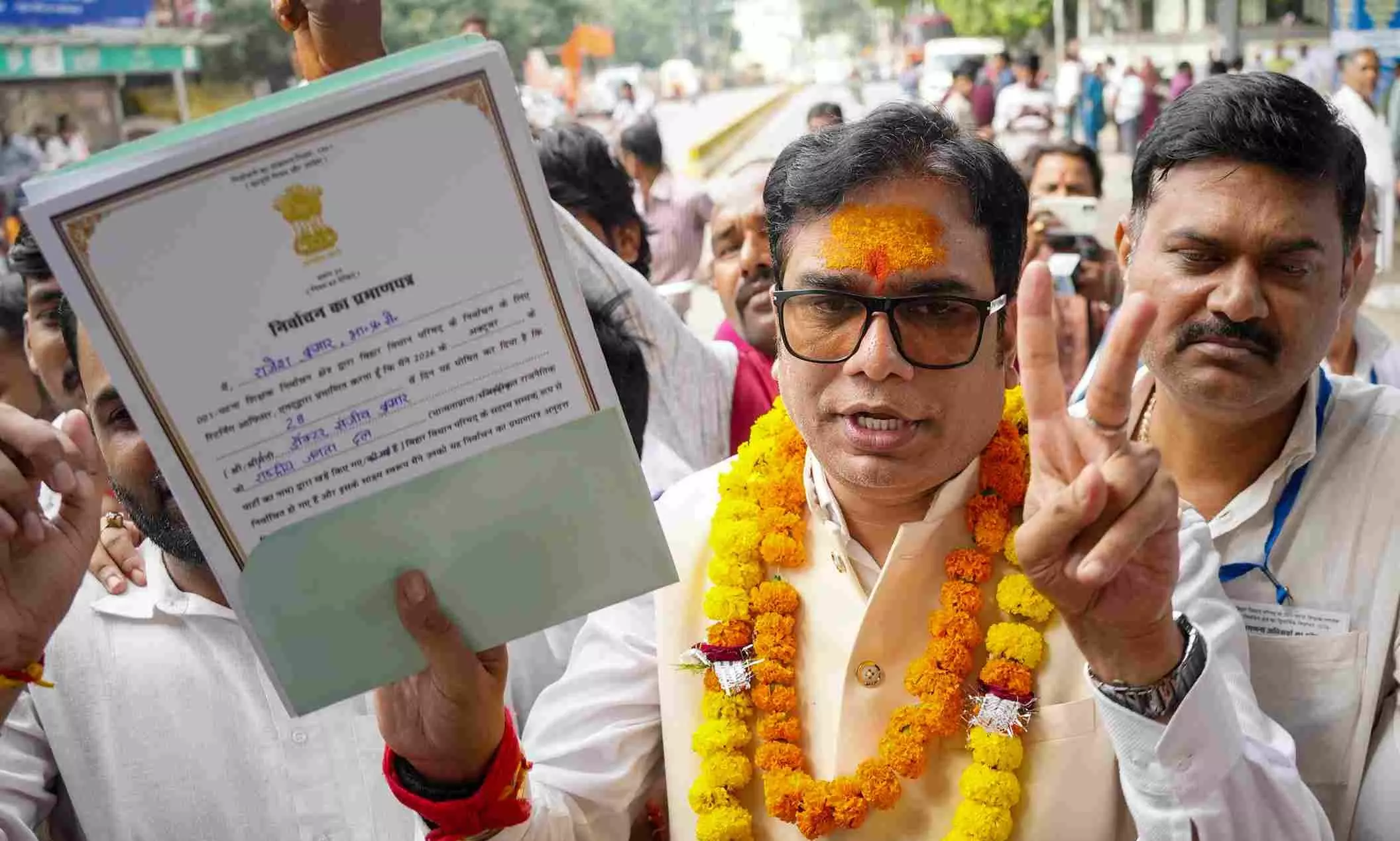
Bihar MLC elections expose cracks in BJP’s caste base as RJD makes gains
RJD’s victories in two seats, including wins by upper-caste candidates, point to shifting voter loyalties, while the JD(U)’s narrow escape exposes internal rivalries

Are political equations changing in Bihar? The results of the eight teachers’ and graduates’ constituencies in the state Legislative Council elections suggest so. The ruling BJP lost two sitting MLC seats to the Opposition RJD. Its major ally JD(U) retained one seat in a close contest, but the battle exposed internal party rivalries.
The RJD, which won two MLC seats, and Prashant Kishor’s Jan Suraaj Party (JSP), which won one for the first time, emerged as the biggest gainers in the elections, unlike the BJP-led NDA.
Also read | Anant Singh vs Neeraj Kumar: How a JD(U) feud is testing Nitish’s party
Despite the tall claims made by the BJP, including Prime Minister Narendra Modi, the party suffered a setback in Bihar as well as neighbouring Uttar Pradesh in the MLC elections.
Upper caste votes reshape contest
This is the BJP’s second setback in Bihar in three months. In early August 2026, JSP founder Prashant Kishor, popularly known as PK, defeated the BJP in the Bankipur Assembly bypoll, one of its urban strongholds and the traditional home turf of BJP national president Nitin Nabin in Patna. The bypoll was necessitated by Nabin’s resignation as an MLA after his election to the Rajya Sabha.
In the Bihar Legislative Council elections, RJD candidate Sanjeev Kumar defeated sitting BJP MLC Nawal Kishor Yadav from the Patna Teachers’ constituency, ending the BJP’s more than three-decade dominance there. Yadav had been an MLC for five consecutive terms. Contrary to local media projections of another comfortable win for Yadav, the RJD’s victory shocked the BJP.
“It was an unbelievable result. Our sitting MLC Yadav was popular among teachers. But RJD’s Sanjeev dented the BJP’s traditional upper-caste support base. What turned the tide against Yadav was his reported use of abusive language against RJD chief Lalu Prasad. This angered Yadav voters, who share Lalu’s caste, while Bhumihars also rallied behind Sanjeev, who belongs to their community. The result is a clear message,” said a senior BJP leader.
Similarly, RJD candidate Anil Kumar Jha defeated sitting BJP MLC Sarvesh Singh from the Darbhanga Graduates’ constituency. Darbhanga is widely seen as a hub of Maithili Brahmins.
Both winning RJD candidates belong to upper castes. Sanjeev is a Bhumihar, a powerful landed community, while Anil belongs to the Brahmin community.
RJD makes inroads into BJP base
Although the RJD is traditionally associated with the Muslim-Yadav combination, the MLC results indicate that it is making inroads into the BJP’s upper-caste support base while consolidating its own support among backward castes, Dalits and Muslims.
Patna-based political analyst Soroor Ahmad said the BJP tended to celebrate even before results were declared. The party’s tally has declined, and two of its sitting MLCs lost to the RJD, which local media had dismissed as a non-player because of the limited electorate of registered teachers and graduates, among whom it has seldom performed well. The RJD had no sitting MLC in any of the eight seats that went to polls. “This rout has come just three months after the BJP’s major loss in the Bankipur bypoll. The party is facing a shift of its loyal supporters towards the RJD and JSP,” he said.
The BJP’s ally JD(U) retained the high-profile Patna Graduates’ MLC seat, with its sitting MLC Neeraj Kumar, considered close to party national president and former chief minister Nitish Kumar, winning for the fourth consecutive time. But the contest was difficult, as Anant Singh, a JD(U) MLA with a strongman image, openly opposed him. Anant Singh campaigned for JSP candidate Anuj Singh and publicly declared that his aim was to defeat Neeraj.
Sensing a tough contest, Neeraj invoked the “Nitish” card. The strategy worked after Nitish himself appealed to voters to support him. After winning, Neeraj credited his victory to the blessings of Nitish Kumar and his son Nishant Kumar, who is a Bihar minister.
Also read | Bihar molestation cases put women’s safety and ‘sushasan’ claims under scrutiny
Neeraj, however, refused to seek the blessings of Union Panchayati Raj Minister and former JD(U) president Rajiv Ranjan Singh, popularly known as Lalan Singh, who had failed to persuade Anant Singh to support him.
Anant Singh faces fresh setback
After the MLC elections concluded on October 23, the JD(U) expelled Anant Singh. Its working president, Sanjay Kumar Jha, said the action had been taken with Nitish Kumar’s approval.
Anant Singh, who was accused and jailed last year in connection with the murder of Dularchand Yadav, who was working for Prashant Kishor’s JSP during the 2025 elections, suffered another legal setback on Friday (October 30). The Supreme Court cancelled his bail in the murder case and directed him to surrender before the authorities by December 1, 2026.
Popularly known as Chhote Sarkar, Anant Singh is a criminal-turned-politician who faces several cases, including murder, kidnapping and extortion, and has served jail terms in serious criminal cases. He has targeted Neeraj, claiming the latter was close to Nitish when he himself was still an unknown figure.
DM Diwakar, a political analyst who has observed Bihar’s political trajectory since the mid-1980s, said the MLC results told a different story that could alarm the BJP. “Rethinking has started among people, particularly traditional BJP supporters. Those who once supported the saffron party blindly are no longer comfortable with rising inflation, rampant joblessness, corruption and crime. All this has forced them to consider alternatives to the BJP,” he said.
Diwakar, a former director of the AN Sinha Institute of Social Studies in Patna, said people were no longer willing to ignore issues affecting their everyday lives, as emotional issues would not solve their problems. “But it is too early to say whether this trend will continue, as the BJP has been using its well-tested emotional issues to polarise voters in election after election,” he said.
Caste loyalties show signs of shifting
Bihar-based political observer Satyanarayan Madan said the MLC results indicated that change was taking place at the grassroots level. “The divide between backward and forward castes is no longer as sharp as it was a few years ago. Backward-caste voters have been supporting upper-caste RJD candidates. This is an example of changing caste patterns,” he said.
Madan said the back-to-back reversals indicated growing disenchantment among educated voters, including teachers and graduates, who were no longer entirely loyal to the BJP.
He said a sizeable section of upper-caste voters were uncomfortable with the BJP over the new UGC regulations and had no hesitation in supporting RJD candidates from their own castes. “This was evident in the MLC elections, when two upper-caste RJD candidates defeated the BJP. This would not have been possible without the support of powerful upper-caste voters,” he said.
Also read | Bihar MLC polls: Before taking on each other, rival alliances face bigger contests within
A political activist said the BJP’s traditional supporters, mainly upper-caste voters, had shifted their loyalties for one reason or another, resulting in the party losing Bankipur after nearly three decades (since 1995). Sensing this shift, Muslim-Yadav voters, traditionally aligned with the RJD, strategically voted for Prashant Kishor’s JSP instead of the RJD to ensure the BJP’s defeat.
This is a bad sign for the BJP and its allies, including the JD(U). Of the eight MLC seats, the RJD won two, independents won two, and the JD(U) and JSP won one each. In the previous elections, the BJP-led NDA had won four seats — three by the BJP and one by the JD(U). The Congress and CPI had won one each, while independents had secured two.