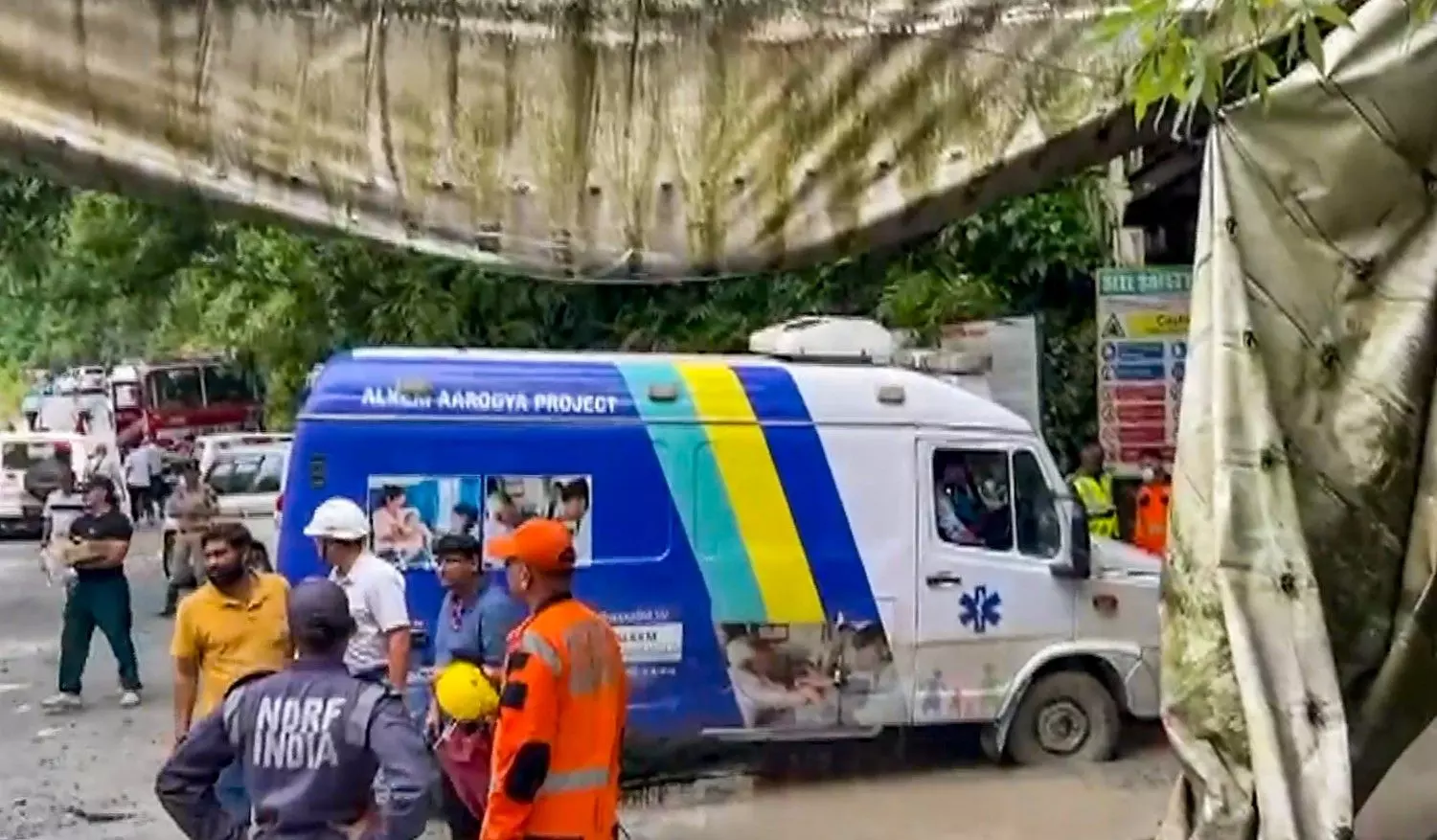
Rescue personnel and emergency responders at the site where an under-construction hydroelectric project tunnel collapsed, in Namchi district, Sikkim, on July 21, 2026. Photo: PTI
Sikkim tunnel disaster revives debate: How much can the Himalayas take?
Three years after the catastrophic glacial lake outburst flood, the tragedy raises concerns over gross oversight, ignored geological warnings, and the true cost of 'green energy'

The collapse inside an under-construction tunnel at National Hydroelectric Power Corporation Limited's (NHPC) 500 MW Teesta Stage VI hydropower project in Sikkim on Monday (July 20), which has left 25 workers dead, is being investigated as a suspected methane gas explosion. All 25 bodies have been retrieved, officials confirmed on Thursday (July 23).
The same day, the state government constituted a high-level committee to investigate the incident, which took place inside the under-construction ADIT-III tunnel at Samardung in Namchi district and recommend measures to prevent similar incidents.
Infra drive in fragile Himalayas
But for environmentalists and local communities, the tragedy raises fresh questions over whether India's accelerating infrastructure drive in the fragile eastern Himalayas is running ahead of the region's ecological limits.
Sikkim Chief Minister Prem Singh Tamang (in brown) speaks with rescue officials at the site of the ill-fated under-construction NHPC tunnel that collapsed on July 20, 2026, a day after the incident. Photo: X/@PSTamangGolay
The accident occurred barely three years after the catastrophic 2023 glacial lake outburst flood (GLOF) that destroyed the 1,200 MW Teesta III hydropower project upstream besides damaging several downstream projects.
Also read: Why some Indians are giving up jobs, businesses to focus on sustainability
Since then, repeated landslides, flash floods and slope failures have underscored how climate change and geological instability are reshaping the Himalayan landscape.
The tunnel collapse now adds to those concerns, highlighting the risks of large-scale underground construction in one of the world's youngest mountain systems.
Unlike older mountain ranges, the Himalayas are still rising as the Indian and Eurasian tectonic plates continue to collide, according to the US Geological Survey (USGS). The agency says the two plates are still converging at about 40-50 millimetres a year, making the region one of the world's most seismically active.
Much of Sikkim lies in Seismic Zone V, India's highest earthquake-risk category.
The geologically young Himalayan rocks are heavily fractured and intersected by faults. Combined with active tectonics and steep terrain, these conditions pose major challenges for tunnel stability, as highlighted in a research paper, Stability Challenges and Remedial Practices in Himalayan Hydro-power Tunnels, published in recent years.
The July 20 incident only goes to prove what we have said in the past, that hydro energy is not green energy. It is the largest contributor of methane gas.
After the latest accident, Devesh Walia, a geologist at North-Eastern Hill University, Shillong, Meghalaya, said methane and other gases may have accumulated within underground fractures in coal-bearing rock formations before triggering the explosion.
The presence of toxic gases had also hampered rescue operations inside the tunnel.
Yet, while the cause of the accident may ultimately prove to be a specific geological event, concerns over the cumulative environmental impact of hydropower and tunnel construction in the Teesta basin are far from new.
Officials at the site after a tunnel under construction collapsed in Namchi district of Sikkim. Photo: PTI
In fact, many of the risks being discussed today had been flagged years before the latest disaster.
One of the earliest warnings came during the environmental appraisal of the Teesta III project itself.
Also read: Why the new Aravalli definition is dangerous | Neelam Ahluwalia interview
A subsequent review of environmental impact assessments in the upper Teesta basin questioned whether ecological impacts had been adequately assessed, while the comptroller and auditor general later found evidence that the appraisal had underestimated wildlife presence in and around the project area.
Critics also argued that the assessment failed to adequately account for the region's biodiversity and geological sensitivity.
Opposition also emerged from local communities, particularly the indigenous Lepchas, for whom the upper Teesta valley holds deep cultural and spiritual significance.
Effects of blasting, tunnelling
For nearly two decades, groups such as the Affected Citizens of Teesta (ACT) have argued that repeated blasting and tunnelling beneath villages were already causing landslides, drying up springs, cracking houses and destabilising slopes. After the destruction of Teesta III in 2023, these concerns only intensified.
A recent policy brief by Shiv Nadar University's Centre of Excellence for Himalayan Studies noted that despite the GLOF disaster, environmental clearance was granted in 2025 for rebuilding Teesta III, even as local communities continued to oppose large hydropower projects across North Sikkim.
The environment ministry's Expert Appraisal Committee, while reviewing the proposal to rebuild the Teesta III project after the 2023 dam breach, reiterated concerns over dam safety, landslide hazards and GLOF risks, echoing issues raised years earlier during the project's environmental appraisal.
Gyatso Lepcha, environmental activist and member of the ACT, said the 2023 GLOF had fundamentally altered the Teesta basin, making reliance on a decades-old environmental impact assessment untenable.
"However, the EIA being used for the rebuilding proposal is the one prepared in 2000. So much has changed since 2000, including the carrying capacity of the river and the topography. A fresh EIA needs to be done. They cannot still use the old EIA," he told The Federal.
More recently, residents have voiced concern that rebuilding and expanding hydropower infrastructure could expose already weakened mountain slopes to further stress.
Villagers attribute landslides, erosion and structural damage to earlier tunnelling and blasting activities, while pointing out that no comprehensive cumulative assessment of seismic or long-term ecological impacts had been undertaken.
Also read: More mining projects, and laxer rules; is Karnataka being reckless?
Lepcha also questioned whether Teesta Stage VI itself had undergone a fresh environmental assessment before construction resumed. The 500 MW project, originally developed by Lanco Teesta Hydro Power Limited, remained stalled after the company entered insolvency proceedings before NHPC acquired it in 2019 and resumed work in 2021.
"The project had remained stalled for some time and then suddenly they started drilling the mountain again. You can't do that. Has Teesta VI gone through EIA again? Everything changes over time and you have to work accordingly," he said.
'Young mountains have trapped methane'
Referring to the July 20 tunnel tragedy, he added, "The incident only goes to prove what we have said in the past, that hydro energy is not green energy. It is the largest contributor of methane gas. Young mountains always have methane trapped in their folds."
He also alleged that the loss of 25 lives pointed to gross negligence of human rights and a lack of accountability.
Across the eastern Himalayas, infrastructure construction has accelerated sharply over the past decade.
Besides dozens of hydropower projects planned or under construction in Sikkim and Arunachal Pradesh, the region is witnessing rapid expansion of strategic highways, railway tunnels, border roads and transmission corridors, driven by India's twin objectives of improving connectivity and strengthening border infrastructure near China.
Environmental experts say each project may individually satisfy regulatory requirements, but their combined impact on a single river basin or mountain landscape often remains poorly understood.
The Teesta basin illustrates this concern vividly. A single valley now hosts multiple dams, diversion tunnels, highways and transmission infrastructure.
Each involves excavation, blasting, disposal of excavated rock, alteration of groundwater flow and modification of natural drainage. Ecologist Maharaj K Pandit argued that assessing such projects in isolation overlooks their cumulative impacts on the fragile Himalayan ecosystem.
Climate change has further complicated this equation.
The 2023 GLOF demonstrated how warming temperatures are increasing the risks posed by expanding glacial lakes across the Himalayas.
Scientists have repeatedly warned that extreme rainfall events, glacier retreat and unstable moraine dams are likely to make such disasters more frequent, posing growing threats not only to downstream communities but also to expensive infrastructure built along narrow Himalayan valleys.
The changes brought about by the GLOF are still visible in communities along the Teesta.
Dikchu, on the border of North and East Sikkim, is home to the reservoir of the 510 MW Teesta V project. The town's name literally means "noisy river".
"Before the hydel project, when the Teesta flowed freely here, we were used to being lulled to sleep by the sound of the river. When the reservoir came, that sound disappeared and it took us days to adjust to the silence," said Wangchuk Bhutia, a resident of Dikchu.
Also read: Toward 2047: Nehru’s caution on rapid growth matters for ecology
"After the GLOF damaged the dam and the gates were opened, the river flowed freely again. It took us some time to adjust once more to the roar of the river."
For nearly three years after the GLOF, the Teesta flowed freely through this stretch for the first time in almost 25 years. Only about a month ago, after Teesta V resumed power generation, the river was impounded once again.
'Hydropower key to India's clean energy plans'
Ecological and topographic concerns, however, do not necessarily diminish the strategic or economic importance of infrastructure in the Northeast, said Nirmalya Banerjee, author of The Buddha and the Borders, a book that explores the region's strategic geography, connectivity and border politics.
"Hydropower remains central to India's clean energy ambitions, while roads, tunnels and railways are critical for border security and regional development," he told The Federal.
"The challenge, however, is to balance these strategic and economic objectives with the ecological realities of the Himalayas."