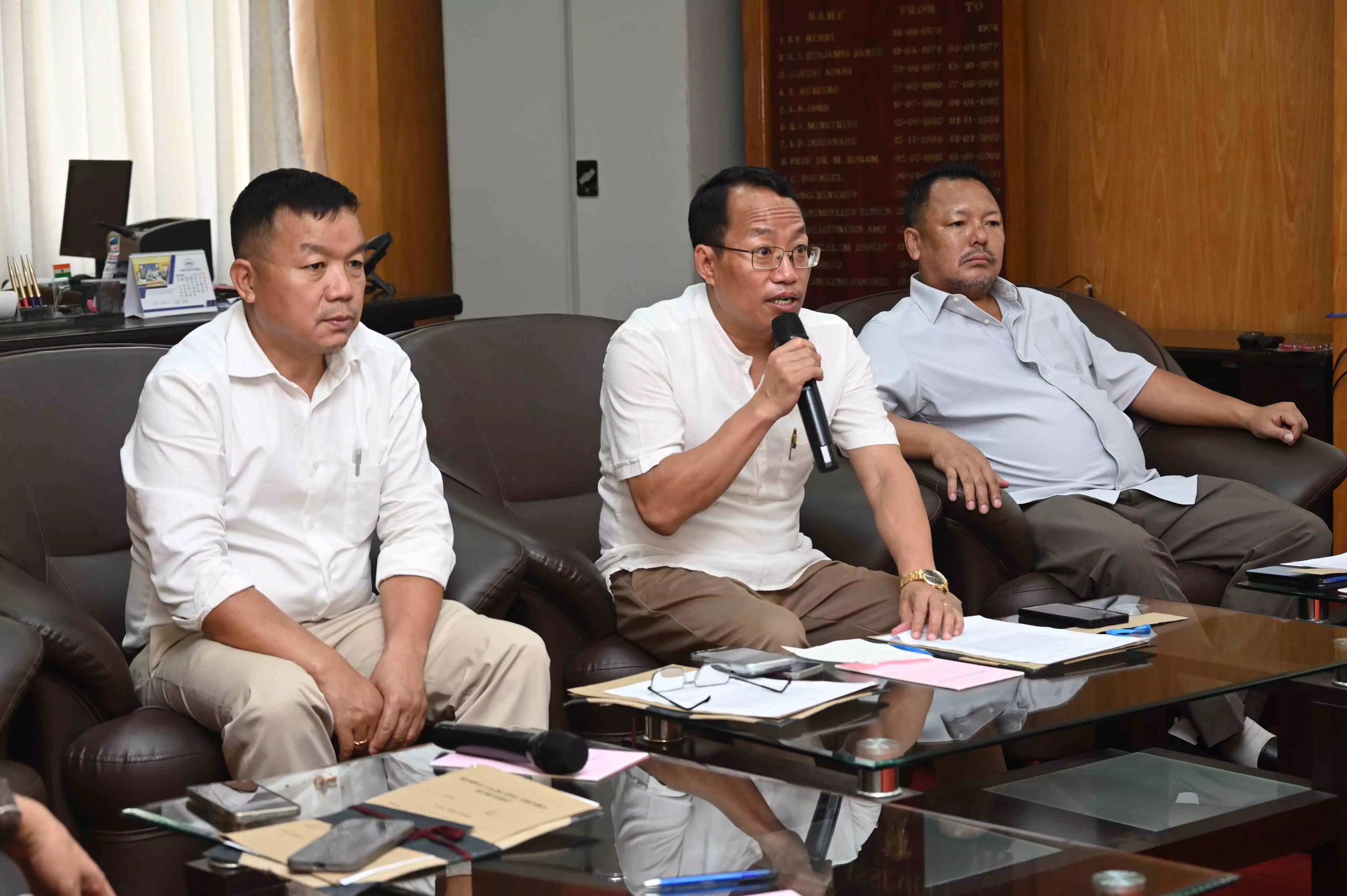
In strife-torn Manipur, why Hill Areas panel’s rare meeting is a crucial reunion
Meeting after long hiatus a welcome step, but offers no real solutions; focus now on future meetings and restoring District Councils

The September 18 meeting of the Hill Areas Committee (HAC) of the Manipur Legislative Assembly, despite being a welcome step in initiating dialogue on matters relating to the hill areas after long-standing violence in the northeastern state, has reportedly not yielded any substantial outcome nor adopted any key resolutions.
All eyes, however, will be on the consultative body to see how frequently it convenes, makes recommendations to the state Assembly and helps in sorting out critical issues including the restoration of the six Autonomous District Councils (ADCs) in Manipur’s hill areas.
MLAs commit, but stay distant
Even though findings of the meeting are yet to be made public, committee chairman, Dinganglung Gangmei, also MLA of the Nungba constituency in Manipur, called it a “welcome reunion to deliberate upon matters concerning the Hill Areas Committee on a common platform once again.”
Posting on his social media platform, Gangmei said the meeting was a “threadbare and meaningful discussion, with an undercurrent of constructive dialogue, mutual understanding and a shared sense of commitment to the interests of the hill areas.”
Also read: SC raps Manipur govt over relief camp deaths, seeks affidavit on probe, safety
Fourteen MLAs attended the meeting, either physically or via video-conferencing. Deputy Chief Minister Losii Dikho was also present. The Naga MLAs, who attended the meeting were Khashim Vashum, Leishiyo Keishing, Kumo Sha, Janghemlung Panmei, and Ram Muivah. The Kuki-Zo MLAs were Haokholet Kipgen, Ngasanglur Sanate, Chinlunthang, Letzamang Haokip, Letpao Haokip, LM Khuate, and Paolienlal Haokip. The latter mostly attended via video-conferencing, which reflects both the commitment and the distance in this meeting. This meeting indicates that things have not gotten back to normal, yet.
What is HAC?
The HAC is a special constitutional body of the Manipur Legislative Assembly constituted under provisions of Article 371C of the Constitution.
Further details are provided in the Manipur Legislative Assembly (Hill Areas Committee) Order, 1972 issued by the President of India.
The HAC comprises members of the Assembly, elected from the hill areas. The chief minister and the Speaker are excluded from the committee. Ministers are entitled to participate in the proceedings of the committee, but may vote only if they are members of the Assembly.
The body’s chief role is to protect the interests of the people of Manipur’s hill areas. Its jurisdiction covers Scheduled Matters including land, land-forestry, jhum cultivation, village administration, health, social customs, succession, marriage, divorce and the administration, finance and organisation of the District Councils. Its advisory and consultative jurisdiction extends to all matters relating to the Hill Areas of Manipur.
What are the functions of HAC?
The advisory and consultative body has the following functions:
- To make its recommendations on all Bills related to hill areas.
- The committee has the right to make recommendations or to take action to obtain the necessary concurrence of the government for the purpose of giving effect to such recommendations.
- If a Bill “is deemed to be admissible for introduction in the House but which the Government considers to be beyond the authority of the Legislative Assembly, the matter shall be placed before the Governor for his decision in consultation with the Council of Ministers…” (by virtue of Rule 12A of the Rules of Business).
- The Governor has been directed “to take due care that the provisions of the Constitution relating to the Hill Areas are implemented.”
Legislative, financial handicap
The HAC, however, has several limitations. It is not a department of the state government nor a subordinate authority.
The 1972 order makes it clear that the Assembly and the HAC are “two distinct and separate bodies.”
It cannot make laws or adjudicate upon any disputes. It has no financial powers or control over the ordinary administration of the hill areas. It also cannot refuse assent to a Money Bill or initiate one.
Also read: Manipur govt-UNC talks begin; Naga body sticks to four demands
The Annual Budget Estimates of the state are meant to be consolidated budget under Article 202 and the Consolidated Fund under Article 266 of the Constitution. The HAC can recommend the grant of separate estimates for the hill areas, but not “the division of the Consolidated Fund.”
The HAC was never intended to be a tentative measure towards secession or separation of power. It is rather a bridge and not a breach between the hill areas and the valley.
Contentious matter of ADCs
The general issue confronting the HAC seems to be the restoration of the six Autonomous District Councils (ADCs) through an ordinance.
Manipur has six ADCs – Chandel, Churachandpur, Kangpokpi (Sadar Hills), Senapati, Tamenglong, and Ukhrul – which function under the Manipur (Hill Areas) District Councils Act, 1971. However, the last elected terms of the ADCs ended in 2020 and no elections have been held since due to reasons including the COVID-19 pandemic and the ethnic violence in the state.
Also, while the original District Councils Act provided for “not more than six” ADCs, the 2022 amendment allowed up to 10 ADCs to cover the newly-formed districts. Despite this, the four additional ADCs are yet to be made operational.
A source said that at the HAC meeting, the hill MLAs were reportedly not unanimous in their stand regarding the ADCs. Some of the MLAs objected to suggestions to restore only six ADCs and called for the restoration of all 10 ADCs.
Why was the meeting important?
The HAC meeting is significant for several reasons. First, Manipur has been witnessing an unparalleled ethnic strife since early 2023, and most institutions have been rendered defunct. The HAC is one of those few forums where the Naga and Kuki-Zo MLAs are able to meet and discuss matters concerning the hill areas.
Second, the meeting highlights the constitutional limitations of the HAC.
Also read: Three years on, renewed violence in Manipur casts a long shadow over calls for peace
It is being speculated that the meeting’s outcome was not made public as it did not yield any substantial outcome. Even some of the Kuki-Zo MLAs attended the meeting through video-conferencing. The HAC serves as a consultative body and has no powers to enforce its decisions. It depends on the cooperation of the state government, the Governor, and the District Councils.
At the executive's mercy
While the September 18 meeting of the HAC was undoubtedly an improvement over the previous meetings, it was also clear that the functioning of the committee depends critically on the will of the state executive. The very fact of the meeting being described as "productive and successful" because it "reaffirmed the importance of collective deliberation and cooperation" indicates that such meetings are rare.
The meeting itself does not appear to have adopted any specific resolutions or decisions, and was apparently focused on deliberations within the committee. The broader constitutional issue continues to remain outstanding, namely whether the mechanism provided by Article 371C is sufficient for protecting the hill areas of Manipur in a state where ethnic polarisation has rendered most institutions suspect.
What to watch out for
It is a positive sign that the meeting enabled the hill MLAs to converge after a long hiatus and to take stock of the situation. In the wake of the meeting, it will be important to watch out for the following developments:
- Regular meetings of the HAC to enable it to perform its constitutional duties.
- Referral of Bills to the HAC and consideration of its recommendations by the government.
- The role of the Governor and his “special responsibility” in respect of the HAC.
- Restoration of the District Councils as envisaged in the amended 1971 Act.
- These developments will determine whether the HAC will be able to serve as a bridge or become a barrier. The return to constitutional normalcy in the hill areas is likely to take place only when the institutions, such as the HAC and the District Councils, function according to the design of the Constitution.
Positive beginning
The HAC was set up to be an advisory body in matters relating to the hill areas, to promote integrated development, and to serve as a channel for the expression of hill opinion. In practice, however, it appears to have been hampered by the lack of functional institutions such as the District Councils for implementing its recommendations. The September 18 meeting appears to have signalled a turnaround towards restoration of its functioning, but it remains to be seen what concrete steps will be taken to regularise its meetings and implement its recommendations.