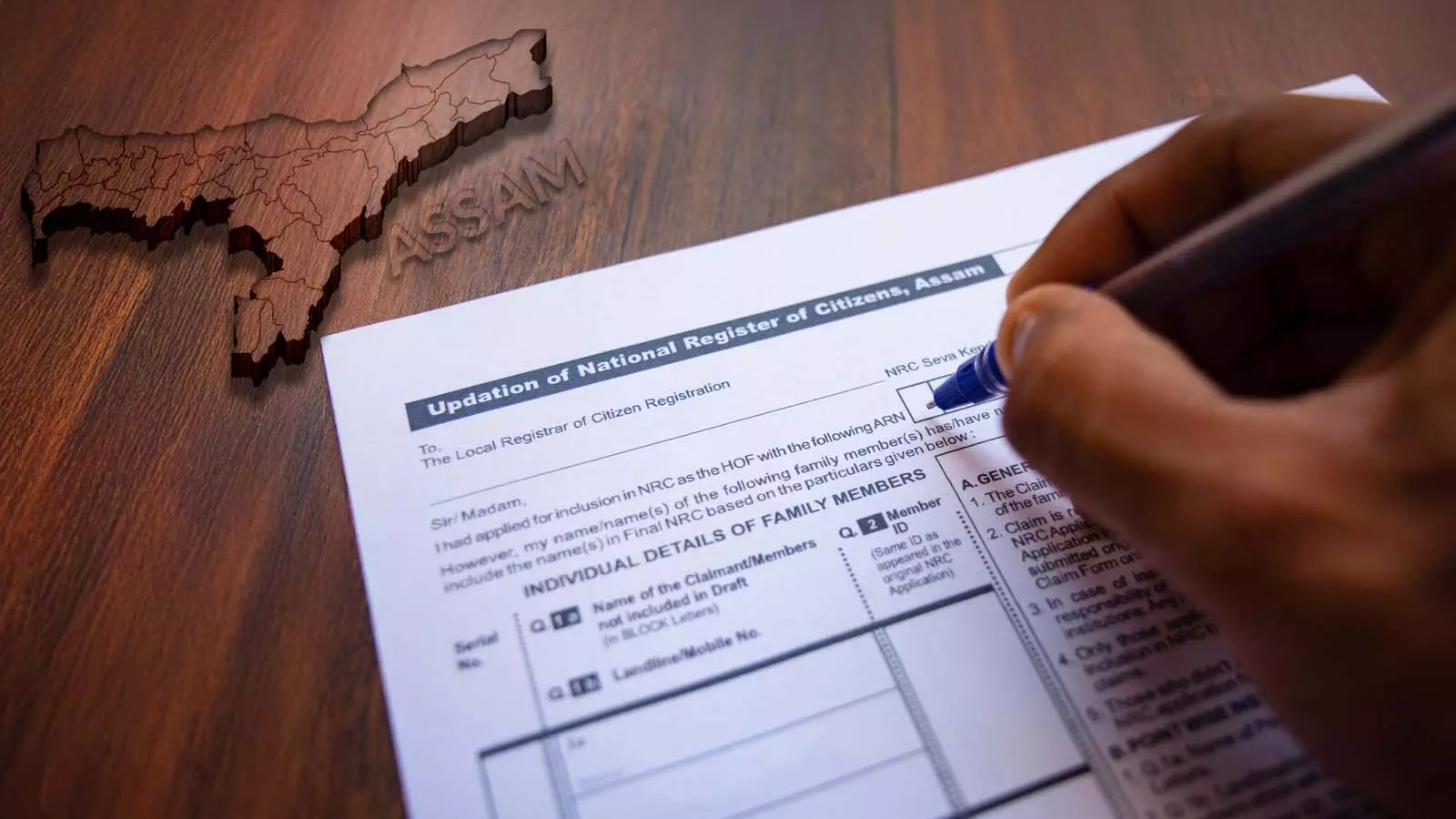
Why Assam’s NRC is still in limbo seven years after publication
The RGI is yet to receive the NRC data as Assam’s security regime remains incomplete, delaying formal notification and rejection slips for around 19 lakh excluded applicants

Seven years after Assam’s National Register of Citizens (NRC) was published, the exercise remains incomplete: the final register has not been formally notified, excluded applicants have received no rejection slips, and the data has not been handed to the Registrar General of India (RGI).
The immediate obstacle is the security regime for protecting NRC data. In a September 28, 2026 affidavit to the Supreme Court, the RGI said the State NRC Coordinator was still putting the regime in place, and that the data had consequently not been shared with it.
The disclosure assumes fresh significance after the Supreme Court on November 17 issued notices to the Centre and Assam on a petition by the All Assam Students’ Union (AASU), seeking a re-examination of the 2019 NRC update.
Separate pleas, overlapping concerns
A Bench of Justices PS Narasimha and Alok Aradhe issued the notices on AASU’s plea alleging large-scale anomalies. The final NRC, published on August 31, 2019, excluded around 19 lakh applicants, a figure AASU cites to question the process’s credibility.
Also read | Supreme Court seeks Centre, Assam govt's replies on delay in issuing NRC Identity Cards
AASU has sought a comprehensive re-examination and renewed its demand for a Special Intensive Revision of Assam’s electoral rolls. It has also called for a halt to issuing identity documents until a revised NRC is published.
Former State NRC Coordinator Hitesh Dev Sarma has filed a separate petition seeking time-bound reverification of the draft NRC and supplementary list under Clause 4(3) of the Schedule to the Citizenship (Registration of Citizens and Issue of National Identity Cards) Rules, 2003.
The Supreme Court issued notices to the Centre, Assam, the concerned NRC official and the RGI in Sarma’s case, which has been tagged with other NRC matters. Court records cited in this report show that the state has not filed its response in that case.
On August 10, the court was told that neither the Centre nor the state had responded. It directed that the matter be listed after the replies were filed. The petition is learnt to have been listed for January 19, 2027.
The state’s request for more time in a separate batch of cases on rejection slips for excluded applicants and identity cards for those included in the NRC should not be confused with the absence of a response in Sarma’s reverification petition.
That batch includes the All Assam Minority Students’ Union (AAMSU) petition, W.P. (C) No. 839 of 2026, and pleas by the Assam State Jamiat Ulama and Jamiat Ulama-i-Hind. They seek rejection slips for those excluded from the 2019 list and NRC identity cards for those included. The Supreme Court sought responses from the Centre and state on August 10.
Security safeguards hold up NRC
The August 31, 2019 publication did not complete the statutory process: the RGI has not formally notified the NRC, and rejection slips have not been issued to around 19 lakh excluded applicants.
The RGI’s September 28 affidavit identifies the immediate reason: the State Coordinator’s security regime was still “under progress”, and the data had not been handed over.
The Supreme Court’s August 13, 2019 order directed the State Coordinator to establish a security regime modelled on Aadhaar safeguards. This was a precondition for sharing the inclusion and exclusion lists with the state government, Centre and RGI.
The RGI says it can notify the final NRC only after receiving the data. The state must therefore complete the security regime and transfer the data before formal notification and subsequent steps can follow.
It remains unclear why the arrangement has taken so long and what work is outstanding. The RGI affidavit gives no component-wise account. It would be premature to claim that any specific security module remains incomplete.
Audit gaps raise fresh questions
The CAG has raised further questions about the management of the NRC project. Its audit recorded that costs rose from Rs 288.18 crore to Rs 1,602.66 crore and flagged the haphazard addition of 215 software utilities, inadequate planning and data-tampering risks without a proper audit trail.
These concerns make transparency over data security vital. The state and NRC authorities need to clarify what is complete, what remains pending, the cost of the security arrangement and whether an independent audit has certified the system.
Also read | ‘Citizenship under question’: Mamata alleges NRC is objective behind SIR
A separate, politically sensitive question is whether NRC family-tree data could be used to revise electoral rolls.
Sarma has written to Chief Election Commissioner (CEC) Gyanesh Kumar suggesting that NRC verification procedures, including family-tree matching, could scrutinise Assam’s electoral rolls. He said the Election Commission could obtain the family-tree data with the Supreme Court’s permission.
This raises questions about whether the Commission has formally sought access to the data, whether court approval is necessary and what safeguards would apply. Privacy, data protection and electoral law would also need consideration before the data was used beyond the NRC exercise.
NRC debate sparks mixed reactions
The Supreme Court’s move to seek responses from the Centre and Assam has drawn sharply differing reactions.
Senior journalist Naba Thakuria, who has written extensively on the NRC, welcomed the development: “Welcome development. Need NRC across India.”
Political analyst Rana Khan dismissed the renewed debate as “a non-issue” and alleged that it was sponsored by the BJP and RSS.
Sarma welcomed AASU’s decision to approach the Supreme Court but questioned its arguments. “Merely approaching the Supreme Court is not enough. What matters are the arguments made in the petition,” he said.
On AASU’s earlier review attempt in W.P. (C) 274/2009, Sarma said it had relied on a report on the foreigners’ issue by former Assam Governor SK Sinha and newspaper clippings. He said these were insufficient to persuade the court. He alleged AASU knew of serious irregularities in NRC verification but failed to raise them in its earlier review petition.
Sarma recalled that in early 2016, when he was NRC executive director, AASU adviser Basanta Deka raised concerns about family-tree verification. Sarma said he later visited parts of Barpeta district, particularly Baghbar, and found what he called alarming irregularities.
Unresolved questions cloud NRC
He alleged that some data-entry operators and officials accepted names that should have been rejected, while indigenous officials faced pressure and threats to allow the inclusion of ineligible names. The allegations could not be independently verified from the material available for this report.
Sarma claimed he reported his findings to then State NRC Coordinator Prateek Hajela, Deka and AASU leader Samujjal Bhattacharya, but no action followed. He questioned why AASU’s earlier petition did not mention the alleged irregularities.
Also read | Manipur NRC stir: Protesters stage rallies, burn effigies of CM, Home Minister
He also accused AASU of failing to pursue the CAG-flagged financial irregularities and challenged it to make its latest affidavit public. His comments reflected his sharply critical view of the student body’s role in the NRC exercise.
On the AAMSU and Jamiat pleas for rejection slips and identity cards, Sarma argued that the demands were premature because the RGI had not formally published the final NRC. He said his affidavit opposed the pleas, arguing that inclusion or exclusion could not be acted upon conclusively before formal publication.
For now, the central issue remains unresolved. The 2019 NRC exists as a published list, but the RGI has not received the data needed to notify it. Until Assam completes the security regime and transfers the data, the process remains caught between a published list and the legal and administrative steps that are yet to be completed.